价格同盟

Search documents
一次性手套行业专家交流
2026-03-16 02:20
Summary of Disposable Glove Industry Conference Call Industry Overview - The disposable glove industry is significantly impacted by the geopolitical situation in the Middle East, leading to a 60% increase in butadiene prices since the end of 2025, with potential raw material supply risks expected in April-May 2026 [1] - Chinese manufacturers have seen an increase in box costs by $2-$2.5, while Malaysian manufacturers, heavily reliant on natural gas and facing subsidy removal, have experienced cost increases exceeding $3 [1] - A price alliance has formed between Chinese and Malaysian manufacturers, with European FOB prices rising from $16.5 to $19-$19.5 per box starting March 2026 [1] Key Points on Cost Structure - In China, the cost structure for producing a box of disposable gloves is approximately 45% for raw materials (mainly nitrile latex), 25% for energy, and varies for labor and transportation [2] - Malaysian manufacturers have a similar cost structure but face higher labor costs compared to China [2] - The main suppliers of nitrile latex include LG from South Korea and two major Chinese companies, with self-synthesizing manufacturers having advantages in cost and supply stability [3] Supply Chain and Raw Material Risks - The supply of upstream raw materials like butadiene and acrylonitrile is heavily influenced by geopolitical factors, particularly in the Middle East, which poses a risk of shortages by April 2026 [3][4] - Current inventory levels of raw materials among Chinese and Korean latex manufacturers are uncertain, but a shortage risk is anticipated [3] Price Trends and Market Dynamics - The price of butadiene has surged due to its extraction from crude oil, with expectations that oil will be prioritized for higher-value uses, leading to reduced availability for chemical production [5] - Prior to the price surge, production costs for Chinese manufacturers were around $13-$14 per box, while Malaysian manufacturers were at $16-$17 [5] - The industry consensus is that raw material prices are unlikely to decrease significantly, with potential glove prices rising to $25-$35 per box [8][9] Market Share and Competitive Landscape - Chinese manufacturers hold over 80% market share in Europe, with top producers operating at full capacity, while Malaysian manufacturers are retreating to the U.S. market due to cost disadvantages [1][10] - Malaysian manufacturers are not profitable in the European market and are focusing on higher-margin segments in the U.S. [10] Pricing Strategies and Adjustments - Recent price adjustments by manufacturers are aimed at covering increased costs while maintaining profit margins, with Malaysian companies like Top Glove raising prices by $3 per box [12] - Domestic manufacturers have formed a price alliance, with new prices set at $19-$19.5 per box, reflecting a $3 increase from previous levels [14] - Distributors and long-term customers are generally accepting of price increases, with many engaging in pre-purchase behaviors due to anticipated further price hikes [14] Production Capacity and Future Outlook - Current production capacity utilization for Malaysian manufacturers is around 60%-70%, with potential for improvement in the U.S. market [19] - Domestic manufacturers do not have expansion plans, viewing the current market as lacking significant opportunities compared to previous pandemic conditions [18] Demand Sensitivity to Price Changes - Prices below $30 per box are expected to have limited impact on overall market demand, but exceeding this threshold may significantly suppress demand, particularly in non-medical applications [20] - Medical-grade gloves, which constitute about 65%-70% of total supply, are less sensitive to price increases due to their essential nature [21]
业主被指抱团“保卫房价” 上海一小区统一挂出1460万价格
Sou Hu Cai Jing· 2025-11-28 04:16
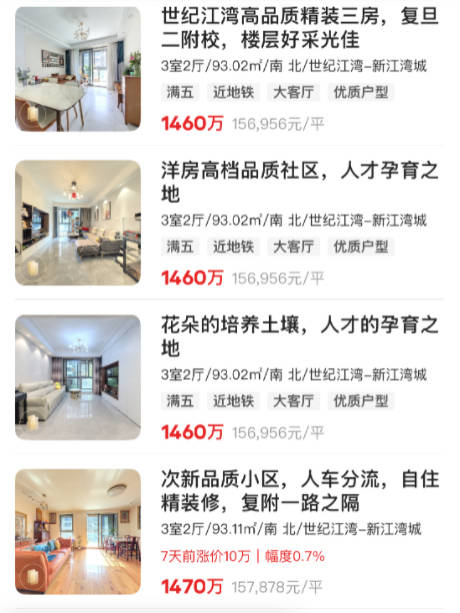
Core Viewpoint - Recent actions by homeowners in Shanghai's "Century Jiangwan" community to list their properties at similar prices have sparked speculation about a "price alliance" aimed at stabilizing property values amid declining market conditions [1][2]. Group 1: Price Stabilization Efforts - Homeowners in the "Century Jiangwan" community have listed multiple properties at approximately 14.6 million yuan, suggesting a collective effort to maintain property values [1]. - Real estate agents indicate that while some homeowners have listed properties at similar prices, the likelihood of a formal "price alliance" is low, as many homeowners do not know each other and are open to negotiation [2]. - Similar "price alliance" initiatives have been observed in other cities, such as Hangzhou and Changsha, where homeowners have encouraged each other to avoid underpricing their properties [3]. Group 2: Market Trends and Data - According to the National Bureau of Statistics, in October, new residential prices in first-tier cities decreased by 0.3% month-on-month, with Shanghai experiencing a slight increase of 0.3% [5]. - Year-on-year, new residential prices in first-tier cities fell by 0.8%, with Shanghai showing a notable increase of 5.7% [6]. - The overall trend indicates a decline in second-hand residential prices across various city tiers, with first-tier cities seeing a month-on-month decrease of 0.9% [5][6]. Group 3: Expert Insights - Industry experts suggest that while collective price stabilization efforts may be well-intentioned, they are unlikely to succeed due to varying economic situations among families and the inherent nature of market dynamics [4]. - Renowned economist Ren Zeping has identified three signals indicating potential future price increases in the real estate market, including policy shifts towards encouragement, signs of economic recovery, and a reversal in supply-demand dynamics in key cities [7]. - The long-term outlook for real estate suggests a divergence in price trends, with demand likely to remain in first- and second-tier cities while lower-tier cities may face stagnant or declining prices [8][9].