企业第二曲线

Search documents
光伏茶饮联姻!“最美光二代”高海纯即将大婚,新郎是霸王茶姬创始人
Xin Lang Cai Jing· 2025-11-20 08:03
Group 1 - The wedding invitation circulating in the photovoltaic industry features Gao Jifan and Wu Chunyan, with the groom Zhang Junjie, founder of Bawang Chaji, and the bride Gao Haichun, daughter of Gao Jifan [1] - Gao Jifan founded Trina Solar in 1997 and has led the company through three industry cycles, while Gao Haichun, known as a "second-generation" leader, has taken on significant responsibilities within the company [2][4] - Trina Solar is diversifying its business, with over one-third of its revenue now coming from solutions rather than photovoltaic manufacturing, aiming to increase this to over 50% in the next two to three years [4] Group 2 - Bawang Chaji, founded by Zhang Junjie in 2017, has expanded its store network to 7,038 globally, with significant growth in overseas markets, particularly in Malaysia and Singapore [4][6] - For Q2 2025, Bawang Chaji reported a total net income of 3.3319 billion RMB, a year-on-year increase of 10.2%, with a global GMV of 8.1031 billion RMB, up 15.5% [6] - The combined market capitalization of Trina Solar and Bawang Chaji exceeds 600 billion RMB, with Trina Solar valued at approximately 41.7 billion RMB and Bawang Chaji at about 26.1 billion USD (approximately 185.7 billion RMB) [6]




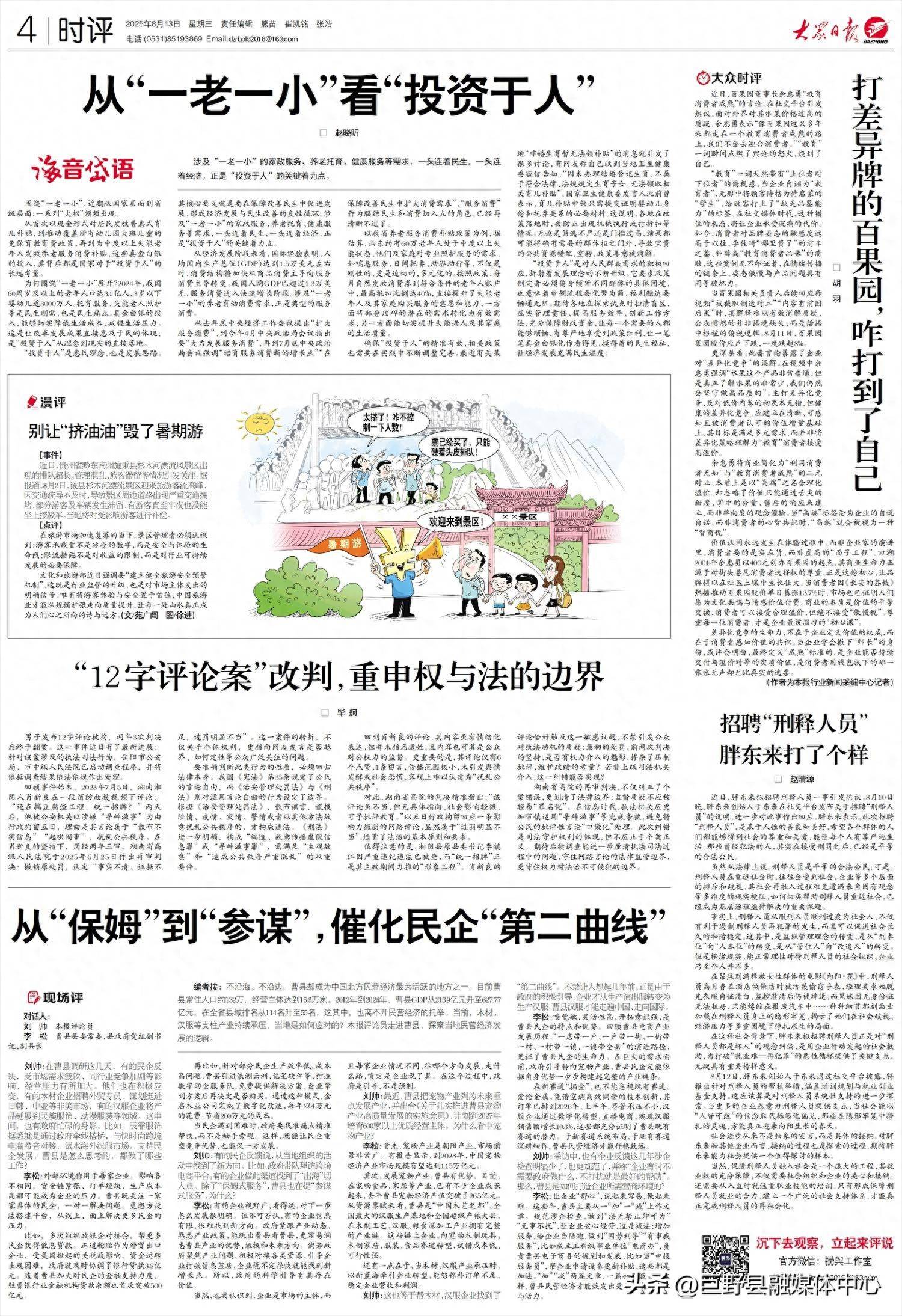
从“保姆”到“参谋”,催化民企“第二曲线”
Sou Hu Cai Jing· 2025-08-13 03:16
Group 1 - The article emphasizes the importance of "investing in people," particularly focusing on the elderly and children, as a long-term strategy by the government to improve living standards and reduce financial burdens on families [3][4] - In 2024, the elderly population aged 60 and above in China is projected to reach 310 million, while there are nearly 30 million children under the age of three, highlighting the urgent need for childcare and elderly care services [3][4] - The government has introduced various financial subsidies, such as childcare allowances and elderly care consumption subsidies, to directly alleviate living costs and enhance the quality of life for these demographics [3][4][5] Group 2 - The shift in consumption patterns from goods to services is noted as GDP per capita approaches $15,000, with service consumption, particularly in elderly and childcare sectors, expected to grow rapidly [4] - Policies aimed at expanding service consumption have been emphasized in recent government meetings, indicating a strong focus on improving living standards through enhanced service offerings [4] - For instance, in Shandong province, a subsidy policy for elderly care services has been implemented, providing up to 40% off for eligible elderly individuals, thereby increasing their ability to access necessary services [4] Group 3 - The article discusses the need for precise and effective implementation of policies related to "investing in people," highlighting the importance of addressing specific community needs and avoiding bureaucratic hurdles [5] - Recent controversies regarding eligibility for childcare subsidies have raised concerns about the accessibility of these benefits, emphasizing the need for clear and fair policy execution [5] - The government is encouraged to listen to the diverse needs of different groups and streamline application processes to ensure that benefits reach those who need them most [5]