优化假期结构

Search documents
春秋假,收好这份“季节的礼物”
Ren Min Ri Bao· 2025-11-02 04:05
Group 1 - The introduction of spring and autumn breaks in schools is part of a broader initiative to boost consumption and enhance educational experiences for students [2][3] - Various regions are experimenting with the implementation of spring and autumn breaks, with examples including Ningbo, which has set breaks of three days each, and Enshi, which has breaks of at least one week [2] - The restructuring of holiday schedules aims to provide families with more flexible travel options, reducing pressure on travel arrangements and enhancing the overall experience [3] Group 2 - The initiative is not just about adding days off; it also addresses concerns about students' self-discipline and the potential for unsupervised children to engage in unproductive activities [3] - Local adaptations include unique programs such as free skiing opportunities in Urumqi and project-based learning in Shenzhen, which encourage student engagement and responsibility during breaks [3] - The value of holidays is emphasized as a means to foster diverse learning experiences, moving away from traditional academic pressures and promoting holistic development [4]
春秋假,收好这份“季节的礼物”(教育时评)
Ren Min Ri Bao· 2025-11-01 21:52
Core Viewpoint - The introduction of spring and autumn breaks in schools is aimed at enhancing educational experiences and boosting consumer spending, while also addressing the need for a balanced approach to holiday structuring [2][3]. Group 1: Policy and Implementation - The Central and State Offices have issued guidelines encouraging localities to explore the establishment of spring and autumn breaks for primary and secondary schools, allowing for adjustments based on local conditions [2]. - Various regions are implementing these breaks differently, with Ningbo, Zhejiang, introducing 3-day breaks in spring and autumn, and Enshi, Hubei, mandating at least one week for each break [2]. Group 2: Impact on Education and Family - The new holiday structure allows families to engage in diverse activities, promoting quality time and educational experiences outside the classroom, such as nature exploration and cultural visits [3][4]. - Concerns have been raised about potential negative impacts on students' learning and supervision during breaks, particularly for dual-income families [3]. Group 3: Economic Implications - The spring and autumn breaks are expected to redistribute consumer spending, enhance demand structure, and contribute to regional economic balance [3]. - The tourism and cultural sectors are experiencing increased activity as families take advantage of the staggered holiday schedule [3]. Group 4: Educational Philosophy - The value of holidays should align with educational goals, emphasizing experiential learning over traditional academic pressures, allowing children to gain knowledge and skills through diverse experiences [4].
中小学春秋假来了,各地怎么放?
Xin Lang Cai Jing· 2025-10-23 04:25
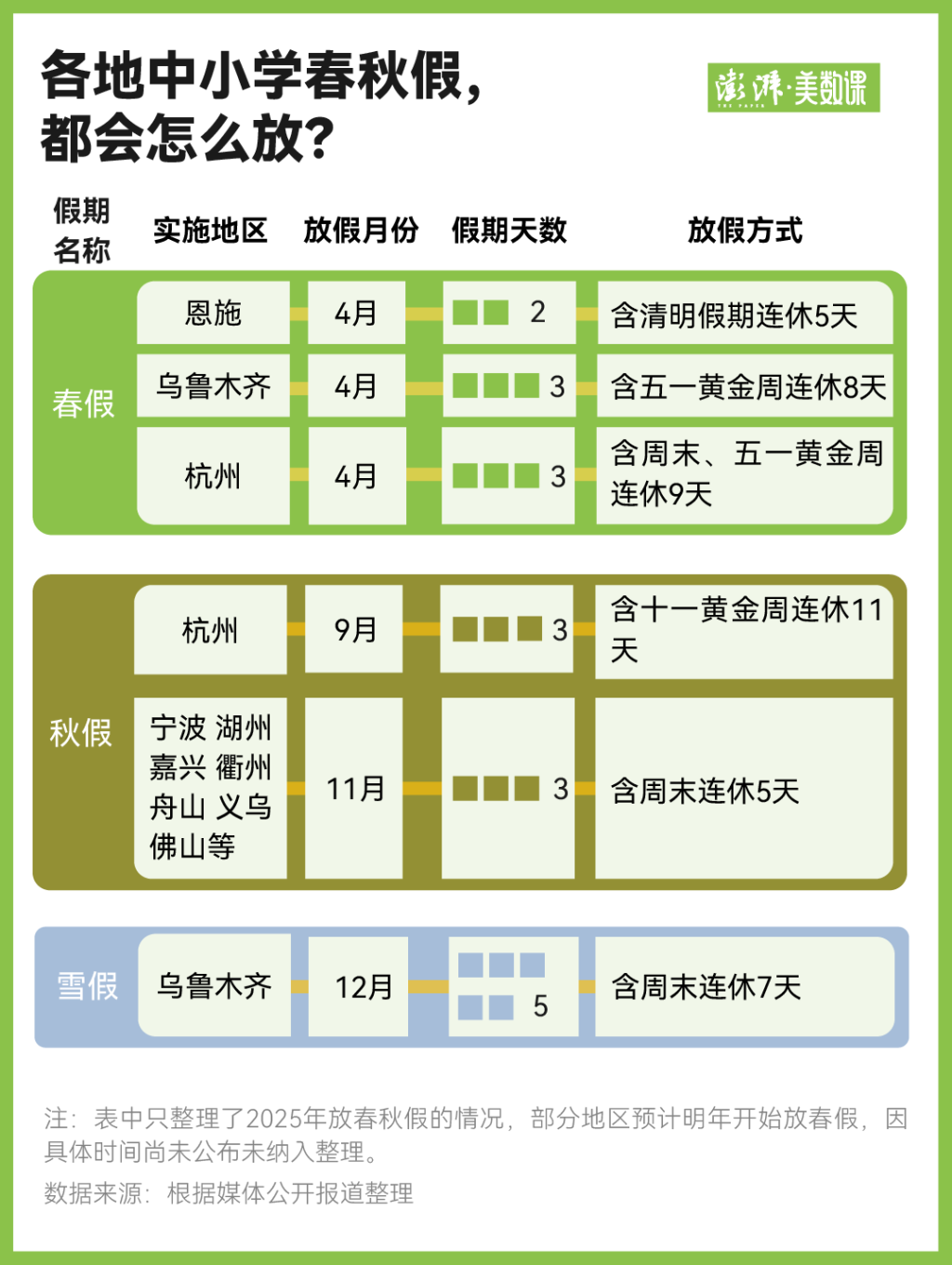
Core Points - The introduction of "spring and autumn breaks" for primary and secondary school students is aimed at optimizing holiday structures and boosting consumer spending [2][5][12] - The implementation of these breaks is expected to enhance travel opportunities during off-peak seasons, potentially redistributing tourist traffic and improving overall satisfaction [6][8] Group 1: Policy and Implementation - The Ministry of Commerce and other departments have encouraged local governments to explore the establishment of spring and autumn breaks while maintaining the total number of school days [2][5] - The concept of spring and autumn breaks is not new, having been proposed in the 2013 National Tourism and Leisure Outline [2][5] - By 2025, more regions are expected to adopt these breaks, often aligning them with existing public holidays [2][5] Group 2: Economic Impact - The introduction of spring and autumn breaks could contribute an estimated 0.4% to 0.6% increase in retail sales in the short term, potentially rising to 1% to 1.66% in the long term [6][12] - The 2024 National Day holiday saw 826 million tourists, with a satisfaction score of only 78 out of 100, indicating room for improvement in the tourism experience [6][12] Group 3: Public Support and Challenges - A survey indicated that 71.3% of respondents support the implementation of spring breaks, but there are concerns about the need for parental paid leave and proper scheduling by schools [8][11] - Some regions have already begun addressing childcare issues during breaks by providing free supervision services for students [11][12] Group 4: Future Outlook - The establishment of spring and autumn breaks may serve as a catalyst for broader improvements in holiday benefits across society [12]