提振居民消费

Search documents
城乡居民如何实现增收?
Zheng Quan Shi Bao· 2025-12-19 17:29
Group 1 - The central economic work conference has prioritized expanding domestic demand as a key task for the year, emphasizing the importance of boosting consumer spending to enhance people's well-being and mitigate external shocks [1] - Recent policies, such as the trade-in program for consumer goods and increased fiscal investment in people's livelihoods, have provided solid support for boosting resident consumption [1] - To fundamentally enhance the internal driving force for consumption, continuous growth in residents' income is necessary, which is why the plan for increasing urban and rural residents' income has garnered significant attention [1] Group 2 - Employment stability is crucial for income stability, with wage income being the largest component of residents' income. Policies should focus on enhancing employment capacity, particularly in the service sector, and removing unnecessary barriers [2] - Increasing public investment in early childhood education and establishing lifelong learning training systems are essential for improving residents' labor skills and enabling them to seek higher-paying jobs [2] - Encouraging listed companies to increase cash dividend ratios and creating a favorable environment for a long-term stable capital market are important directions for promoting income growth and thus boosting consumption [2] Group 3 - Improving income distribution can be achieved through tax adjustments and transfer payments to enhance the basic public service supply system, which is more effective in reducing income disparities [3] - Ensuring comprehensive social security, including education, healthcare, and housing, significantly supports consumer confidence and willingness to spend [3] - Recent policies aimed at directly benefiting residents, such as cash subsidies for children and waiving fees for public kindergarten, highlight the need for continued government investment in these areas to translate macroeconomic growth into consumer benefits [3] Group 4 - The social security system, particularly the pension system, has notable shortcomings that need reform to reduce disparities in funding and benefits between different groups [4] - The "14th Five-Year Plan" suggests optimizing drug procurement and improving insurance payment policies to enhance social security's role as an income distribution regulator [4] - The expectation for a plan to increase urban and rural residents' income reflects a broader aspiration for investing in people and achieving common prosperity for all [4]
努力实现居民收入增长与经济增长同步!郑栅洁解读“十五五”
Nan Fang Du Shi Bao· 2025-11-04 03:12
Core Viewpoint - The article emphasizes the importance of boosting consumer spending as a strategic focus for the next five years, highlighting measures to encourage residents to consume confidently and willingly [1]. Group 1: Current Focus on Boosting Consumption - The government plans to enhance consumer spending through direct policies aimed at consumers, increasing government funding for social welfare, and removing unreasonable restrictions on consumption in sectors like automobiles and housing [3][4]. - Key strategies include optimizing the consumption environment, innovating consumption scenarios, and reducing limitations, while also expanding the supply of quality consumer goods and services [4]. Group 2: Long-term Strategies for Enhancing Consumer Capacity - The focus is on increasing residents' consumption capacity by synchronizing income growth with economic growth, emphasizing stable employment and income distribution [5]. - Measures will include enhancing the proportion of residents' income in national income distribution and improving labor remuneration in initial distribution [5]. Group 3: Expanding Effective Investment - The government aims to optimize investment structures and stimulate private investment by addressing barriers in market access, resource acquisition, and legal enforcement [6]. - Future plans include implementing significant flagship projects in urban renewal, strategic transportation corridors, new energy systems, and major water conservancy projects [7].

郑栅洁:大力提振居民消费,取消不合理或“一刀切”限制措施
Zheng Quan Shi Bao Wang· 2025-10-31 07:29
Core Viewpoint - The article emphasizes the importance of boosting domestic consumption during the "15th Five-Year Plan" period, advocating for an optimized environment and innovative consumption scenarios [1] Group 1: Consumption Strategy - The focus is on significantly enhancing resident consumption as a strategic foundation [1] - It is essential to combine the expansion of consumption with the development of new productive forces tailored to local conditions [1] - The article calls for the removal of unreasonable or "one-size-fits-all" restrictions in the consumption sector [1] Group 2: Management and Supply - There is a need to establish and improve management methods that adapt to new consumption formats, models, and scenarios [1] - The aim is to expand the supply of high-quality consumer goods and services [1]
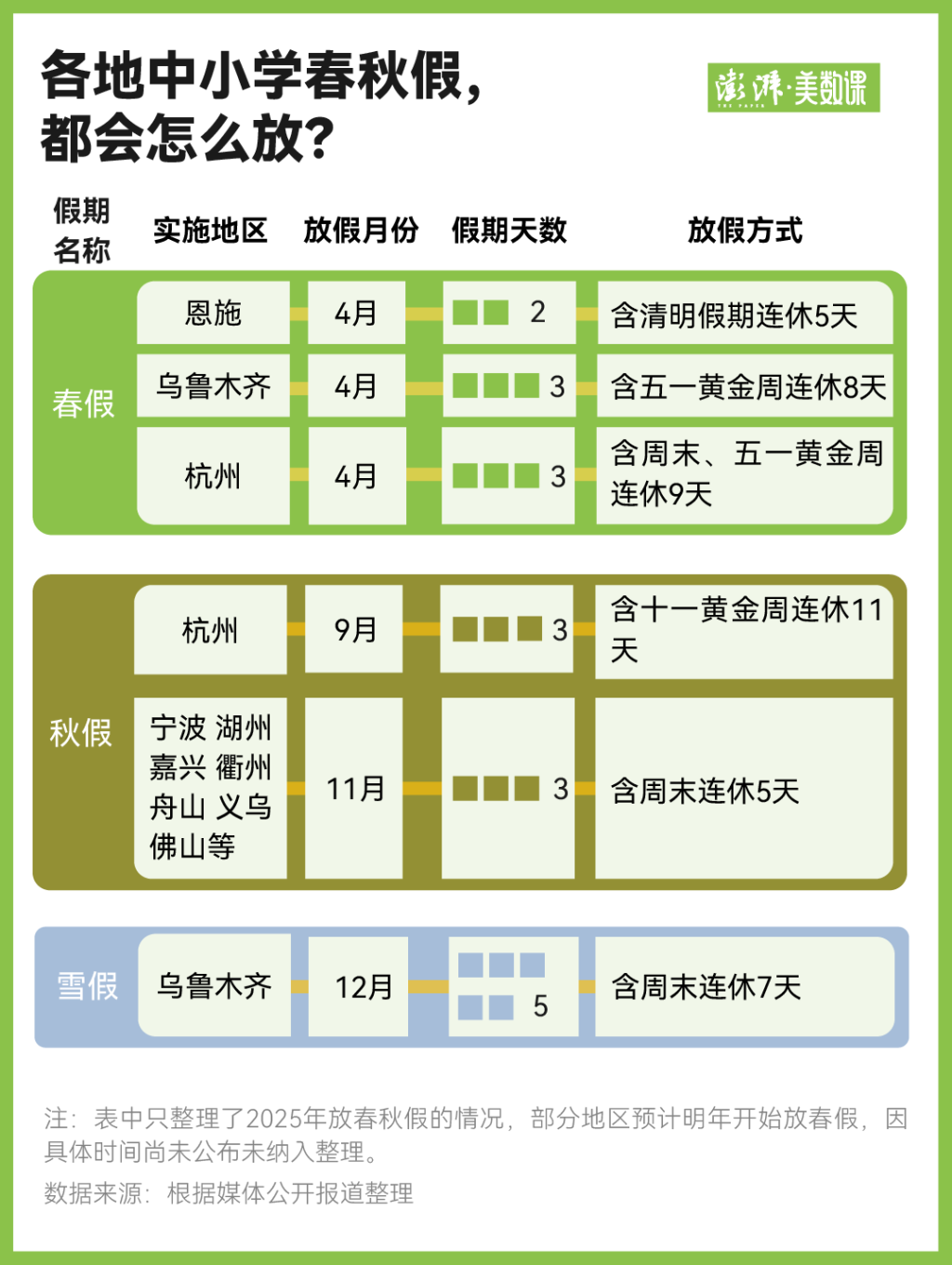
中小学春秋假来了,各地怎么放?
Xin Lang Cai Jing· 2025-10-23 04:25
Core Points - The introduction of "spring and autumn breaks" for primary and secondary school students is aimed at optimizing holiday structures and boosting consumer spending [2][5][12] - The implementation of these breaks is expected to enhance travel opportunities during off-peak seasons, potentially redistributing tourist traffic and improving overall satisfaction [6][8] Group 1: Policy and Implementation - The Ministry of Commerce and other departments have encouraged local governments to explore the establishment of spring and autumn breaks while maintaining the total number of school days [2][5] - The concept of spring and autumn breaks is not new, having been proposed in the 2013 National Tourism and Leisure Outline [2][5] - By 2025, more regions are expected to adopt these breaks, often aligning them with existing public holidays [2][5] Group 2: Economic Impact - The introduction of spring and autumn breaks could contribute an estimated 0.4% to 0.6% increase in retail sales in the short term, potentially rising to 1% to 1.66% in the long term [6][12] - The 2024 National Day holiday saw 826 million tourists, with a satisfaction score of only 78 out of 100, indicating room for improvement in the tourism experience [6][12] Group 3: Public Support and Challenges - A survey indicated that 71.3% of respondents support the implementation of spring breaks, but there are concerns about the need for parental paid leave and proper scheduling by schools [8][11] - Some regions have already begun addressing childcare issues during breaks by providing free supervision services for students [11][12] Group 4: Future Outlook - The establishment of spring and autumn breaks may serve as a catalyst for broader improvements in holiday benefits across society [12]
两会|券商展望全国两会 热议挖掘消费潜力
证券时报· 2025-03-03 00:34
Core Viewpoint - The upcoming National Two Sessions are expected to focus on "stabilizing growth" and emphasize macro policy support to boost domestic demand, with a particular focus on enhancing consumer spending [2][3]. Economic Policy Focus - UBS's chief economist Wang Tao predicts increased fiscal spending on consumption and households, including doubling the scale of trade-in subsidies, establishing childbirth and childcare subsidies, raising basic pension payments, and enhancing government support for basic social security [2]. - Nomura's chief economist Lu Ting highlights the government's potential focus on four areas: transfer payments to local governments, funding for large-scale equipment upgrades and trade-in programs, financial support for the real estate sector, and fiscal assistance for low-income families [3]. - The macroeconomic policy is expected to maintain a "moderately loose" stance, with measures to lower financing costs for enterprises and households, reduce reserve requirements and policy interest rates, and promote reasonable inflation rebound [2]. Industry Trends - The emergence of AI applications, particularly driven by DeepSeek, is expected to stimulate investment in emerging sectors like AI and cloud computing, with the AI core industry projected to exceed 17.3 trillion yuan by 2035, accounting for over 30% of the global market [3]. - The focus on innovation, technology, and modernization is evident in the frequency of related terms in government work reports, indicating a strong emphasis on sectors like AI, quality consumption, new urbanization, infrastructure expansion, and food security [3][4]. Consumption and Market Dynamics - The stock market's recovery has shown a certain wealth effect, and the real estate sector has performed slightly better than expected, indicating a potential shift in consumer sentiment and spending [2]. - The National Two Sessions are anticipated to maintain a GDP growth target of around 5%, with a strong emphasis on boosting consumption as a key priority [4].