
慧眼卫星

Search documents
“鸿蒙”初开 “夸父”追日 星河问源(瞰前沿)
Ren Min Ri Bao· 2025-12-05 22:03
Core Insights - The China Academy of Sciences National Space Science Center held a press conference on November 24, showcasing significant advancements in space science, focusing on cosmic origins, space weather, and the origins of life [3][10]. Group 1: Satellite Missions and Achievements - Since the launch of the space science pilot project in January 2011, eight scientific satellite missions have been completed, including "Wukong," "Shijian-10," "Micius," "Huiyan," "Taiji-1," "Huairou-1," "Kuafu-1," and "Tianguan," achieving multiple "firsts" for China and the world [5]. - "Wukong," launched on December 17, 2015, is China's first dark matter particle detection satellite, which has provided the most precise secondary cosmic ray boron energy spectrum in the TeV/n range based on eight years of data [5]. - "Huiyan," China's first X-ray astronomical satellite, launched on June 15, 2017, has made significant discoveries regarding black hole accretion bursts and neutron star surface nuclear burning [6]. - "Huairou-1," launched on December 10, 2020, has identified new subtypes of gamma-ray bursts and provided insights into the radiation environment near Earth [6]. - "Kuafu-1," launched on October 9, 2022, has revealed a lower-than-expected correlation rate between high-energy C-class flares and coronal mass ejections, offering new insights into solar eruption mechanisms [7]. - "Tianguan," launched on January 9, 2024, has detected 165 significant X-ray transient sources, contributing to the understanding of X-ray phenomena in the galaxy [7]. Group 2: Future Missions and Goals - The "14th Five-Year Plan" will focus on the "Harmonious Plan," which includes a low-frequency radio telescope array of ten satellites aimed at capturing weak signals from the early universe [8]. - "Kuafu-2" will explore solar magnetic activity and its relationship with solar storms by orbiting the sun's poles [9]. - The exoplanet survey satellite aims to find Earth-like planets in habitable zones, while the enhanced X-ray time-variable and polarization space observatory will study extreme conditions in the universe [9]. Group 3: Development and International Collaboration - The space science sector in China has shown robust growth, achieving breakthroughs in various fields, including macro, micro, extreme conditions, and interdisciplinary research [10]. - The project has led to significant advancements in satellite technology and payloads, establishing a national-level X-ray calibration beamline and developing high-sensitivity X-ray telescopes [10]. - International collaborations, such as the "Smile" satellite project with the European Space Agency, have enhanced China's scientific influence and effectiveness in space science [11].

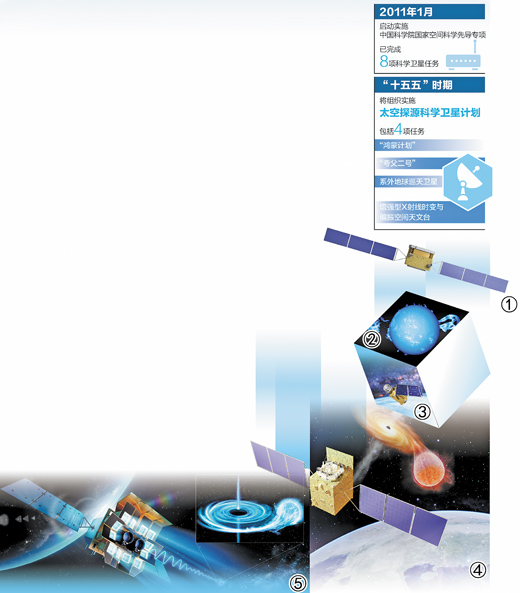
我国空间科学先导专项最新亮点成果发布 “鸿蒙”初开 “夸父”追日 星河问源(瞰前沿)
Ren Min Ri Bao· 2025-12-05 21:59
Core Insights - The recent press conference by the National Space Science Center of China highlighted significant advancements in space science, focusing on the origins of the universe, space weather, and life [2][8] - The "14th Five-Year Plan" will implement the Space Exploration Science Satellite Program, which includes four major missions aimed at achieving breakthroughs in understanding the dark ages of the universe, solar magnetic activity cycles, and exoplanet detection [2][8] Group 1: Satellite Missions and Achievements - Since the launch of the Space Science Pilot Project in 2011, eight scientific satellite missions have been completed, achieving "China's first" and even "world's first" breakthroughs in various fields [3] - The "Wukong" satellite, launched in December 2015, has provided the most precise secondary cosmic ray boron energy spectrum in the TeV/n range, aiding in the understanding of cosmic ray propagation [4] - The "Huiyan" satellite, launched in June 2017, has made significant contributions to understanding black hole accretion bursts and neutron star surface nuclear burning [5] - The "Huairou-1" satellite, launched in December 2020, discovered new subtypes of gamma-ray bursts and provided insights into the radiation environment near Earth [6] - The "Kuafu-1" satellite, launched in October 2022, revealed a lower-than-expected correlation rate between high-energy C-class flares and coronal mass ejections, offering new insights into solar eruptions [7] - The "Tianguan" satellite, launched in January 2024, has detected 165 significant X-ray transient sources, contributing to the understanding of X-ray phenomena in the galaxy [7] Group 2: Future Missions and Goals - The "Hongmeng Plan" aims to capture weak signals from the early universe using a low-frequency radio telescope array consisting of ten satellites [9] - The "Kuafu-2" mission will explore solar magnetic activity and its relationship with solar wind, enhancing understanding of the Earth-sun relationship [9] - The Exoplanet Survey Satellite will search for Earth-like planets in habitable zones, referred to as "Earth 2.0" [9] - The Enhanced X-ray Time-Variable and Polarization Space Observatory will study extreme conditions in the universe, such as black hole event horizons and neutron star surfaces [9] Group 3: Overall Impact and Development - The Space Science Pilot Project has demonstrated a strong development trend in China's space science, achieving breakthroughs across multiple dimensions [10] - The project has led to advancements in satellite technology and international collaboration, enhancing China's influence in global space science [10] - The transition from "catching up" to "keeping pace" and now to "leading" in certain areas reflects the growing importance of China's space science satellite cluster in exploring the unknown universe [10]
【科技日报】中国空间科学创新发展进入“快车道”
Ke Ji Ri Bao· 2025-11-25 02:15
Core Insights - The National Space Science Center of the Chinese Academy of Sciences announced significant scientific breakthroughs in space science, marking a historic leap for China's space science innovation and positioning it as a leader in certain fields [1][5]. Group 1: Achievements and Innovations - Since its launch in 2011, the space science initiative has successfully developed and launched eight scientific satellites, achieving numerous original results and setting multiple records in China and globally [2]. - The "Tian Guan" satellite created the world's first X-ray all-sky map, while the "Wu Kong" satellite provided the most precise cosmic ray energy spectrum to date [2]. - The "Hui Yan" satellite directly measured the universe's strongest magnetic fields and detected high-speed jets near black holes, showcasing advancements in extreme condition measurements [2][3]. Group 2: International Collaboration - The initiative has fostered new paradigms of international cooperation, including the "Tian Guan" satellite project, which involved collaboration with the European Space Agency and other European countries [4]. - The "Wei Xiao" satellite project represents a comprehensive collaboration between China and Europe, covering all phases from design to data analysis [4]. Group 3: Future Plans - The National Space Science Center plans to focus on major frontier issues such as the origins of the universe, space weather, and life, with upcoming projects including the "Hong Meng Plan" and "Kua Fu II" [4]. - The goal is to achieve breakthroughs in areas like the dark ages of the universe and exoplanet detection during the 14th Five-Year Plan period [4].
中国空间科学创新发展进入“快车道”——空间科学先导专项取得系列重大原创成果
Ke Ji Ri Bao· 2025-11-25 00:08
Core Insights - The National Space Science Center of the Chinese Academy of Sciences announced significant breakthroughs in space science, marking a historic leap for China's space science innovation and positioning it as a leader in certain fields [1][5]. Group 1: Achievements and Innovations - Since its launch in 2011, the space science initiative has successfully developed and launched eight scientific satellites, achieving numerous original results and creating multiple "firsts" for China and the world [2]. - The "Tian Guan" satellite produced the world's first all-sky X-ray map, while the "Wu Kong" satellite provided the most precise cosmic ray energy spectrum to date [2]. - The "Hui Yan" satellite directly measured the universe's strongest magnetic fields and detected high-speed jets near black holes, showcasing advancements in extreme condition measurements [2]. Group 2: Technological Advancements - The initiative has driven significant advancements in cutting-edge payload and satellite platform technologies, including breakthroughs in key technologies such as ground-space optical alignment [3]. - The development of a large field-of-view, high-sensitivity lobster-eye X-ray telescope has positioned China at a leading level internationally [3]. Group 3: International Collaboration - The initiative has fostered new paradigms of international cooperation, including the "Tian Guan" satellite project, which involved collaboration with the European Space Agency and other European countries [4]. - The "Smile" satellite project represents a comprehensive collaboration between China and Europe, covering all phases from design to data analysis [4]. Group 4: Future Plans - The National Space Science Center plans to focus on major frontier issues such as the origins of the universe, space weather, and life, with upcoming projects including the "Hong Meng Plan" and "Kua Fu II" [4]. - The goal is to achieve breakthroughs in areas like the dark ages of the universe, solar magnetic activity cycles, and exoplanet detection during the 14th Five-Year Plan period [4].
【科技日报】“怀柔一号”发现磁陀星驱动伽马暴直接证据
Ke Ji Ri Bao· 2025-09-22 06:02
Core Insights - A collaborative team from Nanjing University, the Chinese Academy of Sciences, and the University of Hong Kong has provided direct evidence of magnetar-driven gamma-ray bursts (GRBs) through high-precision observations using the "Huairou-1" satellite [1][2] - Gamma-ray bursts are among the brightest and most intense explosions in the universe, releasing energy exceeding that of the Sun's entire lifespan within seconds [1] - The breakthrough was achieved with the observation of GRB 230307A, the second brightest gamma-ray burst recorded, which posed challenges for international observation equipment due to its brightness [1] Group 1 - The "Huairou-1" satellite successfully observed a stable quasi-periodic oscillation signal with a central frequency of 909 Hz and a duration of 160 milliseconds, indicating a magnetar with a rotation period of approximately 1.1 milliseconds [1] - This observation marks the first time a stable millisecond pulsation signal has been detected in a gamma-ray burst, providing crucial evidence for understanding the nature of compact object mergers [2] Group 2 - The research team plans to continue utilizing data from various satellites, including "Jiguang," "Huiyan," "Tianguan," and SVOM, to search for quasi-periodic oscillation signals in more gamma-ray bursts [2] - The ongoing research will combine theoretical and numerical simulations to comprehensively understand the physical mechanisms behind magnetar-driven gamma-ray bursts [2]