
住宅销售价格指数

Search documents
统计局:2025年11月份70个大中城市商品住宅销售价格变动情况
Xin Lang Cai Jing· 2025-12-15 02:17
Core Insights - The report indicates a general decline in new residential property prices across 70 major cities in China for November 2025, with an average price index of 99.5 compared to the previous month [1][2][3] - The data shows a year-on-year decrease in both new and second-hand residential property prices, suggesting a continued trend of weakening demand in the real estate market [1][4] New Residential Property Prices - The new residential property price index for November 2025 is reported at 99.5, reflecting a decrease of 0.5% from the previous month [1] - Cities such as Beijing and Tianjin show slight declines, with indices of 99.6 and 99.3 respectively, indicating a broader trend of price reductions [1][2] - The average price index for the first eleven months of 2025 stands at 100.1, suggesting a more stable price level earlier in the year compared to November [1] Second-Hand Residential Property Prices - The second-hand residential property price index also reflects a decline, with an average index of 99.4 for November 2025, down from the previous month [2][4] - Major cities like Shanghai and Shenzhen report indices of 99.1 and 99.0 respectively, indicating a similar downward trend in the second-hand market [2][4] - The year-to-date average for second-hand properties is 99.5, showing a consistent decrease in prices throughout the year [2] Price Classification by Property Size - The report categorizes new residential property prices by size, with properties under 90m² showing an index of 99.2, while those between 90-144m² and over 144m² have indices of 99.4 and 99.8 respectively [3][4] - This classification indicates that smaller properties are experiencing a more significant decline compared to larger ones, which may reflect changing buyer preferences [3][4] Conclusion - The overall trend in the residential property market across major cities in China indicates a decline in both new and second-hand property prices, with various factors contributing to this trend, including economic conditions and buyer sentiment [1][2][3][4]

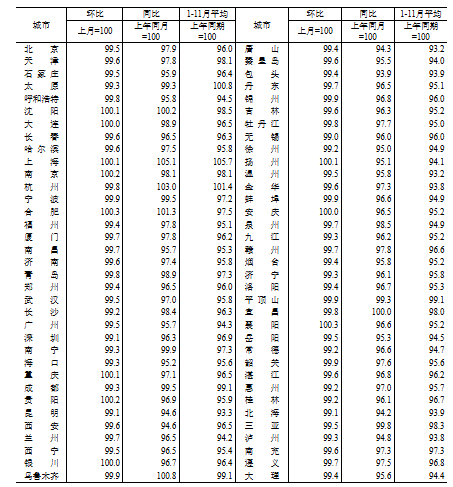
2025年7月份70个大中城市商品住宅销售价格变动情况
Guo Jia Tong Ji Ju· 2025-08-15 01:31
Core Insights - The residential property market in 70 major cities in China shows a mixed trend in new and second-hand housing prices as of July 2025, with some cities experiencing slight declines while others see increases in prices [1][3][4]. New Residential Property Price Index - In July 2025, the new residential property price index for Beijing is at 100.0, with a year-on-year decrease of 3.6% [1]. - Shanghai's index increased to 100.3, reflecting a year-on-year increase of 6.1% [1]. - Cities like Shenzhen and Guangzhou show slight declines in their indices, with Shenzhen at 99.4 and Guangzhou at 99.7, indicating year-on-year decreases of 2.2% and 4.6% respectively [1]. Second-Hand Residential Property Price Index - The second-hand residential property price index for Beijing is at 98.9, with a year-on-year decrease of 2.9% [3]. - Shanghai's index stands at 99.1, reflecting a year-on-year decrease of 2.2% [4]. - Cities such as Tianjin and Chengdu show resilience, with Tianjin at 99.4 and Chengdu at 99.9, indicating year-on-year decreases of 3.2% and 0.1% respectively [3][4]. Price Trends by Property Size - For new residential properties, the price index for units smaller than 90m² in Beijing is at 99.8, with a year-on-year decrease of 3.3% [6]. - In contrast, properties larger than 144m² in Shanghai have an index of 100.3, showing a year-on-year increase of 7.1% [6]. - The average price index for properties between 90-144m² in cities like Hangzhou is at 99.8, reflecting a year-on-year increase of 2.4% [6]. Regional Variations - Cities like Urumqi and Xi'an show strong performance in new residential prices, with Urumqi at 100.3 and Xi'an at 99.7, indicating year-on-year increases of 0.3% and 0.2% respectively [1][5]. - Conversely, cities such as Tangshan and Hohhot are experiencing declines, with Tangshan at 99.3 and Hohhot at 99.4, reflecting year-on-year decreases of 7.6% and 8.7% respectively [1][5].
2025年5月份70个大中城市商品住宅销售价格变动情况
Guo Jia Tong Ji Ju· 2025-06-16 01:30
Core Insights - The residential property market in 70 major cities in China shows a mixed trend in new and second-hand housing prices as of May 2025, with some cities experiencing slight declines while others see increases in prices [1][2][3][4][5][6] New Residential Property Prices - In May 2025, the new residential property price index for Beijing is at 99.6 (month-on-month) and 95.7 (year-on-year), indicating a slight decrease compared to the previous month and a significant drop compared to the same month last year [1] - Shanghai's new residential prices increased slightly to 100.7 (month-on-month) and 105.9 (year-on-year), showing resilience in the market [1] - Cities like Shenzhen and Guangzhou show a month-on-month decrease in new residential prices at 99.6 and 99.2 respectively, while year-on-year comparisons also reflect declines [1] Second-Hand Residential Property Prices - The second-hand residential property price index for Beijing stands at 99.2 (month-on-month) and 99.3 (year-on-year), indicating stability but a slight decline from the previous month [3][4] - In contrast, cities like Hangzhou and Nanjing show a month-on-month decrease in second-hand prices at 99.6 and 99.1 respectively, while year-on-year comparisons also reflect declines [3][4] - The overall trend in second-hand residential prices across major cities indicates a more pronounced decline compared to new residential properties, with many cities reporting lower indices [3][4] Price Classification by Size - The price index for new residential properties categorized by size shows that properties under 90m² in Beijing have a month-on-month index of 99.7 and a year-on-year index of 95.8, indicating a decline [5] - For properties between 90-144m², the index in Beijing is at 99.6 (month-on-month) and 95.0 (year-on-year), while properties over 144m² show a similar trend with an index of 99.6 (month-on-month) and 96.0 (year-on-year) [5] - The classification indicates that smaller properties are experiencing a more significant decline compared to larger properties in several cities [5] Regional Variations - Cities like Chengdu and Xi'an show resilience with month-on-month indices of 100.3 and 99.5 respectively, indicating stable or increasing prices [1][5] - Conversely, cities such as Tangshan and Hohhot show declines in both new and second-hand property prices, reflecting regional disparities in the housing market [1][3][5] - The data suggests that while some major cities are stabilizing or increasing in price, others are facing challenges, highlighting the uneven recovery in the residential property market across China [1][3][5]