供应链及国际业务

Search documents
顺丰控股(002352):公司分析:业务结构逐步调优,看好公司配置价值
Guohai Securities· 2026-03-20 09:09
Investment Rating - The report maintains a "Buy" rating for the company [1][8]. Core Insights - The company is expected to see a short-term profit turning point and long-term value due to business structure optimization and new growth opportunities in supply chain and international business [6][8]. - The company's express logistics business showed a revenue of 36.817 billion yuan in January-February, a year-on-year increase of 8.57%, with business volume growing by 9.44% [6][8]. - Average revenue per package slightly decreased by 0.79% to 14.98 yuan, but is expected to stabilize as the company adjusts its market strategy [6][8]. Financial Projections - Revenue projections for 2025-2027 are 312.76 billion yuan, 342.95 billion yuan, and 372.98 billion yuan, representing year-on-year growth rates of 9.97%, 9.65%, and 8.76% respectively [6][7]. - Net profit forecasts for the same period are 11.075 billion yuan, 12.285 billion yuan, and 13.821 billion yuan, with growth rates of 8.90%, 10.92%, and 12.50% respectively [6][7]. - The expected P/E ratios for 2025-2027 are 17 times, 15 times, and 13 times [6][7]. Business Performance - The company's stock performance over the last 12 months shows a decline of 14.2%, compared to a 14.3% increase in the CSI 300 index [5][6]. - The current stock price is 36.57 yuan, with a 52-week price range of 36.03 to 51.13 yuan [5][6]. - The total market capitalization is approximately 184.26 billion yuan [5].

股市必读:顺丰控股(002352)1月27日董秘有最新回复
Sou Hu Cai Jing· 2026-01-27 16:39
Core Viewpoint - SF Holding (顺丰控股) is experiencing a decline in stock price and facing challenges in maintaining investor confidence, despite being a leading player in the logistics industry. The company is actively engaging with investors to address concerns and enhance its long-term investment value. Financial Performance - As of January 27, 2026, SF Holding's stock closed at 37.86 RMB, down 2.3%, with a turnover rate of 0.84% and a trading volume of 399,000 shares, resulting in a total transaction value of 1.522 billion RMB [1]. Investor Relations - The company clarified that "customer relationships" in its financial statements are recognized as intangible assets during mergers and are recorded at fair value, amortized over their expected benefit period [2]. - SF Holding emphasized its commitment to transparent information disclosure, stating that it adheres to legal requirements and does not have undisclosed negative news affecting its stock price [2][3]. Business Strategy - The company aims to enhance its logistics services by collaborating with high-quality brands like Pang Donglai, which could improve its market presence in the fresh cold chain sector [2]. - SF Holding is focused on becoming a comprehensive logistics solution provider with a global reach, catering to various customer segments, including traditional e-commerce and cross-border logistics [2][3]. Stock Buyback - On January 26, 2026, SF Holding repurchased 1,350,000 A-shares at prices between 38.60 RMB and 38.98 RMB, totaling approximately 52.43 million RMB. The shares will be held as treasury stock [5]. - On January 27, 2026, the company repurchased an additional 2,634,700 A-shares at prices between 37.95 RMB and 38.70 RMB, with a total expenditure of approximately 100.47 million RMB [8]. Market Activity - On January 27, 2026, the main funds experienced a net outflow of 86.12 million RMB, while retail investors saw a net inflow of 202 million RMB [4][7].
快递四巨头全年经营数据出炉:顺丰营收首破3000亿元,“二通一达”胜负已分
Guo Ji Jin Rong Bao· 2026-01-20 12:57
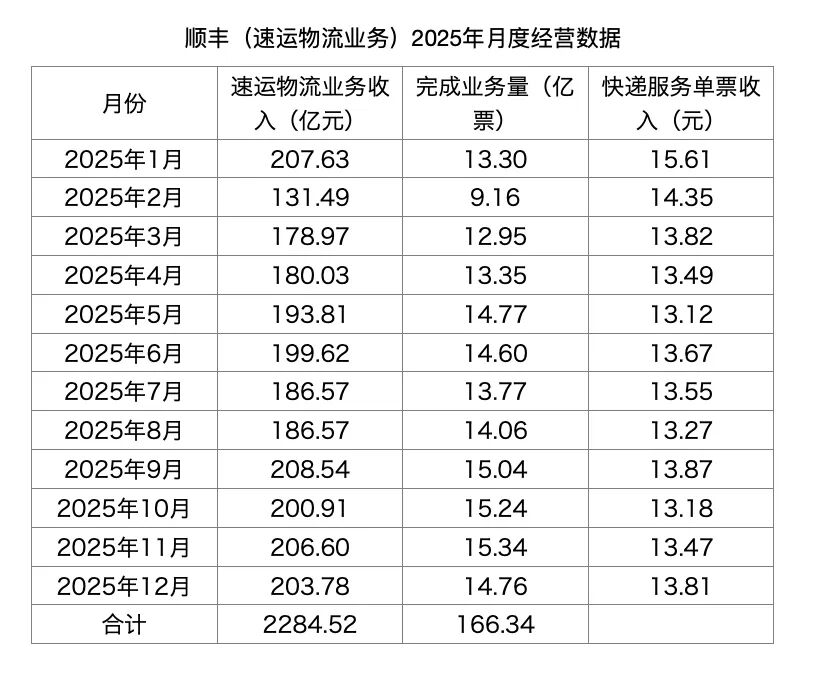
Core Viewpoint - The financial performance of major express delivery companies in A-shares for the year 2025 has been disclosed, showing varied growth rates and strategic developments among the companies [1][6]. Group 1: Company Performance - SF Express reported total revenue of 273.39 billion yuan in December 2025, with express logistics revenue of 203.78 billion yuan, a year-on-year increase of 3.78%, and a total business volume of 1.476 billion packages, up 9.33% year-on-year [1][2]. - YTO Express achieved a revenue of 64.96 billion yuan in December 2025, marking a year-on-year growth of 7.48%, with a business volume of 28.84 billion packages, up 9.04% year-on-year [6]. - Shentong Express reported a revenue of 58.36 billion yuan in December 2025, a significant year-on-year increase of 28.23%, with a business volume of 25.01 billion packages, up 11.09% year-on-year [6]. - Yunda Express had a revenue of 46.26 billion yuan in December 2025, a year-on-year decrease of 1.49%, with a business volume of 21.48 billion packages, down 7.37% year-on-year [6]. Group 2: Strategic Developments - SF Express announced a strategic partnership with Jitu Express, involving mutual share purchases, which will enhance resource sharing and collaboration in logistics network development [4]. - SF Express is increasing its share buyback efforts, having repurchased shares worth approximately 10.45 million yuan in mid-January 2025 [4]. - The overall market capitalization reflects the performance differences, with YTO Express leading at 602 billion yuan, followed by Shentong at 212 billion yuan and Yunda at 202 billion yuan [7]. Group 3: Industry Challenges - The express delivery industry faces challenges such as rising operational costs, including labor, transportation, and facility expenses, alongside the need for differentiation in a highly competitive market [7]. - Regulatory pressures and the need for green transformation, including packaging reduction and carbon emission management, are increasing operational complexity and require ongoing investment [7].