
保险策略

Search documents
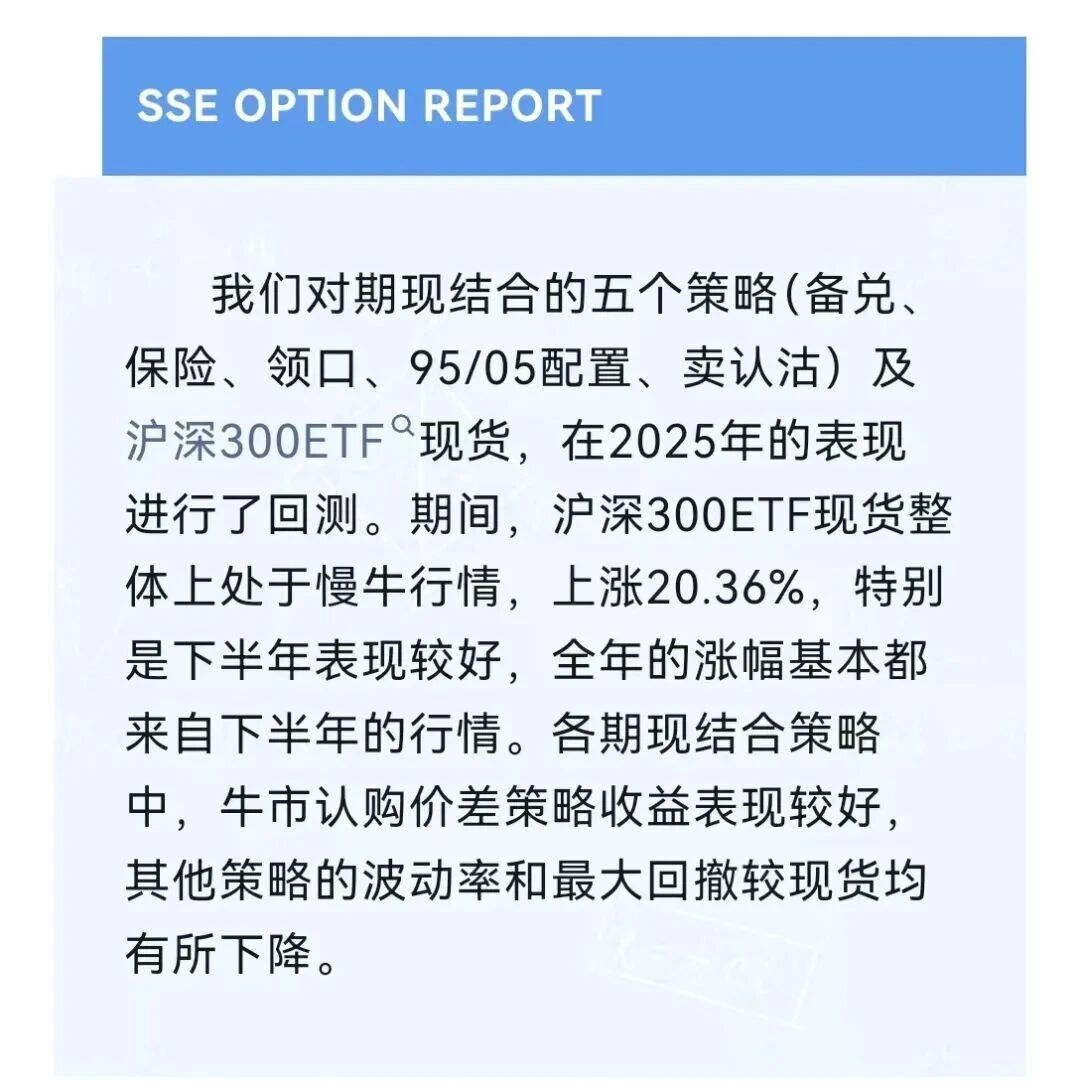
2025年期现结合策略回顾
申万宏源证券上海北京西路营业部· 2026-01-23 02:51
Group 1 - The article discusses various investment strategies, including covered call, insurance, and collar strategies, highlighting their performance in different market conditions [3][6][7] - The covered call strategy performed well in months with little to no price increase, while underperforming during significant price increases in July and August [3] - The collar strategy, which combines covered call and insurance strategies, showed better performance during sideways and significant downturns, with returns slightly higher than the underlying asset and lower volatility and maximum drawdown [3] Group 2 - The government bond ETF yielded only 0.7% for the year, negatively impacting the performance of the 95/05 strategy and the cash-secured put strategy, although both strategies exhibited lower volatility and maximum drawdown, indicating a more stable performance [3] - The 95/05 strategy involves investing 95% in a government bond ETF and 5% in long-term call options, with quarterly rebalancing based on market conditions [6] - The cash-secured put strategy starts with a cash position and involves selling out-of-the-money put options while using the remaining funds to invest in the government bond ETF, with monthly adjustments based on option expiration [7]

期权买方应该注意什么?
申万宏源证券上海北京西路营业部· 2025-12-31 02:24
Group 1 - The core point emphasizes that option buyers often have unrealistic expectations regarding potential returns, misunderstanding the risk-reward dynamics of options trading, particularly the lower win rate compared to option sellers [2] - It is crucial for option buyers to implement stop-loss and take-profit strategies, starting with small positions and gradually increasing based on market movements, while ensuring no single position exceeds 5% of the total options portfolio [3][4] - The cost of insurance strategies must be managed carefully, as high premiums can significantly burden option buyers, especially when using protective puts that may cost more than double compared to at-the-money options [5][7] Group 2 - Time decay is a significant concern for option buyers, as the time value of options diminishes rapidly as expiration approaches, with prices potentially dropping by over 95% just days before expiration [8] - The costs associated with buying straddle strategies should not be underestimated, as they require significant volatility to be profitable, and the price differences between call and put options must be large enough to cover the initial investment [9]

花生周报:现货偏弱调整,期货震荡筑底-20250714
Zheng Xin Qi Huo· 2025-07-14 13:10
Report Industry Investment Rating - Not provided Core Viewpoints of the Report - Spot prices are weakly adjusted, and futures are oscillating to build a bottom. The overall trading in the producing areas is light this week, with the transaction center moving down. New peanut planting area is expected to increase slightly, and the total output is expected to remain high. Spot prices are likely to oscillate weakly in the short term, and the long - term market depends on weather and demand. Futures prices are unlikely to decline significantly in the medium and short term and may enter a bottom - oscillating phase. Appropriate strategies include building a futures - options covered strategy and an insurance strategy for trend traders [6]. Summary by Relevant Catalogs 1. Main Views - The overall trading in peanut producing areas is light, with the transaction center moving down. Some holders are more willing to sell, but downstream procurement is weak. New peanut planting area increases slightly, and the total output is expected to be high. Spot prices may oscillate weakly in the short term, and long - term market depends on weather and demand. Futures prices are unlikely to decline significantly in the medium and short term, suitable for building specific strategies [6]. 2. Market Review 2.1 This week - Peanut weighted index oscillates weakly and reaches the lower edge of the range, finding temporary support. The oilseed sector breaks through the upper edge of the range and then oscillates narrowly. In the short - term market, peanuts are stronger than oils [10]. 2.2 2510 Contract - The 10 - main contract rose to the upper edge of the range after falling below the lower edge last week. If the price continues to rise, the market may develop into an uptrend [14]. 3. Fundamental Analysis 3.1 Oil Mill Inventory and Operating Rate - Peanut oil weekly inventory is 39,290 tons, a decrease of 120 tons from the previous month, and the oil mill operating rate is 4.21%, a decrease of about 0.53% from last week [17]. 3.2 Peanut Commodity Price (Baisha) - The transaction prices of Baisha peanuts in Henan and Northeast China are chaotic. Some low - quality sources have low quotes, while high - quality cold - stored sources are relatively resistant to price drops. The overall trading is light [20]. 3.3 Peanut Oil Price Trend - The average price of first - grade ordinary peanut oil in the main producing areas this week is 15,000 yuan/ton, basically the same as last week [22]. 3.4 Peanut Meal Price Trend - Peanut meal, rapeseed meal, and soybean meal prices maintain an oscillating pattern [26]. 3.5 Imported Peanut Quantity and Price - There are few imported peanuts. Sudanese refined peanuts are scarce, and no new peanuts have arrived at the port. Import prices are stable, and the procurement of Senegalese sources is limited [28]. 3.6 Market Price Index Compared with Last Month - In the wholesale market, peanut prices are mainly negotiated, and the overall transaction price is relatively stable [32]. 4. Spread Tracking 4.1 Basis Spread - Not elaborated in detail in the text, only a chart of peanut - Baisha basis is provided [34]