
保险股行情

Search documents
保险巨头盯上了50万亿到期存款
Xin Lang Cai Jing· 2026-01-19 07:37
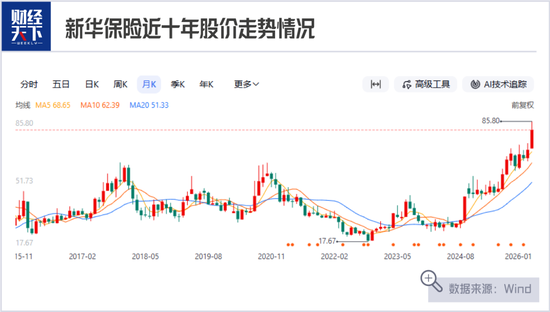
Core Viewpoint - The insurance sector is experiencing a significant rebound at the beginning of 2026, with insurance stocks rising sharply and sales of insurance products improving due to low deposit rates and favorable market conditions [1][19]. Group 1: Stock Performance - Insurance stocks have seen substantial gains, with New China Life leading with a 17.78% increase as of January 16, 2026. The top five listed insurance companies have all recorded double-digit growth over the past three months, with increases ranging from 10.32% to 23.83% [2][20]. - Historical data indicates that since 2014, there have been five notable bullish trends in the insurance sector, with stock market performance being a key catalyst for these trends [2][20]. Group 2: Sales Performance - The insurance industry is witnessing a resurgence in sales, with reports of significant premium collections, such as one company surpassing 3 billion yuan in first-year premium within four days after New Year [5][23]. - The total insurance premium income in China reached 5.76 trillion yuan by November 2025, marking an increase of 400 billion yuan from the previous year [5][23]. Group 3: Product Trends - The rise in sales is attributed to the popularity of participating insurance products, which combine protection and investment features. These products have become attractive due to their lower guaranteed rates and the current low-interest environment [6][24]. - Major insurance companies are focusing on participating insurance products, with new offerings featuring guaranteed rates around 1.75% and projected returns between 3.5% and 3.9% [7][25]. Group 4: Investment Performance - The total investment income of listed insurance companies reached 887.5 billion yuan in the first three quarters of 2025, reflecting a year-on-year increase of 35.64% [10][28]. - The investment strategies of insurance companies have shifted towards equities, with significant increases in stock and equity fund investments, particularly for companies like China Life and Ping An [12][30]. Group 5: Future Outlook - Analysts express optimism about the continued strength of insurance stocks in 2026, driven by robust premium growth and improved business quality, alongside favorable investment conditions [16][34]. - However, challenges remain, particularly regarding the long-term risks associated with interest rate spreads and the need for insurance companies to diversify their product offerings and improve customer satisfaction [16][35].




Q2险资配置更新:股票规模较Q1再增2500亿
SINOLINK SECURITIES· 2025-08-18 13:04
Investment Rating - The industry investment rating is "Buy" with an expectation of an increase exceeding 15% over the next 3-6 months [6]. Core Insights - As of H1 2025, the total scale of funds utilized by the insurance industry reached 36.23 trillion yuan, reflecting an 8.9% growth since the beginning of the year and a 3.7% increase from Q1 [2]. - The allocation of bonds continues to rise, with the proportion of stocks increasing while the share of funds and long-term equity investments is declining. The combined proportion of stocks, funds, and long-term equity investments stands at 21.4%, up 1 percentage point from the end of last year [2]. - The insurance companies are expected to increase their stock investments due to low interest rates and a decline in fixed-income returns, alongside a regulatory push for increased market participation [3]. Summary by Sections Fund Allocation - Bond allocation by life and property insurance companies is 51.1%, up 0.7 percentage points from Q1 and 1.6 percentage points from the end of last year, indicating a strategy to shorten duration gaps [2]. - The stock allocation is 8.8%, with increases of 2,513 million yuan from Q1 and 6,406 million yuan from the end of last year, driven by opportunities from tariff adjustments and asset appreciation in the equity market [2]. - Fund allocation has decreased to 4.8%, down 0.2 percentage points from Q1 and 0.5 percentage points from the end of last year, suggesting a shift towards direct stock investments [2]. - Long-term equity investments account for 7.9%, with a slight decrease, as smaller insurance companies aim to stabilize profits and enhance investment returns [2]. - Bank deposits represent 8.6% of the allocation, reflecting a decrease due to the maturity of high-yield deposits and increased reallocation challenges [2]. Future Outlook - The internal demand for insurance companies to increase stock investments is supported by low interest rates and a decline in fixed-income yields, along with an anticipated rise in the proportion of participating insurance products [3]. - Regulatory encouragement for insurance funds to increase market participation includes requirements for large state-owned insurance companies to allocate 30% of new premiums to A-shares and adjustments to solvency ratios [3]. - It is projected that the allocation to secondary equity markets will increase by approximately 2 percentage points, corresponding to an incremental capital influx of around one trillion yuan [3]. Investment Recommendations - The report suggests focusing on companies with stable operations and strong performance expectations for the first half of the year, as well as those with low valuations and good business quality [4]. - Attention is recommended for companies undergoing transformation towards participating insurance with competitive advantages, such as China Taiping [4]. - The report highlights the importance of large-cap stocks with strong beta characteristics that resonate with market trends [4].