假日文旅市场

Search documents
“史上最长”春节假拿啥迎客
Jing Ji Ri Bao· 2025-11-24 00:08
Group 1 - The announcement of the "longest Spring Festival holiday in history" has led to a surge in travel-related searches, with online travel platforms reporting a doubling in flight and hotel inquiries during the holiday period [1] - The holiday arrangement includes 4 days of statutory leave, 2 days of adjusted leave, and 2 weekends, allowing workers to avoid a continuous 7-day work period before the holiday, thus facilitating both family reunions and travel [1] - Recent adjustments to the holiday system include an increase of 2 days in statutory holidays starting in 2025, and local trials of "spring and autumn breaks" in various provinces to enhance students' exposure to nature [1] Group 2 - The holiday system is a crucial tool for boosting regional consumption and population mobility, with the willingness to travel increasing alongside rising living standards [2] - The introduction of the "Golden Week" in 1999 has led to significant growth in tourism, with domestic travel during the recent 8-day holiday reaching 888 million trips and total spending of 809 billion [2] - The market's performance during holidays indicates a strong potential for the tourism sector to drive domestic demand [2] Group 3 - Local governments are preparing to enhance visitor experiences by leveraging unique local resources and cultural heritage, aiming to create attractive new products and experiences for consumers [3] - There is a need for improved service quality during peak travel times, requiring proactive planning from transportation, health, and tourism sectors to ensure smooth operations during extended holidays [3] - Companies are encouraged to implement paid annual leave policies effectively, providing flexibility for employees and supporting consumer spending [3]
首日,游客量、消费额双增!借助火热数据看假日文旅市场活力显现
Yang Shi Wang· 2025-10-02 03:34
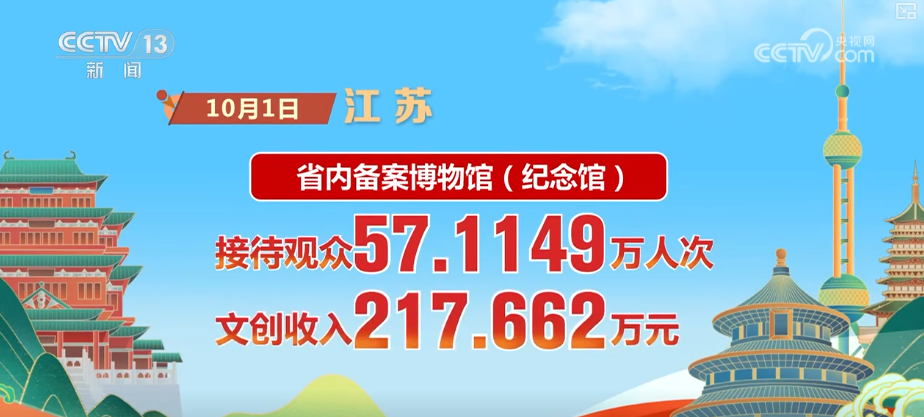
Core Insights - The tourism market during the holiday period is experiencing significant growth across various provinces in China, with notable increases in visitor numbers and revenue. Group 1: Jiangsu Province - Jiangsu's monitored cultural tourism units received 6.42 million visitors, a year-on-year increase of 5.29% [1] - Total visitor spending reached 2.48 billion yuan, up 4.95% from the previous year [1] - Museums in Jiangsu welcomed over 570,000 visitors, generating more than 2.17 million yuan in cultural revenue [1] Group 2: Anhui Province - Anhui's A-level tourist attractions hosted 2.14 million visitors, marking a 6.3% increase year-on-year [2] - Ticket revenue reached 22.56 million yuan, reflecting a 7.2% growth [2] - Key tourist sites like the Ancient Huizhou Cultural Tourism Area and Jiuhua Mountain saw visitor increases exceeding 15% [4] Group 3: Fujian Province - Fujian's 135 4A-level and above scenic spots received 946,800 visitors, a 20% increase compared to last year [5] - Ticket revenue amounted to 17.88 million yuan, up 11.4% [5] - Popular attractions like Sanfang Qixiang and Gulangyu Island experienced significant visitor traffic, with Sanfang Qixiang seeing 152,000 visitors, a 12.6% increase [7] Group 4: Guangdong Province - Guangdong's 4A-level and above scenic spots welcomed 2.78 million visitors, a 6.1% increase year-on-year [9] - Rural tourism sites and historical villages attracted 282,000 visitors, up 4.5% [9] Group 5: Heilongjiang Province - Heilongjiang's key scenic spots saw a notable increase in visitors, with Harbin Polar Park exceeding 10,000 visitors, a growth of over 47% [10] - The region is currently in the peak viewing period for autumn foliage, attracting more tourists [12] Group 6: Liaoning Province - Liaoning received a 15.71% increase in visitors, with tourism revenue growing nearly 16% [16] - The province's 5A-level scenic spots saw a visitor increase of nearly 27% and revenue growth exceeding 22% [18] Group 7: Inner Mongolia - Inner Mongolia welcomed 2.51 million domestic tourists, generating a total expenditure of 1.77 billion yuan [19] - Self-driving travel has become the primary mode of transportation, with visitors from surrounding regions making up 47% of the total [21]