健康养生理念

Search documents
砸90万挤进一线商圈,贴身肉搏奶茶店,糖水铺再现新茶饮神话?
东京烘焙职业人· 2026-01-16 08:33
Core Viewpoint - The article discusses the rapid expansion and challenges faced by the dessert shop industry, particularly focusing on sugar water shops, which are becoming a hot topic among franchisees. Despite their growth, these shops face significant operational challenges and competition from established brands in the beverage sector [5][6][18]. Expansion and Market Dynamics - Sugar water shops are experiencing a surge in new brands, with companies like 麦记牛奶 planning to open over 800 stores by 2025, and 赵记传承 reaching 601 stores after investment from 喜茶's founder [5][12]. - The traditional dessert brands are also accelerating their expansion, with 满记甜品 aiming for 500 direct stores and over 2000 franchise stores in the next 3-5 years [5]. - New tea brands are entering the sugar water market, with products like "红豆沙牛乳" and "桃胶炖奶" being introduced to attract customers [5]. Operational Challenges - Sugar water shops are characterized by non-essential, low-frequency consumption, making it difficult to replicate the success of new tea drinks [6][7]. - The average monthly sales for some franchisees are around 200,000 yuan, with significant costs such as rent and labor making profitability challenging [7][11]. - The initial investment for opening a sugar water shop starts at 700,000 yuan, with additional costs for renovation and equipment [9][10]. Consumer Behavior and Market Saturation - The consumer base for sugar water shops overlaps less with that of tea shops, leading to strategic placement near high-end tea brands to attract young customers [7][12]. - The market is becoming saturated, especially in lower-tier cities, where many local shops compete with established brands, leading to price wars and reduced profit margins [17][22]. - The average gross margin for sugar water shops can reach 70%, but competition and external costs often lead to a recalibration of expected profits [11][22]. Product Diversification and Brand Strategy - New brands are diversifying their product offerings to increase customer spending per visit, with some combining sugar water with other food items like fried chicken and ice cream [15][16]. - The complexity of managing a diverse SKU (Stock Keeping Unit) range is higher for sugar water shops compared to tea shops, leading many brands to adopt a partnership model where franchisees focus on investment while the brand manages operations [15][17]. - The article notes that the sugar water market is facing challenges from new tea brands that can easily adapt their supply chains to include sugar water products, further intensifying competition [22].

水杯饮具消费凸显个性化
Sou Hu Cai Jing· 2025-10-08 23:24
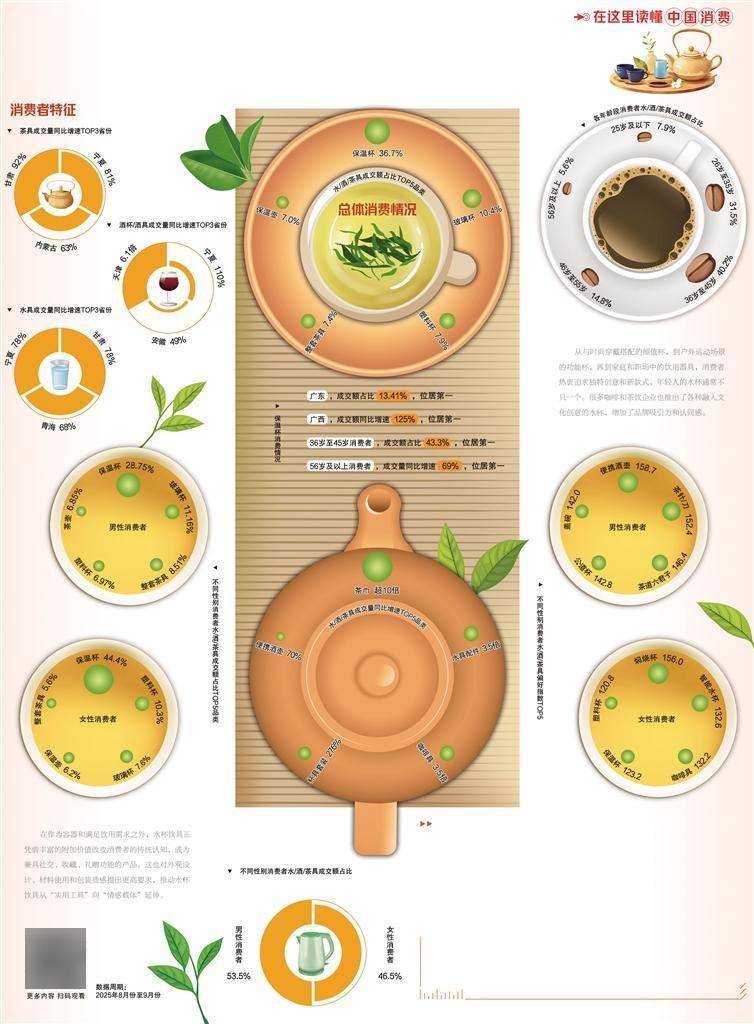
Core Insights - The water cup and drinking container market is evolving from a single functional attribute to a fashionable lifestyle product that reflects quality of life [3][4] - The market is expanding into various subcategories driven by the popularity of beverages like tea and coffee, as well as consumer demand for personalized health solutions [3] Market Trends - From August to September, the top five categories by transaction volume included thermos cups, glass cups, plastic cups, complete tea sets, and thermos flasks [3] - New scene-based products such as coffee cups, travel mugs, and mixing cups are emerging to meet diverse consumer drinking needs [3] Consumer Preferences - Female consumers show a preference for insulated cups, smart water bottles, and coffee accessories, while male consumers favor traditional items like fairness cups and covered bowls [3] - The strong influence of traditional tea culture has led to a rise in popularity for tea-related products, including tea towels and tea utensils [3] Health and Safety Considerations - Health and safety are the primary considerations for consumers when purchasing drinking containers, with a focus on materials like 304 and 316 food-grade stainless steel for thermos cups and high borosilicate glass for glass cups [3] - The integration of smart technology is enhancing the functionality of water cups, with features like real-time temperature display, hydration reminders via apps, and fingerprint unlocking to prevent mix-ups [3] Cultural Significance - Drinking containers are not just functional; they also carry cultural attributes, with items like co-branded mugs becoming souvenirs and landmark-themed coffee cups attracting tourists [4] - The variety of drinking vessels conveys health and wellness concepts while also reflecting unique cultural flavors, fulfilling both "utilitarian value" and "emotional value" for consumers [4] Future Innovations - The water cup and drinking container category is expected to continue innovating towards "functional diversification, scene customization, and intelligent experience" [4]