先富带动后富

Search documents
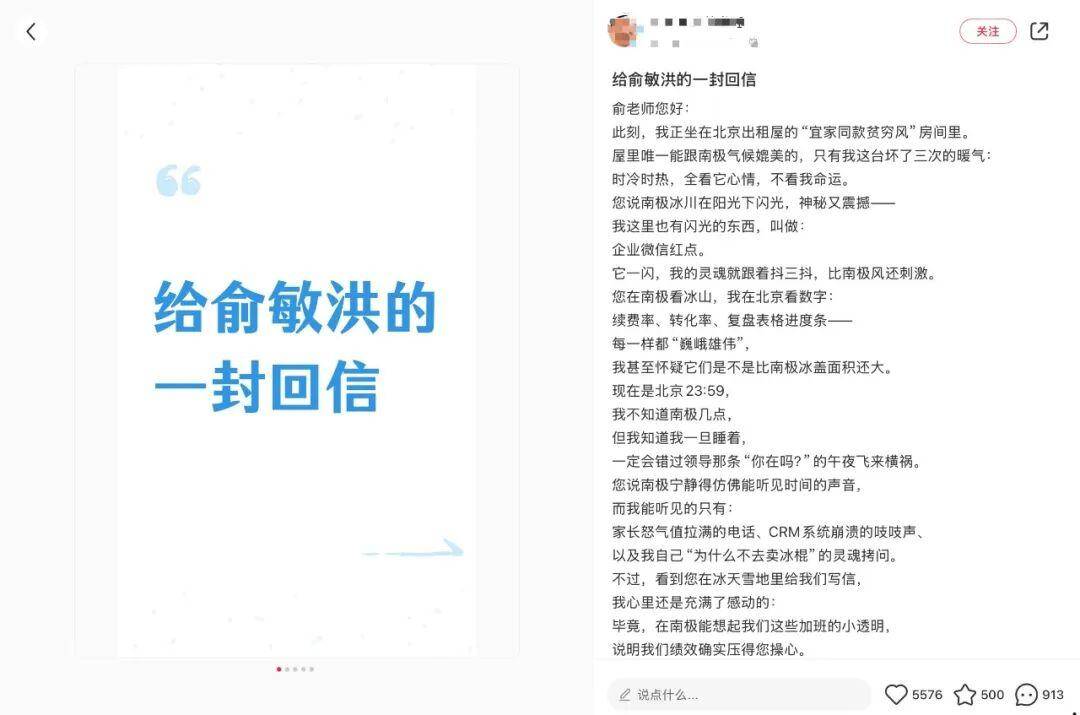
俞敏洪全员信“翻车”:企业家社会责任与教育公平的深层思考
Sou Hu Cai Jing· 2025-11-19 11:24
Core Viewpoint - The internal letter from Yu Minhong, founder of New Oriental, sparked controversy by highlighting the disconnect between the poetic imagery of his experiences in Antarctica and the harsh realities faced by employees, raising questions about the social responsibility of entrepreneurs and the fairness of education [1][2]. Group 1: Empathy Crisis and Entrepreneurial Responsibility - The controversy surrounding Yu Minhong's letter reflects a disconnect between individual narratives and collective struggles, emphasizing the lack of acknowledgment of employee pressures and challenges [1]. - Similar instances of "empathy crisis" have been observed with other entrepreneurs, indicating a trend where successful narratives overlook structural inequalities, leading to increased societal anxiety and diminished trust in business leaders [2]. Group 2: Educational Practice and Challenges - The concept of "the rich helping the poor" in education is fundamentally about ethical resource redistribution, requiring not just equal starting points but also efforts to narrow the gaps in processes and outcomes [3]. - New Oriental's transition from K12 training to diversified sectors like quality education and live commerce illustrates a response to policy changes and an extension of corporate social responsibility, yet it raises concerns about whether the focus on new business growth neglects the original mission of educational equity [3][4]. Group 3: Paths to Implement Social Responsibility - Educational enterprises can implement social responsibility through three main pathways: combining hardware investment with software empowerment, enhancing teacher training and career support, and providing targeted assistance to disadvantaged groups [4][5]. - Specific examples include funding for smart classrooms in impoverished schools, teacher exchange programs, and personalized educational plans for vulnerable populations [4][5]. Group 4: Reconstructing Social Responsibility Narratives - The controversy serves as a warning for entrepreneurs to prioritize empathy and action over mere sentiment, suggesting that educational companies should establish two-way communication mechanisms and integrate social responsibility into their core business strategies [5]. - Collaboration with government and industry to promote educational equity is essential, advocating for increased public investment and forming alliances to share resources effectively [5][6]. Conclusion - The incident with Yu Minhong's letter reflects the struggle between commercial success and social responsibility, emphasizing the need for entrepreneurs to remember that true commitment lies in the classrooms of ordinary educators and the eyes of eager learners [6].