全域感知

Search documents
6G发展或带动WiFi7需求,卓翼科技等上市公司或迎新机遇
Zheng Quan Shi Bao Wang· 2025-11-18 05:48
Group 1 - The emergence of 6G and WiFi 7 is set to revolutionize wireless communication, with 6G focusing on millimeter-wave and Sub-THz spectrum development, while WiFi 7 offers peak rates of 46Gbps and 320MHz channels, creating a new wireless communication ecosystem [1][2] - The 2025 6G Development Conference in Beijing highlighted the need for global consensus on 6G standards and the importance of collaboration among various stakeholders to accelerate technological innovation [2] - China is in a critical phase of 6G development, with clear industrial directions and multiple regions establishing 6G laboratories, indicating a proactive approach to the next generation of mobile communication [2] Group 2 - Companies in the A-share market producing WiFi 7 include Zhuoyue Technology, Zhuosheng Micro, and Fuman Micro, with Zhuoyue Technology entering mass production of WiFi 7 products that significantly enhance transmission rates compared to WiFi 6 [3] - Zhuoyue Technology is leveraging the synergy between 6G and WiFi 7 to position itself as a core supplier in the WiFi 7 market, with its products meeting the high-speed access demands of the 6G era [3] - The global market for WiFi devices is vast, with billions of units in use, suggesting a significant demand opportunity for companies like Zhuoyue Technology as WiFi 7 replaces earlier versions [3]

李长霖:协同治理仍需向深度演进
Jing Ji Ri Bao· 2025-11-17 00:03
Core Insights - Smart landscaping represents not only a technological revolution but also an upgrade in urban governance concepts, transitioning from "experience-driven" to "data-driven" approaches for high-quality urban development [1][2] - The integration of smart landscaping with initiatives like "sponge cities" and "carbon neutrality" is crucial for enhancing urban resilience and promoting sustainable development [1] - A unified data security standard and cross-departmental collaboration mechanism are recommended to ensure efficient data sharing while addressing potential risks [1] Group 1 - The goal of smart landscaping is to achieve universal sharing, necessitating simultaneous advancements in technology and public awareness [2] - Current public understanding of smart landscaping is limited, requiring immersive educational experiences through AR/VR technologies and mechanisms that convert ecological contributions into redeemable rights [2] - Over the next 5 to 10 years, smart landscaping should evolve towards "comprehensive perception, intelligent decision-making, and universal sharing" [2] Group 2 - A support system encompassing standards, funding, and talent is essential at the policy level to facilitate the development of smart landscaping [2] - National technical standards should be established to eliminate data silos, and special funds should be allocated to support key technology research [2] - Collaboration between academia and industry is necessary to cultivate interdisciplinary talents who understand both landscaping and AI technology [2][3]
协同治理仍需向深度演进
Jing Ji Ri Bao· 2025-11-16 22:11
Core Insights - Smart landscaping represents not only a technological revolution but also an upgrade in urban governance concepts, transitioning from "experience-driven" to "data-driven" approaches for high-quality urban development [1] - The integration of smart landscaping with initiatives like "sponge cities" and "carbon neutrality" is crucial for enhancing urban resilience and promoting sustainable development [1] - Data interconnectivity is fundamental for collaborative governance, requiring a unified data security standard and cross-departmental cooperation to ensure efficient data sharing [1] Summary by Sections Smart Landscaping Goals - The goal of smart landscaping is to achieve universal sharing, necessitating simultaneous technological advancements and public awareness [2] - Current public understanding of smart landscaping is limited, requiring immersive educational experiences and mechanisms to convert ecological contributions into redeemable rights [2] Future Development - Over the next 5 to 10 years, smart landscaping should evolve towards "comprehensive perception, intelligent decision-making, and universal sharing" [2] - Comprehensive perception involves optimizing sensor networks for integrated data collection, while intelligent decision-making relies on AI ecological modeling and blockchain technology for dynamic resource allocation [2] - Universal sharing can be stimulated through low-threshold interactive technologies and open data platforms to enhance public engagement [2] Policy Recommendations - A supportive system encompassing standards, funding, and talent development is essential for the advancement of smart landscaping [2] - National technical standards should be established to eliminate data silos, and special funds should be allocated to support key technology research [2] - Collaboration between academia and industry should be strengthened to cultivate interdisciplinary talents proficient in both landscaping and AI technology [2] Future Outlook - With the expansion of comprehensive perception networks and improved public participation mechanisms, smart landscaping is poised to become a bridge connecting nature and urban environments, continuously injecting wisdom into the development of low-carbon, livable modern cities [3]
WRC2025聚焦(1):展出通用具身智能,GOVLA架构成亮点
Haitong Securities International· 2025-08-12 01:01
Investment Rating - The report does not explicitly provide an investment rating for the industry or specific companies within it Core Insights - The 2025 World Robot Conference (WRC) showcased over 200 companies and 1,500 exhibits, highlighting advancements in swarm intelligence, humanoid robotics, and multi-modal large models [1][15] - China's robotics industry is projected to generate nearly RMB 240 billion in revenue in 2024, maintaining its status as the largest industrial robot market globally for 12 consecutive years [4][18] - The commercialization of general-purpose humanoid robots follows a phased approach, transitioning from algorithm validation to household applications [3][17] Summary by Sections Event Overview - The WRC 2025 opened on August 8, 2025, in Beijing, featuring over 200 companies and 1,500 exhibits, including more than 50 humanoid robot manufacturers [1][15] Industry Achievements - The conference highlighted breakthroughs in swarm intelligence, humanoid robotics, and fully self-developed embodied intelligence systems, with notable demonstrations from companies like UBTech and Unitree [2][16] Market Dynamics - In the first half of 2025, industrial robot output reached 370,000 units, a 35.6% year-on-year increase, while service robot output reached 8.824 million units, up 25.5% year-on-year [4][18] - Industrial robots are utilized across 71 major and 241 sub-categories of the national economy, with applications in automotive manufacturing, electronics, and healthcare [4][18] Technological Framework - The Global & Omni-body Vision-Language-Action Model (GOVLA) represents a significant technological advancement, enabling coordinated control and task execution across various environments [3][17][20] - The phased rollout of humanoid robots includes stages from algorithm validation to public service and ultimately to household assistance [3][17] Future Outlook - The report indicates a strong foundation for future consumer adoption of humanoid robots, with a focus on high-value B2B markets in the early stages [3][17]
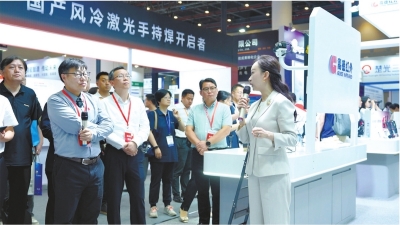
“中国光电子企业有实力、也有底气走出去” 光电子领军企业家集体探展
Chang Jiang Ri Bao· 2025-05-17 00:50
Core Insights - The 20th Optics Expo showcased significant advancements in the optoelectronics industry, with nearly 100 core technologies making their debut [1][5] - High-tech products such as high-resolution infrared detectors and advanced laser manufacturing equipment were highlighted, indicating China's strong position in these sectors [2][3] Group 1: Company Innovations - Gaode Infrared introduced a 5-megapixel high-temperature mid-wave cooled infrared detector, marking it as the first of its kind in China and breaking technological barriers in this field [3] - Huagong Technology presented a complex curved six-axis laser micro-hole processing equipment capable of completing micro-hole processing with a diameter of less than 0.3 mm in just 2 seconds, targeting aerospace and shipbuilding industries [2] - Yifei Laser showcased its cylindrical full-tab lithium battery laser welding equipment, recognized as a national manufacturing single champion, emphasizing its leading position in this niche market [2] Group 2: Industry Collaboration and Development - The event facilitated collaboration among leading optoelectronic companies, with a complete industry chain established in the Wuhan Optics Valley, enhancing cooperation between component manufacturers and optical chip producers [5] - The National Digital Design and Manufacturing Innovation Center presented a self-developed adsorption-type mobile processing robot, emphasizing the importance of practical industry validation for technological advancements [3][5] - Zhang Yan, General Manager of Gaode Infrared, encouraged entrepreneurs to engage in global competition, asserting that Chinese optoelectronic companies possess the strength and confidence to expand internationally [5]