全球宏观政策风险对冲

Search documents
贵金属评论:基于粘性对冲需求上调黄金价格预测-Precious Comment_ Raising Our Gold Price Forecast on Sticky Hedges
2026-01-23 15:35
Summary of Key Points from the Conference Call Industry Overview - The report focuses on the gold market and the factors influencing gold prices, particularly the forecast for December 2026. Core Insights and Arguments - **Gold Price Forecast**: The gold price forecast for December 2026 has been raised to $5,400 per ounce from a previous estimate of $4,900 due to increased private sector diversification into gold [2][3][5] - **Drivers of Price Increase**: - Central bank purchases are expected to average 60 tonnes per month in 2026, contributing 14 percentage points (pp) to the anticipated 17% price increase [2][29] - Western ETF holdings are projected to rise as the Federal Reserve cuts the funds rate by 50 basis points in 2026, contributing an additional 3 pp to the price increase [2][29] - The assumption that hedges against global macro policy risks will remain stable, as these risks may not fully resolve by 2026, supports the higher price forecast [2][29] Important Developments - **Central Bank Activity**: The acceleration in central bank gold purchases, particularly after the freezing of Russia's reserves in February 2022, has driven significant price increases of 15% in 2023 and 26% in 2024, with a notable 67% increase in 2025 [8][30] - **Private Sector Diversification**: There has been a marked increase in private sector investment in gold, particularly through Western ETFs, which have gained around 500 tonnes since the start of 2025 [12][13] - **Emerging Hedging Instruments**: New channels for hedging macro policy risks, including physical purchases by high-net-worth families and increased demand for investor call options, have become significant sources of demand [17][18] Risks and Considerations - **Two-Sided Risks**: The risks to the upgraded gold price forecast are considered two-sided but skewed to the upside, as private sector investors may continue to diversify amid ongoing global policy uncertainty [30] - **Potential Downside Risks**: A sharp reduction in perceived risks regarding long-term global fiscal and monetary policy could lead to the liquidation of macro policy hedges, posing a downside risk to the forecast [30] Market Behavior and Indicators - **Supply Inelasticity**: Gold supply is largely price-inelastic, meaning that price rallies typically reverse only when demand falls due to easing geopolitical or macro policy risks or a shift in Federal Reserve policy from rate cuts to hikes [31][32] - **Key Markers to Watch**: A sustained drop in central bank gold demand towards pre-2022 levels or lower would signal a potential reversal in gold prices [33] Conclusion - The gold market is experiencing significant changes driven by both central bank and private sector activities, with a bullish outlook for prices through 2026 based on current trends and assumptions regarding macroeconomic risks and investor behavior [2][30]
黄金牛市难歇,高盛“撕报告”:年底目标价上调至5400美元
Feng Huang Wang· 2026-01-22 10:48
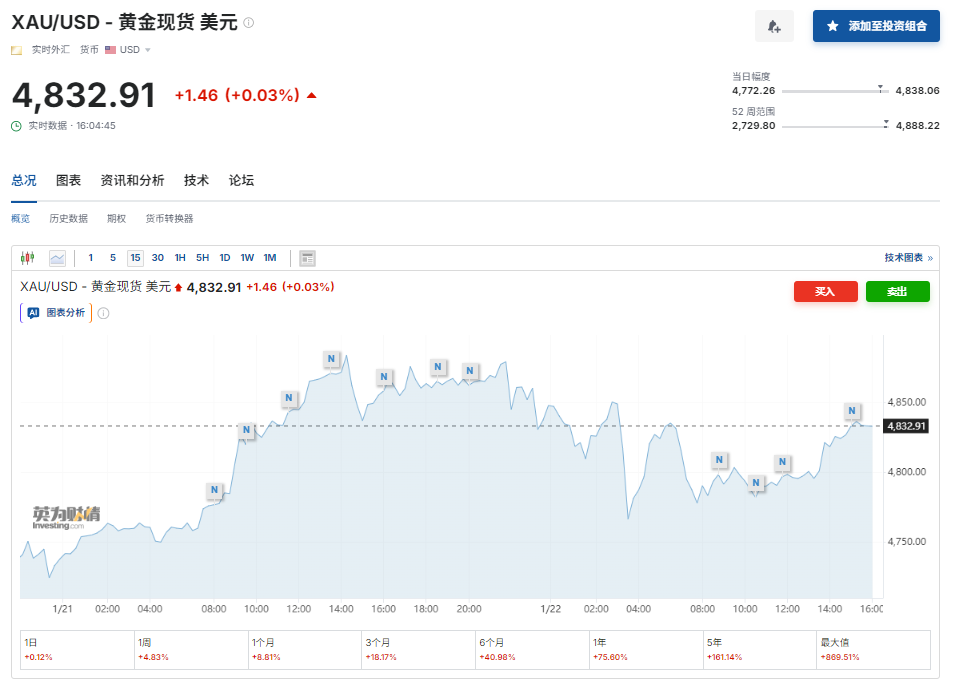
Core Viewpoint - The price of gold is expected to rise significantly, with Goldman Sachs raising its year-end forecast to $5,400 per ounce, reflecting strong demand from private investors and central banks [2][6]. Group 1: Price Trends - Gold prices have surged over 60% since 2025, marking the largest increase since 1979, despite some fluctuations this year [1]. - As of the latest report, gold prices are hovering around $4,830 per ounce, having increased approximately 11% this year and more than doubled since early 2023 when prices were around $1,865 per ounce [2][6]. - Analysts predict that gold prices will break the $5,000 mark this year due to declining real interest rates and ongoing diversification efforts away from the dollar [8][9]. Group 2: Demand Drivers - The demand for gold is being driven by private sector investments, with high-net-worth families purchasing physical gold and investors buying call options [6]. - Central banks are expected to average monthly gold purchases of 60 tons, as they diversify their assets and compete with private investors for limited gold supplies [6]. - The demand for gold as a hedge against global macroeconomic risks is anticipated to remain stable, with private investors showing increased "stickiness" in their positions [6]. Group 3: Supply Dynamics - The supply of gold remains stable, as the majority of gold already exists and new production accounts for only about 1% of the total global supply [7]. - Gold prices typically only stop rising when demand weakens, such as during geopolitical easing or when central banks feel less need to diversify [7]. Group 4: Market Sentiment - There is a growing optimism on Wall Street regarding gold prices, with analysts expecting a continued upward trend due to geopolitical tensions and the search for safe-haven assets [8][9]. - The London Bullion Market Association's survey indicates that analysts expect gold prices to reach $5,400 per ounce this year, reflecting a robust long-term trend rather than speculative peaks [9].