全球股市开门红

Search documents
如何看待本轮开门红的结构与延续性?
Sou Hu Cai Jing· 2026-01-12 00:17
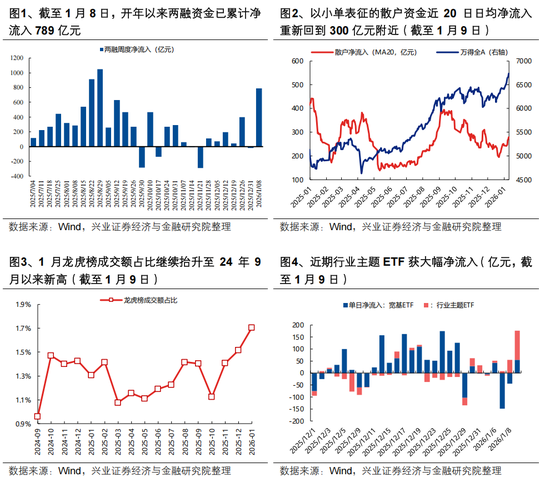
Group 1 - The recent "opening red" in the A-share market reflects a warming macroeconomic environment and ample liquidity, which supports market risk appetite and attracts incremental capital into the market, creating a positive feedback loop between capital inflow and market rise [1][18] - Various types of trading funds have shown signs of accelerated entry, including a net inflow of 78.9 billion yuan in margin financing since the beginning of the year, and daily net inflows of retail funds returning to around 30 billion yuan [1][6] - The consensus among different types of funds regarding the main themes has strengthened, focusing on sectors such as TMT (storage, AI applications), military industry (commercial aerospace), non-ferrous metals, new energy (controlled nuclear fusion), machinery (robots), and pharmaceuticals (innovative drugs, brain-machine interfaces) [6][13] Group 2 - The global stock markets are experiencing a strong start in 2026, driven by common macro and industrial narratives, with A-shares reflecting these global trends [13][18] - Key events such as geopolitical changes and new industrial trends are influencing the market, including the rise in resource strategic value due to geopolitical events in Venezuela and innovations showcased at the CES [13][18] - The recent "opening red" is characterized by concentrated hotspots and theme-driven trading, with upcoming earnings reports expected to play a significant role in market direction [33] Group 3 - The market is currently in a window where downside risks are limited, while there is significant potential for upside, supported by improved PMI and price data, as well as a favorable calendar effect in February [19][30] - The commercial aerospace sector has seen significant recent gains, but concerns about its current crowdedness and sustainability are emerging, especially with the upcoming earnings forecast disclosures [22][30] - The focus for future investments should include sectors with upward revisions in profit forecasts, particularly in technology, advanced manufacturing, cyclical industries, and consumer sectors [33][34]

兴证策略:如何看待本轮开门红的结构与延续性?
Xin Lang Cai Jing· 2026-01-11 10:28
Group 1 - The current market rally, referred to as "开门红," is supported by improving macroeconomic data and ample liquidity, which enhances market risk appetite and attracts new capital inflows [1][9][40] - Various types of trading funds have shown accelerated entry into the market, including a net inflow of 78.9 billion yuan in margin financing since the beginning of the year and an average daily net inflow of retail funds returning to around 30 billion yuan [1][9][40] - The structural consensus among different types of funds is strong, focusing on sectors such as TMT (storage, AI applications), military (commercial aerospace), non-ferrous metals, new energy (controlled nuclear fusion), machinery (robots), and pharmaceuticals (innovative drugs, brain-machine interfaces) [2][35][38] Group 2 - The global stock market is experiencing a strong start in 2026, driven by expectations of loose liquidity, geopolitical changes, and emerging industrial trends, with A-shares reflecting this global narrative [5][38] - Key events such as the International Consumer Electronics Show (CES) and geopolitical developments are catalyzing themes in the market, enhancing the strategic value of resource products and driving structural similarities across global markets [5][38] - The market is currently in a favorable position with limited downside risk and significant potential for upward movement, supported by improved PMI and price data, as well as a high percentage of stocks still below their previous highs [11][44] Group 3 - The recent surge in the commercial aerospace sector has raised concerns about its current crowding and sustainability, with trading volume indicating a potential for further upward movement [16][51] - As the earnings forecast disclosure period approaches, the correlation between stock prices and earnings will increase, necessitating a focus on structural adjustments based on performance [21][57] - Industries with significant upward revisions in profit forecasts since November include technology (consumer electronics, computing), advanced manufacturing (new energy, military), and cyclical sectors (building materials, non-ferrous metals) [26][58]