全球贸易环境修复

Search documents
广开首席产研院展望2026年全球经济金融趋势:世界经济面临“四重变局”
Sou Hu Cai Jing· 2026-02-09 09:27
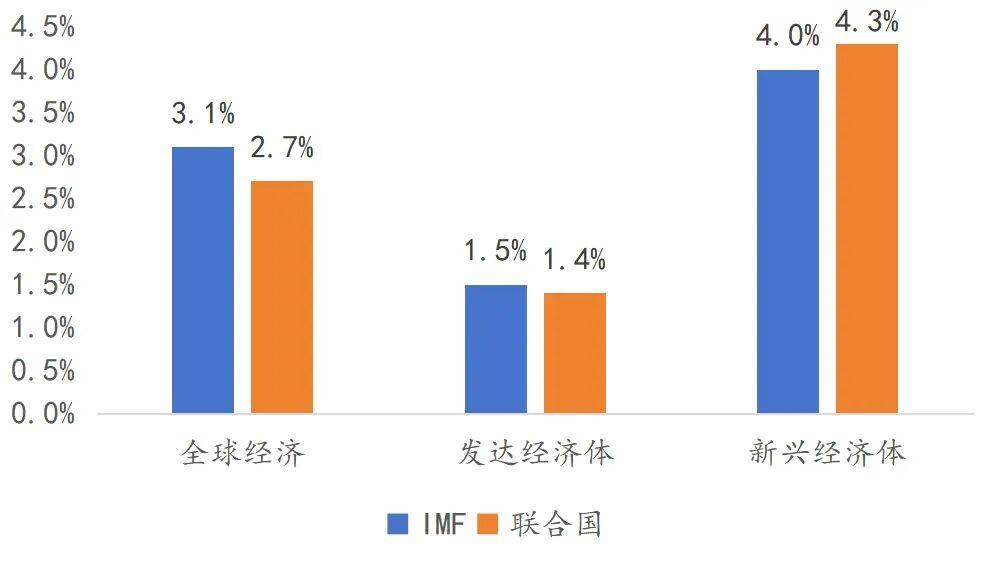
Group 1 - The global economy is expected to face challenges in 2026 due to geopolitical tensions, trade protectionism, and inflationary pressures, leading to a projected growth rate of 2.7%-3.1%, slightly down from 2025 [2][3] - Emerging economies, particularly in Asia, are anticipated to show stronger growth, with East Asia, South Asia, and Africa projected to grow at rates of 4.4%, 5.6%, and 4.0% respectively [3] - The U.S. economy is projected to grow at 1.8%-2.2%, while the Eurozone and Japan are expected to see much lower growth rates of 0.9%-1.2% and 0.7%-0.9% respectively, indicating a slowdown in developed economies [3][5] Group 2 - Inflation is expected to moderate globally, decreasing from 3.4% in 2025 to 3.1% in 2026, although some developed economies may still face inflationary pressures due to sticky service prices and delayed tariff impacts [5][6] - The Federal Reserve's monetary policy may experience significant volatility, with potential for both aggressive rate cuts and rapid shifts to rate hikes depending on inflation trends [7] Group 3 - U.S.-China trade relations are expected to enter a phase of relative easing in 2026, moving towards selective cooperation in non-sensitive areas, as indicated by recent U.S. policy adjustments [10][11] - China is actively promoting dialogue and cooperation in emerging industries, which may enhance bilateral trade interactions and stabilize economic expectations [11] Group 4 - The global trade environment is showing signs of structural recovery, with the U.S. likely to pragmatically adjust its trade protection measures and engage in multilateral cooperation [15][16] - "South-South trade" is expected to gain importance, with emerging economies seeking to reduce reliance on developed markets, projected to grow at 8% in 2025 and continue strengthening in 2026 [16][19] Group 5 - The international financial markets are anticipated to experience increased volatility, with U.S. stocks entering a phase of "structural bull market" characterized by high valuations and weak growth [20][21] - Emerging market stocks are expected to attract more investment due to favorable conditions such as a weaker dollar and improved trade environments, particularly in Asian economies [22] Group 6 - The U.S. dollar is projected to remain weak in 2026, influenced by rising government debt and a potential shift towards "de-dollarization" [23][25] - Non-dollar currencies are expected to show divergence, with the Chinese yuan likely to appreciate moderately against the dollar, while the euro and yen may experience fluctuations based on economic conditions [26] Group 7 - Gold prices are expected to remain strong amid geopolitical risks and a weakening dollar, with projections indicating a price range of $4,500 to $5,500 per ounce in 2026 [27]

2026年世界经济面临“四重变局”
Sou Hu Cai Jing· 2026-01-22 10:33
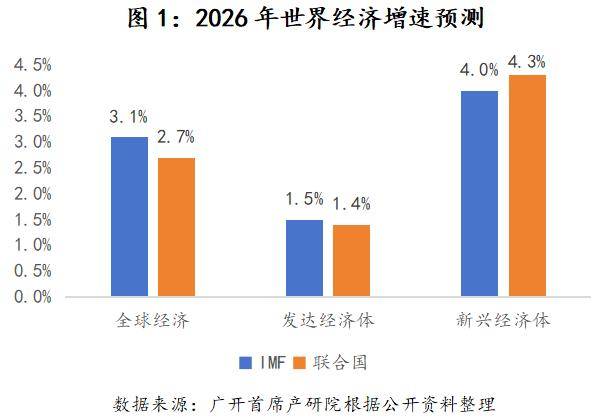
Group 1: Global Economic Outlook - In 2026, the global economy is expected to face challenges due to the implementation of "reciprocal tariffs," worsening trade conditions, increased foreign exchange market volatility, and escalating geopolitical conflicts, leading to a continued pressure on recovery [1] - Global economic growth is projected to slow down to approximately 2.7% to 3.1% in 2026, with emerging economies, particularly in Asia, showing stronger performance compared to developed economies [3] - Developed economies are anticipated to experience low growth rates, with the US projected at 1.8% to 2.2%, the Eurozone at 0.9% to 1.2%, and Japan at 0.7% to 0.9% [3] Group 2: Inflation and Monetary Policy - Global inflation is expected to moderate from 3.4% in 2025 to 3.1% in 2026, although some developed economies may still face inflationary pressures due to sticky service prices and delayed tariff impacts [6] - The Federal Reserve's monetary policy may face significant changes, with potential for both accelerated rate cuts and unexpected rate hikes depending on inflation trends [7] Group 3: US-China Trade Relations - The US-China economic relationship is likely to see a phase of easing in tensions, moving towards selective cooperation in non-sensitive areas, as indicated by recent US policy adjustments [11][12] - China is actively promoting dialogue and cooperation in emerging industries, which may help stabilize bilateral trade relations [12] Group 4: Global Trade Environment - The global trade environment is showing signs of structural recovery, with the US expected to pragmatically adjust its trade protection measures and engage in multilateral cooperation [17][18] - "South-South trade" is becoming increasingly important, with emerging economies seeking to reduce reliance on developed markets, projected to grow at 8% in 2025 and continue strengthening in 2026 [18] Group 5: Financial Market Dynamics - Global stock markets are expected to experience volatility, with US markets facing a "structural bull market" characterized by high valuations and weak growth [25] - Emerging markets are likely to attract more investment due to favorable conditions, including policy support and competitive advantages in labor and resources [27] Group 6: Currency and Commodity Trends - The US dollar is projected to remain weak due to various factors, including rising government debt and ongoing "de-dollarization" trends [28] - Gold prices are expected to experience high volatility but maintain an overall upward trend, driven by geopolitical risks and the weakening of the dollar [30]