公共数据管理

Search documents
“条条”为民生“事事”可感知——滨州坚持“服务发展、特色创新、务实管用、便民惠民”立法思路,推进政府立法十周年纪实
Xin Lang Cai Jing· 2025-12-28 15:18
Core Viewpoint - The article highlights the achievements of Binzhou in local legislation over the past decade, focusing on enhancing public data management, improving the business environment, and addressing local issues through innovative legal frameworks. Group 1: Legislative Achievements - Binzhou has enacted 17 government regulations in areas such as urban construction, ecological civilization, cultural heritage protection, and grassroots governance to support development [1] - The introduction of the "Binzhou Public Data Management Measures" in 2023 provides a legal framework for public data management, facilitating a comprehensive data sharing system [2] - The "Binzhou Engineering Construction Project Bidding Supervision Management Measures" aims to eliminate unfair bidding practices and enhance transparency in the bidding process [3] Group 2: Focus on Local Issues - The "Binzhou Measures for Ensuring Payment of Wages to Construction Workers" addresses the issue of wage arrears for migrant workers, establishing a comprehensive wage guarantee mechanism [4][5] - The "Binzhou Residential Fire Safety Management Measures" provides a framework for the maintenance and management of shared fire safety facilities, ensuring timely repairs and compliance [6] - The "Binzhou Urban Housing Safety Management Measures" establishes a lifecycle management system for urban housing, enhancing safety and accountability [8] Group 3: Enhancing Public Services - The "Binzhou Public Sports Facilities Management Measures" aims to improve the availability and quality of public sports facilities, promoting community health [9] - The "Binzhou Pre-Hospital Medical Emergency Service Management Measures" enhances the efficiency of emergency medical services, ensuring rapid response times [10] - The legislative efforts are aimed at improving the quality of life for residents by addressing their needs in education, healthcare, and housing [9]
“十四五”期间江苏全面深化改革开放取得新进展
Xin Hua Ri Bao· 2025-12-23 23:14
Core Insights - The article emphasizes the importance of reform and opening-up as a key driver for high-quality development in contemporary China, particularly in Jiangsu province, which has achieved significant milestones during the "14th Five-Year Plan" period. Group 1: Economic Development and Reform - Jiangsu has over 14.6 million business entities, with registered individual businesses exceeding 10 million, leading the nation [1] - The province's actual foreign investment during the "14th Five-Year Plan" period surpassed $119 billion, maintaining the top position in the country [1] - Jiangsu has focused on key areas for reform, enhancing the socialist market economy system and expanding international cooperation [1] Group 2: Domestic Market and Logistics - Jiangsu has strengthened the foundation for domestic circulation, actively participating in the construction of a unified national market [2] - The province has established 10 national logistics hubs and 8 national-level demonstration logistics parks, with logistics costs as a percentage of GDP reduced to 12.7%, 1.3 percentage points lower than the national average [2] - The Yangtze River Delta region has accelerated market integration through collaborative initiatives among Shanghai, Zhejiang, and Anhui [2] Group 3: Factor Market and Financial Support - Jiangsu has advanced the market-oriented allocation of factors, enhancing technological innovation, land utilization, talent attraction, and capital supply [3] - The province has seen a significant increase in social financing, with new loans ranking first nationally since 2022, and 256 new domestic listed companies established during the "14th Five-Year Plan" [3] Group 4: Data and Digital Economy - Jiangsu has pioneered a unified public data management model, registering 14,908 types of public data resources, the highest in the country [4] - The province has established a trading framework for data, including a data exchange and a unified platform system [4] Group 5: Quality and Efficiency of Business Entities - Jiangsu's business entities have shown renewed vitality, with state-owned enterprises investing a total of 670 billion yuan during the "14th Five-Year Plan," accounting for nearly one-sixth of provincial major project investments [5][6] - The province has achieved high-quality standards in manufacturing and public services, with quality indices ranking first nationally [6] Group 6: Open Economy and Investment Environment - Jiangsu has maintained its position as the top province for foreign investment, with a cumulative scale exceeding $119 billion during the "14th Five-Year Plan," representing about one-sixth of the national total [7] - The province has been recognized for its favorable business environment for five consecutive years, aiming to become a premier investment destination [7]
分类分级激活数据价值 西安出台公共数据管理办法
Zhong Guo Jing Ying Bao· 2025-12-14 05:37
Core Viewpoint - The Xi'an Municipal Government has issued the "Xi'an Public Data Management Measures," which will take effect on December 25, 2025, and will be valid for five years. The measures aim to standardize the management of public data, promote data sharing and utilization, and ensure data security [1]. Group 1: Public Data Definition and Scope - Public data refers to data generated by public management and service institutions during their lawful duties or provision of public services. This includes various public enterprises such as water, gas, heating, electricity, public transportation, communication, medical, education, and cultural tourism [2]. - The Xi'an Public Data Platform serves as the foundational data base for digital government construction, connecting various municipal departments and integrating data across national, provincial, municipal, and district levels. Local public management and service institutions are required to utilize this platform and refrain from establishing independent data platforms [2]. Group 2: Data Sharing and Open Access Principles - The measures outline principles and processes for public data sharing and open access, categorizing data into unconditional sharing, conditional sharing, and non-sharing. Public institutions must determine the sharing attributes scientifically and reasonably [3]. - For conditional sharing data, institutions must specify the sharing scope and usage conditions in the public data directory. Non-sharing data must also be justified in the directory with legal references [3]. - Different types of data have specific sharing rules and response timelines: unconditional sharing data must be responded to within one working day, while conditional sharing data has a response time of five working days, extendable by a maximum of ten days under special circumstances [3]. Group 3: Data Open Access Classification - Public data open access follows a classification system similar to sharing, divided into unconditional open access, conditional open access, and non-open access. Priority is given to data closely related to people's livelihoods and urgent social needs [3]. - Individuals and organizations can access data through the public data open platform, with unconditional open access data available directly, while conditional open access data requires initial and secondary reviews before use [3].
上海市普陀区印发《上海市普陀区公共数据管理办法》
Jing Ji Guan Cha Wang· 2025-09-26 01:48
Core Viewpoint - The Shanghai Putuo District Government has issued the "Public Data Management Measures" to enhance the lifecycle management of public data, promote high-quality supply and compliant circulation of public data resources, improve government governance capabilities and public service levels, and drive high-quality economic and social development as well as comprehensive digital transformation of the city [1] Summary by Relevant Sections - **Public Data Definition and Management Principles** - The measures provide a detailed definition of public data and outline the management principles that govern its lifecycle [1] - **Work Mechanism and Responsibilities** - The document specifies the work mechanisms and delineates responsibilities among various stakeholders involved in public data management [1] - **Governance and Registration** - It includes guidelines for governance, registration, sharing, opening, authorized operation, security management, and rights protection of public data [1] - **Implementation Timeline** - The measures will come into effect on October 3, 2025 [1]
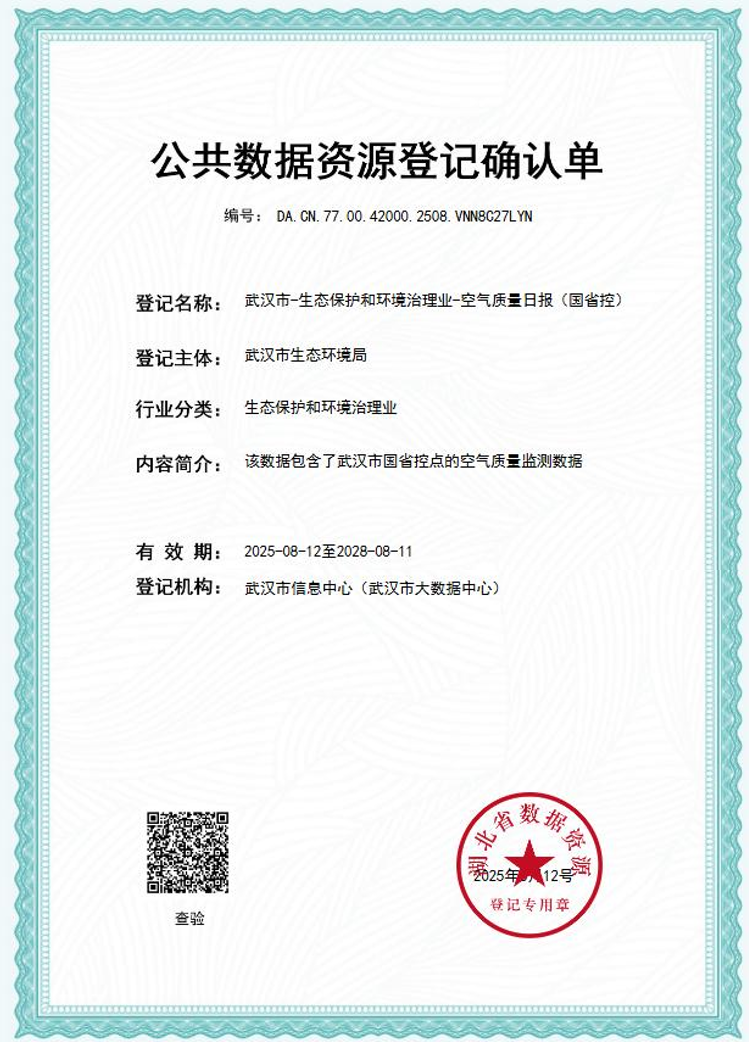
武汉空气质量数据有了“身份证”!全市首笔市级部门公共数据完成登记
Chang Jiang Ri Bao· 2025-08-12 08:22
Core Insights - Wuhan's ecological environment bureau has registered air quality daily data on the public data resource platform, marking a significant step in public data management and resource activation in the city [1][5]. Group 1: Data Registration and Accessibility - The registration of public data resources acts like an "ID card" for data, facilitating data circulation and ensuring clarity on data sources and usage [5]. - The registered dataset includes real-time monitoring information from 21 national and provincial monitoring stations, covering key pollutants such as PM2.5, PM10, sulfur dioxide, nitrogen dioxide, as well as the Air Quality Index (AQI) and air quality types [5][6]. - The initiative aims to resolve the difficulties faced by environmental enterprises and research institutions in accessing authoritative data [5]. Group 2: Impact on Industry and Technology - High-quality environmental monitoring data is essential for developing industry models, as noted by a technology executive from a local company [5]. - The unified registration and authorized opening of air quality data will support precise source tracing analysis, pollution warning system development, and specialized model development in the atmospheric environment sector [5]. - The availability of high-quality datasets is expected to enhance the resolution and accuracy of air quality forecasts and accelerate the training efficiency of pollution source tracing models, ultimately aiding local governments in pollution control [5]. Group 3: Future Developments - The registration of air quality data is just the beginning, with plans to progressively register more ecological environment data resources, including air and water quality [6]. - The city’s big data center will increase promotional efforts and continue to facilitate public data resource registration to enhance the value and efficient circulation of data elements [6].