公司治理透明度

Search documents
美高梅中国股价受母公司费用上调影响暴跌,机构关注股息政策
Jing Ji Guan Cha Wang· 2026-02-18 20:30
Core Viewpoint - The recent stock price volatility of MGM China (02282.HK) is directly related to the controversy surrounding the increase in licensing and branding fees imposed by its parent company, MGM International (MGM.N) [1] Group 1: Stock Price Movement - On December 29, 2025, Morgan Stanley reported that starting in 2026, MGM China will increase its licensing fee from 1.75% to 3.5% of monthly net revenue, resulting in an additional annual cost of HKD 1.2 billion [1] - Following this announcement, MGM China's stock price plummeted by 17%, closing at HKD 12.91, with a market value loss of approximately HKD 10.2 billion and trading volume surging to HKD 610 million, an increase of 8-9 times compared to usual [1] Group 2: Reasons for Stock Price Fluctuation - The fee increase is based on MGM China's performance improvement, with a projected 1.7 times increase in market share of total gaming revenue by 2025, reaching 16.2%, and a 1.6 times increase in adjusted EBITDAR to USD 1.203 billion [2] - The payment is directed to MGM B&D, a non-listed entity jointly owned by MGM International and Pansy Ho, with Citic Securities acknowledging the rationale behind the adjustment but noting insufficient communication exacerbated negative market sentiment [2] Group 3: Market Reaction - Morgan Stanley estimates that the increased fees will account for 15.2% of MGM China's EBITDA in 2026, significantly higher than competitors like Sands China (approximately 5%) and Galaxy Entertainment (zero), leading to valuation discounts [2] - Despite MGM China's price-to-earnings ratio being only 11.4 times (compared to Galaxy Entertainment's 17 times), investor sentiment remains cautious due to perceived prioritization of parent company interests [2] Group 4: Institutional Perspectives - Institutional focus has shifted to dividend policies, with Citic Securities suggesting that increasing the dividend payout ratio from 50% to over 53% could mitigate the impact of rising costs, which is considered a manageable threshold [4] - In January 2026, Macau's gaming revenue increased by 24% year-on-year to MOP 22.6 billion, with mass market revenue accounting for 70-75%, supporting the industry's fundamental profitability recovery [4] Group 5: Future Developments - The fee controversy highlights issues regarding corporate governance transparency, and further increases in licensing fees or unmet dividend expectations may continue to suppress valuations [5] - The Macau gaming industry faces macro risks such as regulatory policies and intensified competition [5]


中裕铁信IPO:毛利率逆势大涨,控制权高度集中下的上市疑云
Sou Hu Cai Jing· 2025-08-01 05:44
Core Viewpoint - The article discusses the challenges faced by Zhongyu Tiexin Transportation Technology Co., Ltd. in its pursuit of an IPO, highlighting concerns over its financial performance, governance structure, and the implications of its business model [1][3]. Group 1: IPO Journey - Zhongyu Tiexin's IPO journey has been tumultuous, initially applying for the ChiNext board in March 2023 with a fundraising plan of 550 million yuan, but failing to succeed [4]. - The company switched its sponsorship to Dongfang Securities in December 2023 and attempted to list on the Beijing Stock Exchange in early 2024, only to revert back to the ChiNext board by June 2025 [3][4]. Group 2: Business Fundamentals - Established in 1996, Zhongyu Tiexin specializes in transportation infrastructure products, with bridge bearings accounting for 57.04% of its 2024 revenue, making it highly dependent on national infrastructure investment [6]. - The company has a concentrated ownership structure, with the actual controller holding 85.99% of shares, raising concerns about minority shareholder interests [7][10]. Group 3: Financial Performance - In 2024, Zhongyu Tiexin reported a 26.56% decline in revenue to 700 million yuan, while net profit slightly decreased by 1.58% to approximately 98.71 million yuan [11][14]. - Despite the revenue drop, the company's gross margin increased to 37.66%, significantly higher than the industry average of 28.23% [11][12]. - The company's cash flow from operating activities surged by 1237.95% to 202 million yuan, contrasting sharply with the revenue decline [13]. Group 4: Operational Risks - The company faces high customer concentration, with the top five customers accounting for 62.54% of sales, exposing it to risks from fluctuations in demand [15]. - Accounts receivable constituted 40.70% of total assets by the end of 2024, indicating deteriorating collection capabilities [16]. Group 5: Governance and Related Party Transactions - Zhongyu Tiexin's complex network of related party transactions raises concerns, particularly following a 200 million yuan dividend payout in 2020, which was questioned due to the company's subsequent need for funds [19][21]. - The company has faced governance issues, including a lack of transparency in related party transactions and a history of internal control failures [19][21].


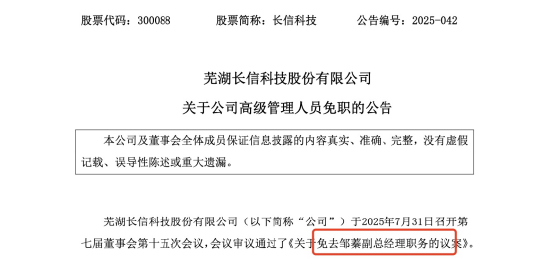
长信科技5年资深副总因“违纪”被免!狂揽特斯拉、华为订单,24年净利增47.7%,难掩治理透明度隐忧
Xin Lang Zheng Quan· 2025-07-31 08:00
Core Viewpoint - The sudden dismissal of Zou Zheng, the Vice President of Wuhu Changxin Technology Co., Ltd., raises concerns about potential undisclosed issues within the company, despite the firm stating that this will not adversely affect daily operations [2][3][4]. Company Overview - Wuhu Changxin Technology reported impressive financial results for 2024, with revenue reaching 11.058 billion yuan, a year-on-year increase of 24.4%, and a net profit of 357 million yuan, up 47.7% year-on-year [9]. - The company ranks third in net profit among domestic listed companies in the panel industry for 2022 and serves major global brands such as BOE, Tesla, BYD, Huawei, Apple, and Samsung [10]. Management and Governance - The dismissal of Zou Zheng, who joined the company in 2014 and became Vice President in August 2020, reflects the company's commitment to internal discipline and governance [3][11]. - The independent board's endorsement of the decision enhances the credibility of the company's governance processes [11]. Market Reaction and Future Outlook - The market's reaction to the dismissal indicates underlying investor concerns about transparency and potential risks, despite the company's strong performance and strategic ambitions [5][12]. - The company operates in both consumer electronics and automotive electronics sectors, indicating a broad business scope and future growth potential [11]. - The incident serves as a stress test for the company, highlighting the need for effective communication with investors to maintain trust and confidence in management stability and governance transparency [12].