
公园城市理念

Search documents
灵隐寺免票,是城市最好的投资
经济观察报· 2025-11-20 10:20
Core Viewpoint - The article discusses the implications of free public park access in cities like Hangzhou, Chengdu, and Beijing, emphasizing the shift from revenue generation to enhancing human happiness and urban quality of life [1][5]. Group 1: Free Park Access - Starting December 1, 2025, Hangzhou's Lingyin Feilai Peak Scenic Area will no longer charge an entrance fee, allowing visitors to access Lingyin Temple, Yongfu Temple, and Taoguang Temple for free, which previously cost 75 yuan [2]. - The decision to eliminate entrance fees reflects a long-term strategy, as seen in 2002 when West Lake removed barriers, leading to a significant increase in tourism revenue from 29.4 billion yuan in 2002 to 345 billion yuan in 2024 [3]. Group 2: Social and Economic Impact - Free access to parks removes financial barriers, allowing diverse populations to share public spaces, which promotes social equity and enhances community engagement [3]. - The money saved on entrance fees is likely to be redirected towards local businesses, such as dining and accommodations, transforming parks from profit centers into catalysts for local economic activity [3]. Group 3: Urban Management Challenges - The transition to free access presents challenges for urban management, including the need for effective visitor management systems, environmental maintenance, and transportation logistics [4]. - Successful management of these challenges requires a shift in focus from merely controlling visitors to providing services that enhance the visitor experience [4]. Group 4: Global Context and Urban Planning - The article highlights global examples of urban park management, such as London’s green belts and Tokyo’s disaster preparedness parks, illustrating that modern parks serve multiple functions beyond aesthetics [4]. - The concept of "park cities" in China aims to integrate green spaces into urban planning, emphasizing their role as essential infrastructure for sustainable urban development [4].


灵隐寺免票,是城市最好的投资
Jing Ji Guan Cha Wang· 2025-11-20 08:42
Core Insights - From December 1, 2025, the Lingyin Feilai Peak Scenic Area in Hangzhou will no longer charge an entrance fee, allowing visitors to access Lingyin Temple, Yongfu Temple, and Taoguang Temple for free with an online reservation, previously costing 75 yuan [1] - This decision, while appearing to forgo nearly 1 billion yuan in direct revenue, reflects a long-term strategy similar to the 2002 removal of entrance fees at West Lake, which led to a significant increase in tourism revenue from 29.4 billion yuan in 2002 to 345 billion yuan in 2024 [1] Group 1 - The removal of entrance fees is seen as a way to eliminate barriers, allowing diverse groups of people to share the same scenic resources, promoting social equity [1] - The shift from a profit-driven model to one that stimulates local consumption is highlighted, as visitors may spend their saved ticket money on local food, accommodation, and crafts [2] - The transformation of parks into consumption starting points rather than mere attractions is emphasized, with successful examples from cities like New York showcasing the value of increased foot traffic [2] Group 2 - The decision to eliminate entrance fees also poses challenges for urban management, requiring effective systems for crowd control, sanitation, and cultural preservation [2] - The modern park concept in cities worldwide has evolved to encompass ecological infrastructure that supports leisure, safety, and economic functions, moving beyond mere green spaces [2] - The current trend in Chinese cities towards park-centric urban development reflects a deeper understanding of urban planning, focusing on sustainable growth and human well-being rather than just economic metrics [3] Group 3 - The free access to parks raises fundamental questions about the purpose of urban development, emphasizing the importance of creating spaces that enhance human happiness rather than just numerical growth [3] - Young people are increasingly favoring cities with rich public spaces and cultural considerations, indicating a shift in urban desirability [3] - The removal of financial barriers to access is viewed as a significant step towards modern urban development that prioritizes human-scale experiences [3]
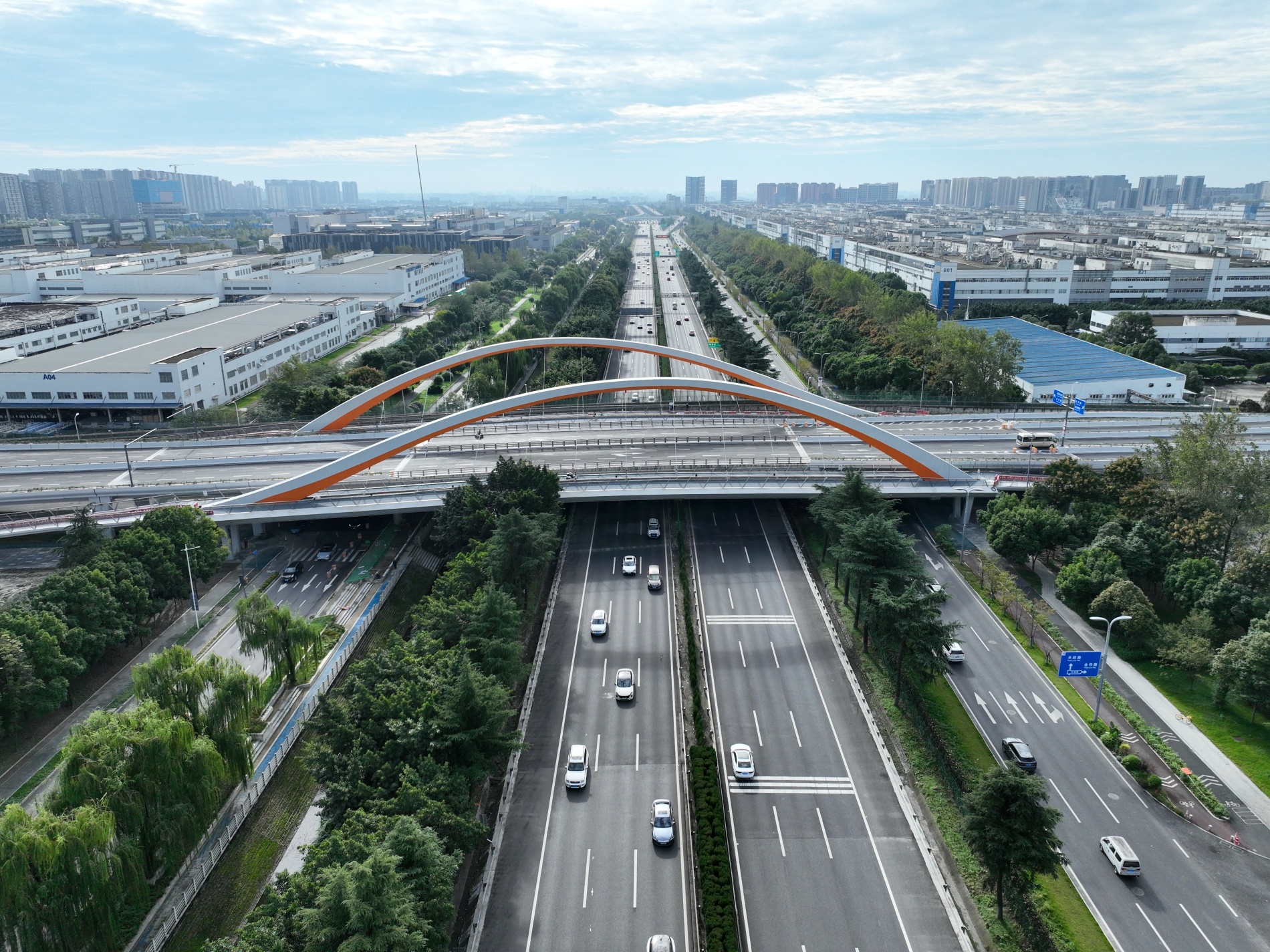
成都市天健路长跨线桥正式通车
Yang Shi Wang· 2025-10-14 11:22
Core Viewpoint - The opening of the Tianjian Road Long-span Bridge in Chengdu marks a significant upgrade in the regional transportation system, facilitating the city's goal of becoming a "Park City Intelligent Manufacturing Development Demonstration Zone" [1] Group 1: Project Overview - The Tianjian Road Long-span Bridge has a total length of 2.56 kilometers, with the main bridge length being approximately 1.72 kilometers, designed with inspiration from the "Egrets Spreading Wings" concept [1] - The bridge is constructed to a standard of four lanes in both directions, with additional ramps and pedestrian bridges to enhance traffic efficiency and safety [1] Group 2: Traffic Impact - The bridge will implement a "crossing over straight traffic + ground-level intersection" diversion model, effectively separating incoming and outgoing traffic, which will alleviate previous congestion issues [1] - The new infrastructure will facilitate quick connections to the Chengdu-Dujiangyan Expressway and improve the regional road network, promoting the flow of talent, goods, and information [1] Group 3: Project Management - The project team focuses on the core objectives of "implementing the Park City concept and enhancing street quality," employing technical measures to ensure quality and safety [2] - The team has proactively planned and utilized specialized schemes and meticulous management to strengthen quality assurance amidst various challenges [2]
临沂奥体:城市公园新样本
Da Zhong Ri Bao· 2025-08-01 02:15
Core Insights - The Linyi Olympic Sports Park represents a "3.0 version" of urban parks, integrating sports, culture, and commercial activities into a comprehensive cultural and sports service complex with a total investment of 8.5 billion yuan and covering an area of 1,218 acres [2][3] Group 1: Urban Park Evolution - Traditional urban parks have evolved from a single-function "1.0 version" to a more dynamic "2.0 version," and now to the "3.0 version" exemplified by Linyi Olympic Sports Park, which combines leisure, entertainment, sports, culture, and consumption [1][2] - The park's design includes a 200-acre active water lake, a multi-functional space that supports various activities beyond just leisure [2] Group 2: Economic Impact - The park has hosted over 60 events and more than 160 sessions since its opening in 2024, attracting over 1 million visitors and contributing over 500 million yuan to the local economy [4] - Major events, such as concerts, have significantly boosted local consumption, with a reported 300% increase in nearby restaurant revenues [4] Group 3: City Image Transformation - The successful hosting of high-profile events has transformed Linyi's image from a traditional logistics hub to a modern, culturally vibrant city, enhancing its appeal on social media and among residents [5] - The park serves as a platform for showcasing Linyi's organizational capabilities and cultural charm, marking a shift in public perception [5] Group 4: Community Engagement and Accessibility - The park has implemented a "triple flow rocket" model to convert transient visitors into long-term consumers, with various community events attracting over 310,000 participants [4][7] - Facilities are open for at least 8 hours daily during holidays and fitness days, ensuring accessibility for local residents to enjoy international-level amenities [7] Group 5: Integration of Urban Development Concepts - Linyi Olympic Sports Park embodies the "park city" concept, enhancing urban ecology and living environments by integrating commercial spaces, cultural venues, and natural landscapes [6][7] - The park promotes a harmonious coexistence of people, city, and nature, serving as a benchmark for measuring urban development in Linyi [7]
临沂| 临沂奥体:城市公园新样本
Da Zhong Ri Bao· 2025-08-01 01:40
Core Insights - The article highlights the transformation of Linyi's urban landscape through the establishment of the Linyi Olympic Sports Park, which integrates sports, culture, and commercial activities into a comprehensive community hub [3][4][5]. Group 1: Urban Development and Infrastructure - Linyi Olympic Sports Park represents a "3.0 version" of urban parks, with a total investment of 8.5 billion yuan and covering an area of 1,218 acres, redefining the traditional concept of sports centers [3][4]. - The park features a dual-axis structure with two main zones, combining venues, parks, and commercial spaces to meet community fitness and consumption needs [3][4]. - The park has successfully hosted over 60 events and more than 160 sessions since its opening in 2024, attracting over 1 million visitors and contributing over 500 million yuan to the local economy [5][6]. Group 2: Economic Impact and Community Engagement - The park's events, such as concerts and sports competitions, have significantly boosted local consumption, with a reported 300% increase in nearby restaurant revenues [5]. - The "three-tier flow rocket" model effectively converts transient visitor traffic into sustained economic activity, enhancing the local economy [5][6]. - Community engagement is fostered through various activities, with over 310,000 participants in events like the "Olympic Trend Festival" since its inception [8]. Group 3: Cultural and Social Significance - The park serves as a platform for high-profile events, elevating Linyi's image from a logistics hub to a modern, culturally vibrant city [6][7]. - The integration of cultural spaces, such as art galleries and non-heritage exhibition halls, promotes accessibility to cultural experiences for residents [7][8]. - The park embodies the "Park City" concept, enhancing urban ecology and living environments while promoting a harmonious relationship between people, the city, and nature [7][8].