农信机构改革

Search documents
中小银行整合加速推进
Jing Ji Ri Bao· 2025-12-11 21:34
Consolidation and Restructuring of Small and Medium Banks - The pace of mergers and restructuring among small and medium banks has accelerated, with over 300 banks completing mergers or dissolutions by December 8, 2025, including more than 100 village banks in the first three quarters [1] - Large commercial banks are increasingly involved in the "village-to-branch" transformation, with notable examples including the Industrial and Commercial Bank of China and Agricultural Bank of China acquiring village banks and converting them into branches [1][2] - The number of village banks is projected to decrease significantly, with 99 banks expected to close in 2024, accounting for nearly 50% of the total reduction in banking institutions [1] Rural Financial Institutions and Reforms - As of June 2025, the number of rural commercial banks in China was 1,505, a decrease of 58 from the previous year, while village banks saw a reduction of 98, indicating a trend towards consolidation [3] - The reform of rural financial institutions is gaining momentum, with several provinces establishing provincial-level rural commercial banks or cooperative banks, enhancing the integration of small banks into larger entities [2][3] Support for Agricultural Financing - The primary responsibility of rural small and medium banks is to support agriculture and small enterprises, with recent regulatory measures aimed at enhancing their role in rural financial services [4] - By the end of 2024, rural cooperative financial institutions are expected to have a total agricultural loan balance of 13.11 trillion yuan, serving nearly 44.94 million households [4] Risk Management and Governance - The Chinese government emphasizes the importance of risk management in the financial sector, particularly for small and medium banks, to prevent systemic risks [7][8] - Regulatory bodies are focusing on improving corporate governance within small banks, which is seen as crucial for achieving high-quality development and sustainability [8]



改革三年董事长谢幕 青农商行再陷“主场焦虑”
Hua Er Jie Jian Wen· 2025-12-02 04:59
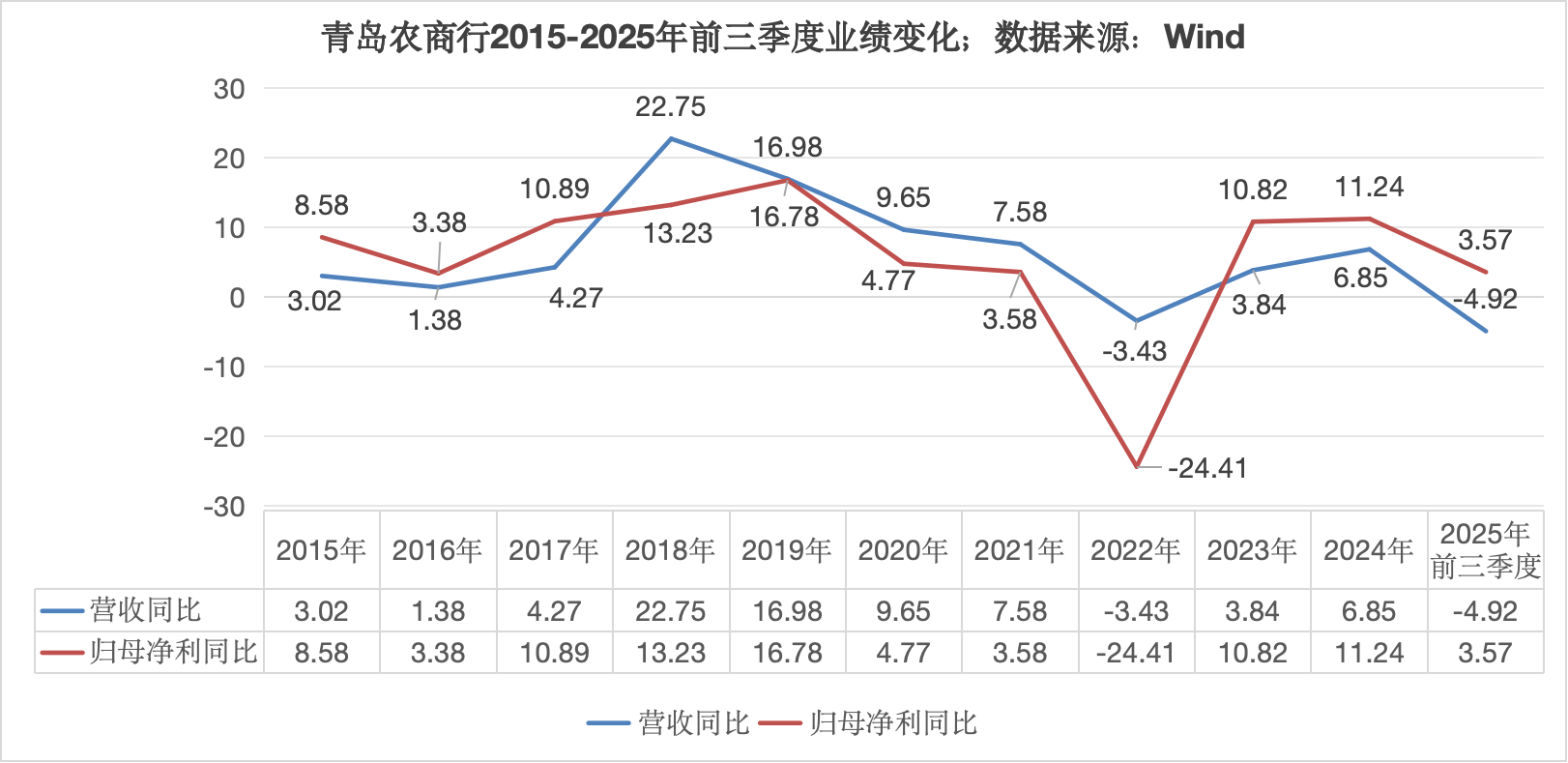
Core Viewpoint - The retirement of Wang Xifeng, chairman of Qingdao Rural Commercial Bank, after two years of leading the bank, has sparked discussions about the bank's compensation mechanism and performance during his tenure, particularly as the bank has transitioned from a significant performance decline to a stable profit growth phase [1][12]. Group 1: Performance and Financial Metrics - Upon taking over in 2022, Qingdao Rural Commercial Bank was facing a severe performance downturn, with profits declining over 20% year-on-year and incurring fines exceeding 70 million yuan due to poor management of real estate loans [1]. - By the first three quarters of 2025, despite a revenue decline of 4.92%, the bank achieved a profit growth of 3.57%, indicating some resilience in profitability [1]. - The bank's interest income contribution remained around 70% from 2020 to the first three quarters of 2025, although it has been declining due to market fluctuations and reduced credit income [5][8]. Group 2: Challenges and Competition - The bank faces significant challenges, including a real estate industry non-performing loan rate exceeding 20% and stagnant credit expansion, compounded by increasing competition from local banks like Qingdao Bank and Qilu Bank [2][12]. - Qingdao Rural Commercial Bank's loan market share and growth have been lackluster, with a mere 0.77% increase in loans compared to deposits, leading to a low loan-to-deposit ratio of 79.99% [8]. - The bank's asset quality is under pressure, with a non-performing loan rate of 1.73%, the worst among A-share city commercial banks, and a significant portion of its real estate loans facing risks [13]. Group 3: Strategic Direction and Expansion - The bank is focusing on expanding its operations beyond Qingdao, having opened 24 new branches outside the city and merged with five village banks to enhance its regional presence [17][18]. - The bank's strategy involves addressing internal challenges while navigating external competition, particularly as it seeks to establish a differentiated competitive edge in a saturated market [5][19]. - The management team, with an average age of 54, may face ongoing personnel changes that could impact strategic continuity, alongside potential regulatory changes affecting the bank's operational framework [20][22].