减少对华依赖

Search documents
柬副首相通告全球,减少对华依赖,转头发现,美军高速战舰抵云壤
Sou Hu Cai Jing· 2026-01-28 08:04
Group 1 - The article discusses Cambodia's complex diplomatic balancing act between the United States and China, highlighting recent developments in 2026 that showcase this tension [1][12][28] - The U.S. threatened to impose punitive tariffs of up to 49% on Cambodian exports due to trade deficits, which could lead to a GDP shrinkage of over 3% for Cambodia [5][7] - After negotiations, the tariffs were reduced to 19%, but Cambodia had to agree to unprecedented origin inspections and commit to purchasing $1.5 billion worth of U.S. products over three years [8] Group 2 - Cambodia's actions, such as the arrest of a notorious fraudster and the introduction of visa exemptions for Chinese citizens, indicate a strategic effort to maintain relations with China while appeasing the U.S. [14][16] - The Cambodian government confirmed an order for 20 Chinese C909 passenger aircraft valued at 5.4 billion yuan, reflecting its economic ties with China despite public statements of independence [16] - The presence of U.S. military vessels in Cambodia juxtaposed with the ongoing presence of Chinese naval ships illustrates the delicate geopolitical balance the country is trying to maintain [24][29]


德国财长找补:给稀土设置价格下限,不是对抗中国
Sou Hu Cai Jing· 2026-01-13 03:14
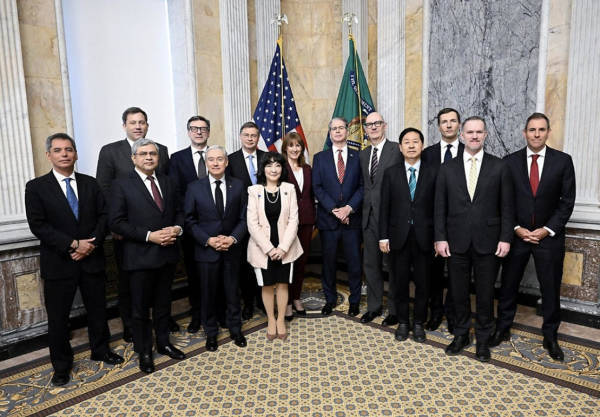
Group 1 - G7 countries are intensifying discussions on establishing a price floor for rare earth elements to reduce dependence on China, especially after recent retaliatory measures from China against the US and Japan [1][2] - The G7 finance ministers, led by US Treasury Secretary Janet Yellen, discussed mechanisms for minimum pricing of critical raw materials and the formation of trade alliances during a high-level meeting [1][5] - The meeting highlighted the urgency for G7 nations to collaborate on securing strategic rare earth supplies, with a focus on reducing reliance on China [1][5] Group 2 - Germany's Finance Minister Lars Klingbeil emphasized that the proposed price floor mechanism would provide clear market price expectations and weaken the influence of countries attempting to manipulate market prices [1][2] - The discussions are still in early stages, with many unresolved issues, and future negotiations will involve foreign and energy ministers [2] - The US is pushing for accelerated solutions to rare earth supply issues, but other G7 countries have shown less urgency, leading to frustration from US officials [5][7] Group 3 - The US has signed a key minerals cooperation agreement with Australia, valued at $8.5 billion, aimed at breaking China's dominance in the sector [6] - Recent Chinese export restrictions on rare earths to Japan could significantly impact Japanese manufacturers, who are heavily reliant on Chinese supplies for electronics and semiconductors [7] - China's stance on maintaining stability and security in the global supply chain for critical minerals remains unchanged, asserting that all parties have a responsibility to contribute constructively [7]
“硅谷入局,想撼动中国主导?”
Guan Cha Zhe Wang· 2025-12-10 14:35
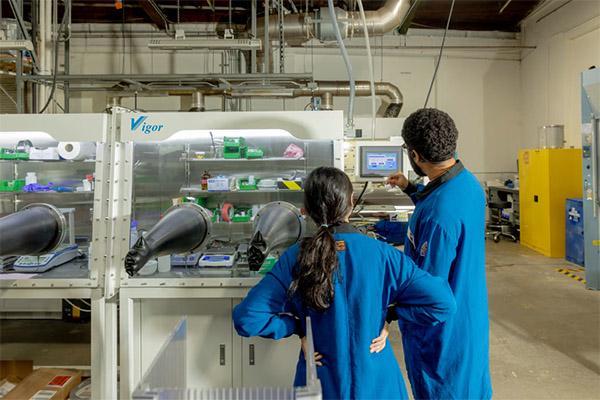
Core Viewpoint - The article discusses how American companies, particularly a startup named Brimstone, are attempting to process diabase to reduce reliance on critical minerals imported from China, aiming to produce aluminum, magnesium, and other essential minerals [1][4]. Group 1: Company Initiatives - Brimstone, founded in 2019, has raised over $80 million from investors including Amazon and Bill Gates, and is working on a proprietary chemical process to extract minerals from diabase [1]. - The company claims its method can produce multiple minerals from the same rock, with costs approximately 40% lower than traditional methods, and anticipates energy costs could decrease by 30% to 50% upon full production [1]. - Currently, Brimstone is in the laboratory phase and has not yet established a facility for industrial-scale production, with no timeline for construction [1]. Group 2: Industry Context - The U.S. has limited aluminum ore reserves, meeting less than 17% of its demand, and relies heavily on China for titanium and magnesium, which are critical for various industries [4]. - Previous attempts by the U.S. to establish a competitive supply chain for critical minerals have largely failed, with most of the 54 minerals classified as critical by the U.S. Geological Survey being dependent on imports [4]. - In 2023, venture capital investments in U.S. critical mineral startups reached a record $600 million, reflecting increased funding from both the government and private investors [5]. Group 3: Technological Developments - Some researchers are applying mathematical models from autonomous vehicle development to mineral exploration, while others are using AI to enhance exploration success rates [6]. - Companies like Milvus Advanced are developing lab-synthesized alternatives to critical minerals using machine learning, claiming to produce alloys at costs at least 70% lower than market prices [6]. - Experts express skepticism about the feasibility of these startups, citing a shortage of skilled labor in the industry as a significant barrier to success [6].
中国升级稀土管制,为何欧盟感到深深寒意?
Sou Hu Cai Jing· 2025-10-13 12:11
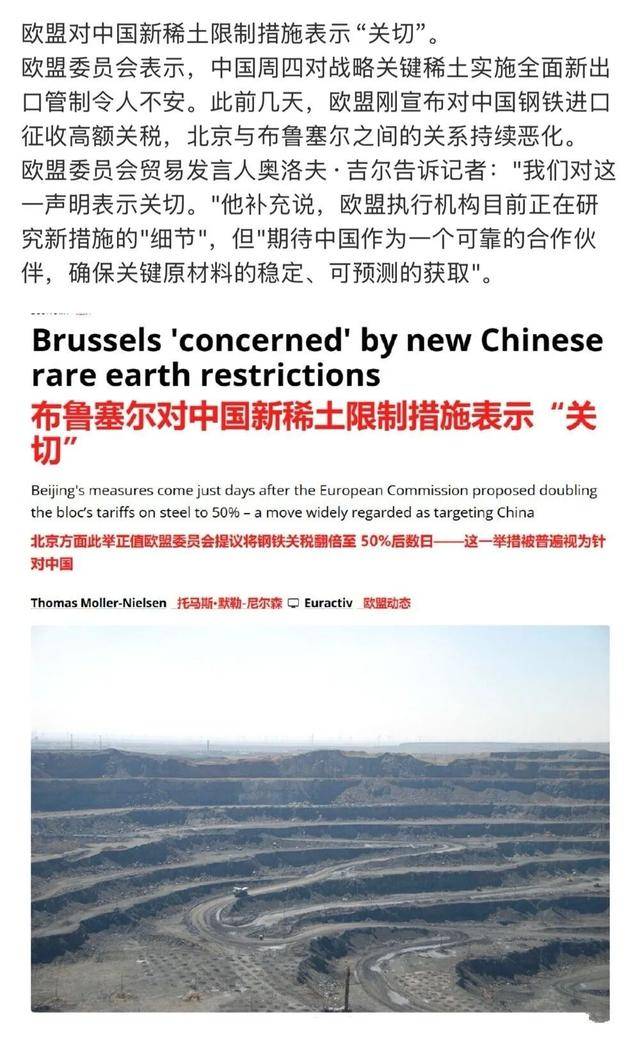
Core Viewpoint - The European Union (EU) expresses deep concern over China's recent rare earth export control measures, indicating anxiety about the impact on European industries [1][4]. Group 1: EU's Response and Position - The EU's trade spokesperson emphasizes the expectation for China to act as a reliable partner, revealing a sense of helplessness in their response [4]. - The EU had recently imposed a 50% tariff on Chinese steel and reduced quotas by 45%, indicating a confrontational stance towards China, which was countered by China's rare earth export controls [4][10]. - The EU's attempt to impose price controls on Chinese rare earths was preempted by China's actions, showcasing a strategic advantage for China in this trade conflict [4][6]. Group 2: China's Strategy and Implications - China's export control policy signals a clear message: compliance with demand reporting will be rewarded, while attempts to resell to the U.S. will result in supply cuts [6]. - The EU is heavily reliant on China for rare earths, with over 90% of its supply coming from China, making it difficult for Europe to find alternatives in the short term [6][7]. - China's control over the entire rare earth supply chain positions it as a "global distributor," complicating the EU's ability to negotiate effectively [14]. Group 3: Future Dynamics and Industry Impact - The competition over rare earths is expected to escalate, with potential for increased geopolitical tensions and conflicts among EU member states over access to these resources [9][16]. - The EU's dual approach of seeking to reduce dependency on China while simultaneously relying on Chinese supplies reflects a contradiction in its policy [10][12]. - In the long term, China's strategic use of rare earths could lead to significant shifts in global supply chains, impacting industries reliant on these materials, such as defense and technology [16][18].
德国嫌自己困难不够多,主动找上了印度
Hu Xiu· 2025-09-15 06:34
Group 1 - The core viewpoint of the article emphasizes Germany's shift in foreign policy, focusing on reducing dependence on China and fostering partnerships with countries like India, Indonesia, and Japan to enhance security and economic resilience [1][7][8] - Germany's Foreign Minister Wadephul has made two recent trips to Asia, specifically to Japan, Indonesia, and India, indicating a strategic pivot towards these nations [2][3] - The article highlights the geopolitical and economic significance of Japan, Indonesia, and India, noting their roles as key partners in Germany's efforts to diversify trade and supply chains away from China [5][6] Group 2 - The article discusses the complexities in the bilateral relationships between China and Japan, China and Indonesia, and China and India, pointing out unresolved issues that could affect Germany's strategic interests [4] - It notes that Germany views these three countries as critical partners in its "De-Risking" strategy to reduce reliance on China, reflecting a broader trend of seeking diversified international relationships [7][8] - The article raises concerns about the potential risks associated with Germany's partnership with India, including India's strategic autonomy and its historical ties with Russia, which may complicate Germany's objectives [25][32][34] Group 3 - The article outlines India's strategic importance as a rising power, emphasizing its economic growth, demographic advantages, and its role as a balancing force in the Indo-Pacific region [14][16][42] - It discusses India's diplomatic approach of maintaining strategic autonomy, which poses challenges for Western countries, including Germany, in fully aligning with India's geopolitical strategies [15][46] - The article warns that while India is seen as a potential ally against China, there are underlying concerns about India's future trajectory and its ability to become a competitor similar to China [42][44][52]