
分散持仓

Search documents
绩效新规下,公募基金经理的“最大化薪酬打法”
Hua Er Jie Jian Wen· 2025-12-26 01:51
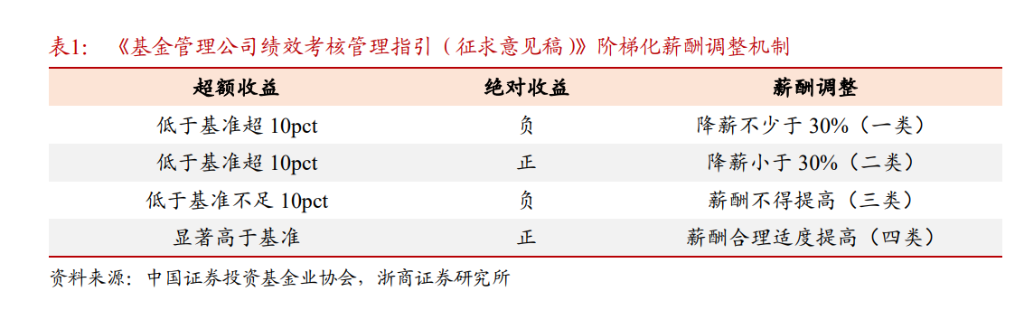
Core Insights - The new regulations linking fund manager compensation to long-term performance have become a central issue in the public fund industry, emphasizing the need to maximize market outperformance while minimizing the risk of salary reductions [1] Group 1: Performance Assessment and Compensation - The new performance assessment system has established a "tiered salary adjustment mechanism," directly linking fund manager compensation to the rolling performance of the funds they manage over the past three years [1] - If a fund's performance lags the benchmark by more than 10 percentage points and has a negative profit margin, the performance compensation must decrease significantly, by no less than 30% [1][2] - The report indicates that this rigid constraint requires fund managers to pursue relative returns while tightly controlling downside risks, particularly avoiding significant underperformance against benchmarks [1] Group 2: Market Conditions and Fund Performance - The ability of funds to outperform benchmarks is closely tied to macroeconomic conditions, with data showing that the proportion of ordinary equity funds underperforming benchmarks from 2022 to 2025 fluctuated significantly [3] - In 2024, the market's rolling annualized growth rate was the lowest at 11.6%, corresponding to the highest underperformance rates for funds, reaching 72.3% [3] - Interestingly, the first year of a bear market (2022) saw the highest outperformance rates due to prior bull market performance supporting results [3] Group 3: Fund Types and Performance - Active management funds have a significantly higher underperformance rate compared to quantitative funds, with active funds showing underperformance rates of 6.2%, 48.1%, 74.5%, and 50.0% from 2022 to 2025, while quantitative funds had lower rates of 3.5%, 39.4%, 52.3%, and 27.1% [5] - The report attributes the better performance of quantitative funds to their highly diversified holdings and systematic trading strategies, which mitigate irrational behavior and individual stock risks [6] Group 4: Diversification and Fund Size - The report highlights that funds with more than 200 stocks in their portfolio and a maximum weight of the largest holding below 2% have lower underperformance rates compared to the overall market [10] - Funds with over 500 stocks show even better performance, completely outperforming benchmarks in weaker market conditions from 2022 to 2023 [10] - Fund size is inversely related to underperformance rates, with larger funds (over 5 billion) consistently showing lower underperformance rates compared to smaller funds [16][18] Group 5: Manager Stability and Performance - The frequency of fund manager changes significantly impacts long-term performance, with funds that frequently change managers exhibiting higher underperformance rates [22] - Conversely, funds with stable management teams tend to have lower underperformance rates, benefiting from consistent investment strategies and reduced transaction costs [22] Group 6: Benchmark Changes and Risk Management - Changing performance benchmarks can effectively reduce compensation risk, as funds that adjust their benchmarks show lower significant underperformance rates, which are critical for avoiding salary reductions [19] - Selecting a benchmark that aligns with the fund manager's investment strategy is crucial for managing relative performance and compensation under the new regulations [19]


侃股:分散持仓可有效应对热点快速轮动
Bei Jing Shang Bao· 2025-12-03 10:04
Core Viewpoint - The rapid rotation of hot sectors in the A-share market necessitates a diversified investment strategy to mitigate risks and avoid significant losses from chasing trends [1][2][3]. Group 1: Market Dynamics - The frequent rotation of hot sectors is a result of capital flowing between different segments of the market, making it challenging for retail investors to chase these trends effectively [1]. - Investors may find themselves in a vicious cycle of buying high and selling low due to the quick changes in market sentiment, leading to amplified losses [1][2]. Group 2: Diversification Strategy - A diversified holding strategy is essential for risk management, adhering to the principle of not putting all eggs in one basket, which helps to cushion against significant losses from any single sector [2]. - Diversification allows investors to maintain a balanced portfolio, where the performance of non-hot sectors can stabilize overall returns during market adjustments [2][3]. Group 3: Psychological Benefits - Diversification aids in maintaining a calm investment mindset, reducing anxiety and panic that can arise from rapid market fluctuations [2]. - By focusing on a broader perspective rather than short-term volatility, investors can make more rational decisions and avoid emotional trading mistakes [2].