
基金跑输率

Search documents
绩效新规下,公募基金经理的“最大化薪酬打法”
Hua Er Jie Jian Wen· 2025-12-26 01:51
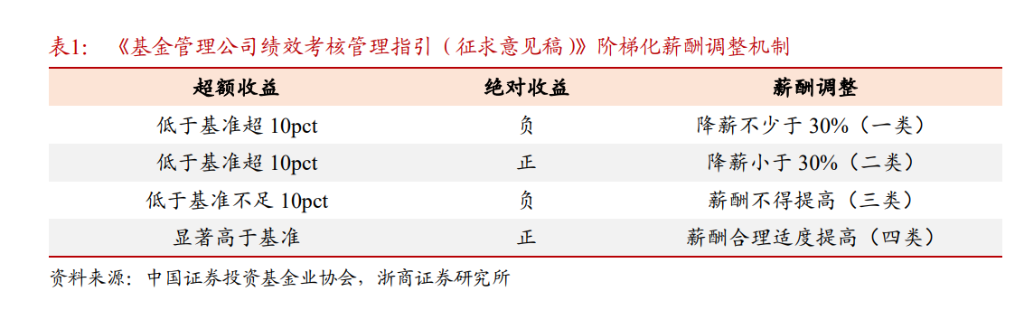
Core Insights - The new regulations linking fund manager compensation to long-term performance have become a central issue in the public fund industry, emphasizing the need to maximize market outperformance while minimizing the risk of salary reductions [1] Group 1: Performance Assessment and Compensation - The new performance assessment system has established a "tiered salary adjustment mechanism," directly linking fund manager compensation to the rolling performance of the funds they manage over the past three years [1] - If a fund's performance lags the benchmark by more than 10 percentage points and has a negative profit margin, the performance compensation must decrease significantly, by no less than 30% [1][2] - The report indicates that this rigid constraint requires fund managers to pursue relative returns while tightly controlling downside risks, particularly avoiding significant underperformance against benchmarks [1] Group 2: Market Conditions and Fund Performance - The ability of funds to outperform benchmarks is closely tied to macroeconomic conditions, with data showing that the proportion of ordinary equity funds underperforming benchmarks from 2022 to 2025 fluctuated significantly [3] - In 2024, the market's rolling annualized growth rate was the lowest at 11.6%, corresponding to the highest underperformance rates for funds, reaching 72.3% [3] - Interestingly, the first year of a bear market (2022) saw the highest outperformance rates due to prior bull market performance supporting results [3] Group 3: Fund Types and Performance - Active management funds have a significantly higher underperformance rate compared to quantitative funds, with active funds showing underperformance rates of 6.2%, 48.1%, 74.5%, and 50.0% from 2022 to 2025, while quantitative funds had lower rates of 3.5%, 39.4%, 52.3%, and 27.1% [5] - The report attributes the better performance of quantitative funds to their highly diversified holdings and systematic trading strategies, which mitigate irrational behavior and individual stock risks [6] Group 4: Diversification and Fund Size - The report highlights that funds with more than 200 stocks in their portfolio and a maximum weight of the largest holding below 2% have lower underperformance rates compared to the overall market [10] - Funds with over 500 stocks show even better performance, completely outperforming benchmarks in weaker market conditions from 2022 to 2023 [10] - Fund size is inversely related to underperformance rates, with larger funds (over 5 billion) consistently showing lower underperformance rates compared to smaller funds [16][18] Group 5: Manager Stability and Performance - The frequency of fund manager changes significantly impacts long-term performance, with funds that frequently change managers exhibiting higher underperformance rates [22] - Conversely, funds with stable management teams tend to have lower underperformance rates, benefiting from consistent investment strategies and reduced transaction costs [22] Group 6: Benchmark Changes and Risk Management - Changing performance benchmarks can effectively reduce compensation risk, as funds that adjust their benchmarks show lower significant underperformance rates, which are critical for avoiding salary reductions [19] - Selecting a benchmark that aligns with the fund manager's investment strategy is crucial for managing relative performance and compensation under the new regulations [19]


从2022-2025年样本的回测与模拟中找出的九规律:股票基金经理如何最大化跑赢率,最小化薪酬调整风险?
ZHESHANG SECURITIES· 2025-12-25 09:32
Group 1 - The report highlights a new tiered performance compensation adjustment mechanism for public fund managers, linking their pay directly to fund performance over the past three years [8][10][11] - A profile of stock funds with higher outperformance rates is depicted, emphasizing the importance of appropriate performance benchmarks, lower stock concentration, larger fund sizes, and higher manager tenure stability [1][12] - The backtesting results show that the proportion of funds underperforming the benchmark is directly related to market conditions, with significant variations observed from 2022 to 2025 [12][24] Group 2 - Active funds have a higher underperformance rate compared to quantitative funds, indicating that quantitative strategies may provide better risk management through diversified holdings [18][19] - Non-market funds exhibit higher underperformance rates than market funds, particularly in fluctuating market conditions, suggesting that concentrated strategies may lead to missed opportunities [24][25] - Funds with more diversified holdings (over 200 stocks) show lower underperformance rates, reinforcing the idea that diversification can mitigate risks associated with individual stock volatility [35][36] Group 3 - Fund size is inversely correlated with underperformance rates, with larger funds generally exhibiting lower rates of underperformance compared to smaller funds [38][39] - Changing performance benchmarks can significantly reduce the rate of significant underperformance, highlighting the importance of selecting optimal benchmarks in the context of new regulations [24][38] - The report notes that funds with a high concentration in a single industry but benchmarked against broad indices tend to underperform, emphasizing the need for appropriate benchmark selection [32][34]