
创新药出海模式

Search documents
GIC与AZ双重押注,和铂医药-B(2142.HK)凭什么成为创新药赛道"稀缺资产"?
Ge Long Hui· 2025-09-03 01:43
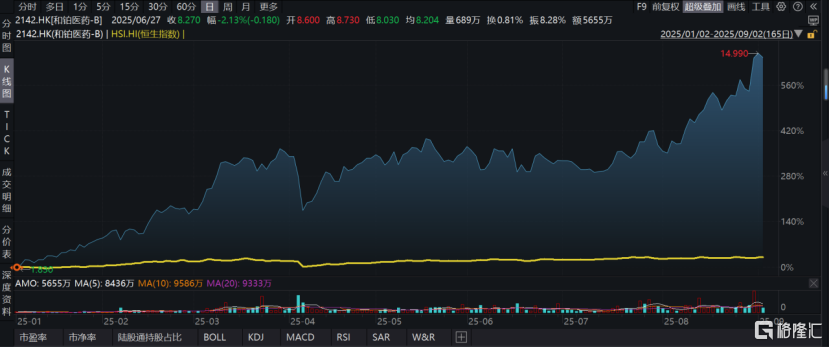
Core Viewpoint - The Chinese innovative drug industry is experiencing a significant moment in 2025, driven by strong policy support and frequent License-out transactions, making it one of the hottest sectors in the capital market. HBM Holdings Ltd. (2142.HK) stands out with a remarkable stock price increase of 691.94% year-to-date as of September 2, 2025, due to its unique antibody technology platform and international collaborations [1][4]. Company Performance - HBM Holdings Ltd. reported a mid-year profit growth exceeding 50 times, attracting interest from top sovereign funds. The Government of Singapore Investment Corporation (GIC) invested approximately HKD 511 million to acquire 45.02 million shares, increasing its stake from 1.62% to 6.37% [1][4][8]. - Earlier in March 2025, AstraZeneca also made a strategic investment in HBM, acquiring 9.15% of newly issued shares at a price of approximately HKD 10.74 per share, representing a 37.2% premium over the closing price on the day of the agreement [1][11]. Investment Trends - GIC's investment is seen as a long-term commitment to the innovative drug sector, reflecting confidence in the underlying value and future growth potential of HBM. This investment is not merely financial but a strategic vote of confidence in the company's business model and platform value [7][9]. - The trend indicates a shift in valuation logic for Chinese innovative drug companies, moving from pipeline-based valuation to platform technology and business model-centric pricing [17]. Strategic Collaborations - HBM has established a unique value creation system through a three-dimensional cooperation model involving technology licensing, joint development, and equity investment, completing over 40 business development (BD) collaborations since its inception. The total amount of external cooperation has surpassed USD 6 billion in 2025 [11][12]. - The company is evolving towards a more comprehensive "antibody+" strategic ecosystem, aiming to transform into a top-tier platform-based pharmaceutical enterprise by 2028 [12][16]. Market Outlook - Several brokerage firms are optimistic about HBM's future, with East China Securities predicting revenues of USD 154 million, USD 110 million, and USD 144 million for 2025-2027, respectively, alongside net profits of USD 82 million, USD 47 million, and USD 63 million [12]. - The capital market's enthusiastic response is attributed to HBM's robust technology and clear BD strategy, which have garnered recognition from industry giants like AstraZeneca and GIC [16].

关税扰动下,如何布局医药板块
2025-06-18 00:54
Summary of Conference Call on Pharmaceutical Sector Industry Overview - The conference call focuses on the pharmaceutical sector, particularly the impact of tariffs on innovative drugs and the performance of traditional Chinese medicine (TCM) [1][2][5]. Key Points and Arguments Impact of Tariffs on Innovative Drugs - Innovative drugs are minimally affected by tariffs due to the "borrowing ship" model, which allows companies to avoid customs duties by licensing patents to U.S. firms [2]. - For example, even with a 100% tariff on certain oncology products from Hehuang Pharmaceutical, the valuation impact is only 1% to 2% [1][2]. Future Development of Innovative Drug Sector - The future growth of the innovative drug sector relies heavily on business development (BD) logic. The second half of 2025 may see a divergence in market performance, with companies that can deliver on BD continuing to rise, while those that cannot may face declines [3][4]. - A significant increase in conflict of interest agreements is expected in 2025, which will transition into service contracts requiring about two quarters to digest, indicating sustained BD activity throughout the year [4]. Export Dynamics - China's exports of pharmaceutical products to the U.S. are relatively low, with medical devices and diagnostic reagents making up over 30% of total exports, while ordinary drugs account for less than 20% [5]. Performance of Traditional Chinese Medicine (TCM) - The TCM market is showing signs of improvement in Q2 2025, with the high base effect from Q1 diminishing. The third quarter is expected to see accelerated performance due to a lower base from the previous year’s anti-corruption measures in healthcare [6]. - Key stocks to watch include Zhaoli Pharmaceutical, which has a high degree of certainty in procurement and performance completion [6]. Biopharmaceutical Sector Stability - The biopharmaceutical sector, particularly vaccines and blood products, is expected to maintain stable growth. Investors are encouraged to focus on the long-term potential of these companies based on their existing business foundations [3][8]. Additional Important Insights - The overall valuation in the innovative drug sector is currently around three times price-to-sales (PS) ratio, with expectations to correct to five times PS, indicating significant upside potential [4]. - Retail performance for TCM products is strong, with notable sales growth for products like Ma Ying Long hemorrhoid ointment and Yunnan Baiyao's Qi Xue Kang [6]. This summary encapsulates the key insights from the conference call regarding the pharmaceutical sector, highlighting the resilience of innovative drugs against tariffs, the promising outlook for TCM, and the stability of the biopharmaceutical industry.