券商佣金反内卷

Search documents
沪上A股平均佣金率跌破万2,行业反内卷呼声强烈
Sou Hu Cai Jing· 2025-11-18 01:33
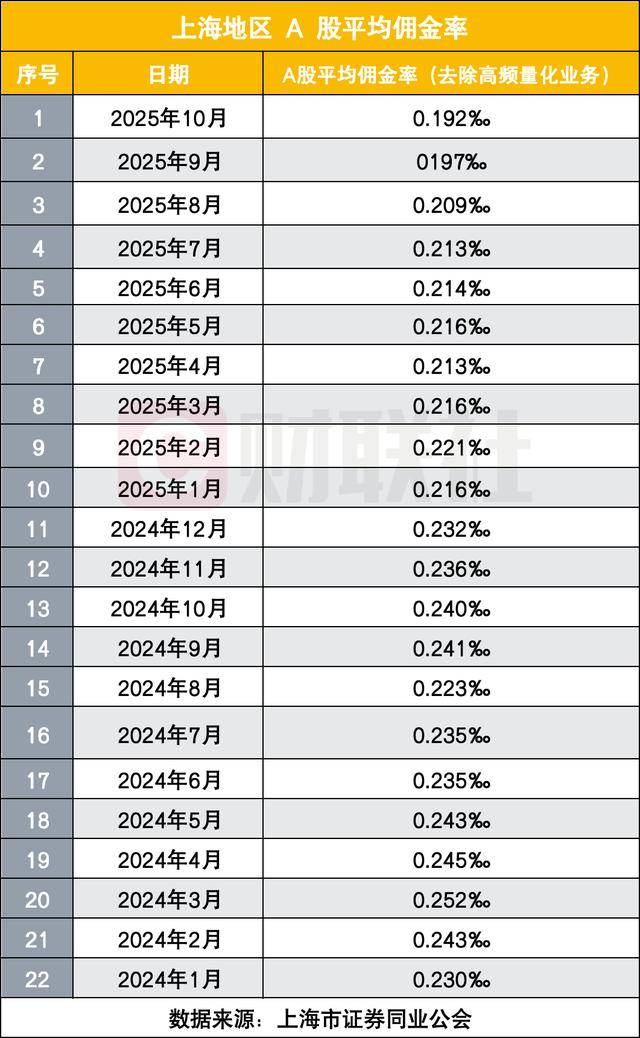
Core Viewpoint - The average commission rate for A-shares in Shanghai has dropped to 0.192% in October, marking the second consecutive month below the 0.2% threshold, indicating a significant decline in commission rates within the industry [1][2]. Summary by Sections Commission Rate Trends - The average commission rate for A-shares in Shanghai fell to 0.192% in October, down from 0.197% in September, continuing a downward trend [2][3]. - The average commission rate for 2024 is projected at 0.223%, which is a 5.9% decrease compared to 2023, while the October rate represents a 16% drop from the 2024 average [1][2]. Composition of Commission Rates - The reported commission includes both the net commission received by brokers and transaction fees, with the latter accounting for approximately 0.0641% of the total [4]. - After deducting the fixed transaction fees, brokers are left with an effective net commission of about 0.013% [4]. Competitive Landscape and Industry Response - The intense competition has led to many brokers offering commissions as low as 0.008% for new accounts, with ETF trading commissions dropping to 0.005% [5]. - The industry is experiencing a shift where brokers are increasingly relying on low commissions to attract clients, leading to a phenomenon of "internal competition" among firms [5]. - There are calls within the industry for a return to rational competition, as the ongoing price war is seen as detrimental to the overall health of the sector [5]. Transformation Strategies - Brokers are exploring various strategies to adapt to the declining commission rates, including enhancing advisory services, leveraging financial technology, and optimizing operations to reduce costs [6]. - The focus is shifting from price competition to service differentiation, with an emphasis on professional capabilities such as investment advisory, product selection, and risk management [6]. - Some firms are already implementing changes, such as strengthening research capabilities and adopting digital service models to improve customer experience and retention [6].

禁“万1免5,券商佣金反内卷传闻刷屏,真相如何?
3 6 Ke· 2025-09-30 03:25
Core Viewpoint - The rumors regarding the regulatory requirements for brokerage commission "anti-involution" have sparked significant discussion, highlighting the urgent need for the industry to return to rational competition and avoid destructive price wars [1][3][4]. Group 1: Regulatory Rumors - The rumors suggest two main regulatory requirements: prohibiting "万1免5" services and banning customer acquisition through "zero commission" or below-cost pricing, aligning with the direction emphasized by the CSRC for industry norms by 2025 [1][3]. - The authenticity of these rumors remains unconfirmed, with several brokerages stating they have not received any official notifications and continue to follow existing pricing rules [3][4]. Group 2: Industry Competition Dynamics - The current brokerage commission "involution" is a reflection of intensified competition, with many brokerages lowering commission rates to attract clients amid bullish market expectations [4][5]. - Head brokerages are experiencing pressure from clients requesting commission reductions, with some clients demanding rates approaching zero, indicating a lack of sustainable competitive strategies [4][5]. Group 3: Impact on Small and Medium Brokerages - Small brokerages face significant challenges as they cannot afford to lower costs in the same way as larger firms, leading to potential losses if they follow suit in reducing commissions [5]. - The minimum commission rule of 5 yuan per transaction means that many small transactions do not benefit from lower rates, resulting in higher effective costs for small investors [5][6]. Group 4: Shift Towards Service-Driven Competition - The industry recognizes the need to shift from a "commission-only" focus to a service-driven model, emphasizing wealth management, research services, and investor education as key areas for sustainable growth [2][7]. - Some brokerages are already exploring transformation strategies, such as adopting buyer advisory models and leveraging financial technology to enhance service differentiation and operational efficiency [2][7].

禁“万1免5”,券商佣金反内卷传闻刷屏,真相如何?
Hu Xiu· 2025-09-30 03:17
Core Viewpoint - The rumors regarding the regulatory requirements for brokerage commission "anti-involution" have sparked significant discussion, highlighting the urgent need for the industry to return to rational competition and move away from a price war that has eroded the industry ecosystem [1][5][9] Group 1: Regulatory Rumors - The rumors suggest two main regulatory requirements: prohibiting the "万1免5" service and banning the solicitation of clients through "zero commission" or below-cost pricing [1][3] - The authenticity of these rumors has not been confirmed, with several brokerages stating they have not received any official notifications regarding changes to commission pricing [4][6] Group 2: Industry Competition - The current competitive landscape has led many brokerages to lower commission rates to "floor prices" in an effort to capture market share, especially with a bullish market outlook [5][6] - Head brokerages are experiencing pressure from clients requesting commission reductions, with some clients demanding rates approaching zero [6][9] Group 3: Impact on Small Investors - The existing rule of a minimum commission of 5 yuan per transaction means that many small transactions do not benefit from lower nominal rates, leading to higher effective costs for small investors [2][7] - For small asset investors or those engaging in high-frequency trading, the minimum commission rule significantly impacts their actual trading costs, often negating the benefits of lower commission rates [8][10] Group 4: Industry Transformation - The need for a shift from a "commission-only" competition model to a service-driven approach is emphasized as crucial for the industry's sustainable development [2][9] - Some brokerages are already exploring transformation strategies, such as enhancing research capabilities and leveraging financial technology to improve service quality and customer experience [10]
禁“万1免5,券商佣金反内卷传闻刷屏,真相如何?
财联社· 2025-09-30 02:24
Core Viewpoint - The recent rumors regarding the regulatory requirements for brokerage commission "anti-involution" reflect the urgent need for the industry to address the ongoing price war and return to rational competition [1][4][7] Group 1: Regulatory Rumors and Industry Response - The rumors state that regulators have set two core requirements: prohibiting "万1免5" services and banning customer acquisition through "zero commission" or below-cost pricing [1][3] - Multiple brokerages have confirmed they have not received any official notifications regarding these changes, but they support the idea of anti-involution, recognizing the detrimental effects of the ongoing price war on the industry ecosystem [1][3][4] Group 2: Current Market Dynamics - The brokerage industry is experiencing intensified competition, with many firms lowering commission rates to attract clients, especially in the context of a bullish market outlook [4][5] - Head brokerages are facing pressure from clients requesting commission reductions, with some clients demanding rates approaching zero [4][5] Group 3: Challenges for Small Brokerages - Small brokerages are particularly vulnerable, as they lack the scale to compete on cost and risk falling into a "loss from commission reduction" scenario [5][6] - The minimum commission rule of 5 yuan per transaction means that many small investors do not benefit from low commission rates, as their actual costs can be significantly higher than the nominal rates [5][6] Group 4: Need for Industry Transformation - The ongoing price war is unsustainable, and the industry must shift towards service-driven competition, focusing on wealth management, research services, and investor education [2][7][8] - Some brokerages are already exploring transformation strategies, such as adopting buyer advisory models and leveraging financial technology to enhance service quality and operational efficiency [2][8]