医学教育

Search documents
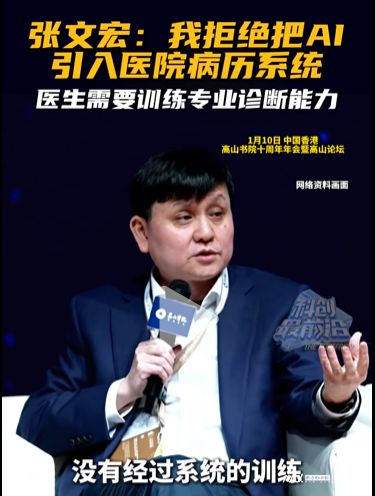
张文宏拒绝把AI引入病历系统,同行们“吵”起来了
Nan Fang Du Shi Bao· 2026-01-15 08:53
Core Viewpoint - The introduction of AI in medical record systems is controversial, with concerns about its impact on the training of young doctors and the potential for AI errors [3][11][12] Group 1: AI in Medical Training - Zhang Wenhong, a prominent figure in infectious disease medicine, refuses to integrate AI into medical record systems, arguing it could disrupt the training of young doctors who need systematic training to diagnose diseases [3] - Some young doctors believe that traditional methods of medical education are outdated in the AI era, suggesting that AI can accelerate learning and enhance clinical skills [9] - The debate centers around whether AI can effectively replace the hands-on training traditionally provided by experienced doctors [6][9] Group 2: AI Applications in Healthcare - AI has been applied in various healthcare scenarios, with over 80 recommended applications outlined by the National Health Commission, including intelligent diagnostic assistance in medical imaging and clinical decision-making [4] - The most common application is in medical imaging, with 73 cases reported, followed by clinical decision support for specific diseases and intelligent medical record generation [4][5] - AI tools are reported to significantly improve efficiency in tasks such as medical record writing and patient history organization, reducing time spent on these activities [5][6] Group 3: Concerns About AI Errors - There are significant concerns regarding the potential for AI to make mistakes, particularly when young doctors may lack the experience to identify these errors [11][12] - Some AI systems have demonstrated lower error rates than human doctors in specialized fields, but issues remain, such as the inability to access external databases for real-time corrections [11][12] - The responsibility for AI errors is a critical issue, with the consensus that users must possess the knowledge to verify AI outputs [12]

1.05亿元!遵义医科大学采购大批仪器、耗材
仪器信息网· 2025-10-31 03:55
Core Insights - Zunyi Medical University has announced four procurement intentions for laboratory equipment, with a total budget of 105 million yuan [1][2]. Procurement Overview - The procurement includes projects for research platform construction, teaching platform construction, experimental consumables, and reagents [2]. - The expected procurement period is from June to October 2025 [2]. Detailed Procurement List - Research Platform Construction Project: Budget of 49.99 million yuan, aimed at enhancing research capabilities [4]. - Teaching Platform Construction Project: Budget of 49.97 million yuan, focused on improving teaching facilities [4]. - Pharmaceutical Experimental Teaching Demonstration Center: Budget of 1.52 million yuan, intended to enhance experimental capabilities [4]. - Experimental Consumables and Reagents: Budget of 4 million yuan, aimed at meeting teaching and research needs [5]. Institutional Background - Zunyi Medical University is a key institution for medical education in China, with a strong emphasis on interdisciplinary research in biology, chemistry, environment, and materials [5]. - The university has established several high-level research platforms, including key laboratories in pharmacology and oncology, contributing significantly to regional economic and social development [6].

如何培养出中国的好医生①|一代代医学生的“成长日记”
Ren Min Wang· 2025-06-11 08:32
Core Viewpoint - The article discusses the evolution of medical education in China, highlighting various educational systems and their impact on the training of medical professionals, emphasizing the importance of foundational knowledge and clinical experience in shaping competent doctors [5][6][7][15]. Group 1: Historical Context of Medical Education - The medical education system in China has undergone significant changes since the late 1970s, with different academic structures such as 5-year, 6-year, and 7-year programs emerging over time [5][6][7]. - Graduates from the 5-year program in the late 1970s, like Wang Peijun, achieved notable success in national examinations, indicating the effectiveness of their training despite the shorter duration [5]. - The 7-year program at Harbin Medical University was particularly prestigious in the 1990s, with graduates being highly sought after by hospitals, often regarded as more valuable than traditional doctoral graduates [7][8]. Group 2: Educational Structures and Their Implications - The 6-year program at Beijing Medical University was seen as providing a solid foundation, with students benefiting from a longer study period compared to previous 5-year programs [6]. - The 8-year program at Peking University Medical School combines undergraduate and graduate studies, allowing students to complete all necessary training in one continuous program, although it requires significant commitment and effort [15][16]. - The 4+4 program allows students from non-medical backgrounds to transition into medicine, reflecting a flexible approach to medical education that accommodates diverse academic histories [17]. Group 3: Personal Experiences and Perspectives - Personal anecdotes from medical professionals illustrate the rigorous nature of medical training, with students often working long hours and gaining hands-on experience through internships [15][16]. - The importance of foundational knowledge in subjects like biology and the integration of different academic disciplines are emphasized as beneficial for developing a well-rounded medical perspective [17]. - The article highlights that the journey to becoming a competent doctor is marked by a commitment to continuous learning and the accumulation of clinical experience over time [10][16].