
临床思维

Search documents
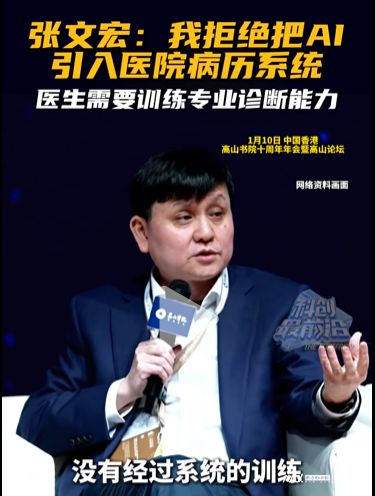
张文宏拒绝把AI引入病历系统,同行们“吵”起来了
Nan Fang Du Shi Bao· 2026-01-15 08:53
Core Viewpoint - The introduction of AI in medical record systems is controversial, with concerns about its impact on the training of young doctors and the potential for AI errors [3][11][12] Group 1: AI in Medical Training - Zhang Wenhong, a prominent figure in infectious disease medicine, refuses to integrate AI into medical record systems, arguing it could disrupt the training of young doctors who need systematic training to diagnose diseases [3] - Some young doctors believe that traditional methods of medical education are outdated in the AI era, suggesting that AI can accelerate learning and enhance clinical skills [9] - The debate centers around whether AI can effectively replace the hands-on training traditionally provided by experienced doctors [6][9] Group 2: AI Applications in Healthcare - AI has been applied in various healthcare scenarios, with over 80 recommended applications outlined by the National Health Commission, including intelligent diagnostic assistance in medical imaging and clinical decision-making [4] - The most common application is in medical imaging, with 73 cases reported, followed by clinical decision support for specific diseases and intelligent medical record generation [4][5] - AI tools are reported to significantly improve efficiency in tasks such as medical record writing and patient history organization, reducing time spent on these activities [5][6] Group 3: Concerns About AI Errors - There are significant concerns regarding the potential for AI to make mistakes, particularly when young doctors may lack the experience to identify these errors [11][12] - Some AI systems have demonstrated lower error rates than human doctors in specialized fields, but issues remain, such as the inability to access external databases for real-time corrections [11][12] - The responsibility for AI errors is a critical issue, with the consensus that users must possess the knowledge to verify AI outputs [12]

这份万名医生报告,推动医学护肤进入“临床路径”时代!
FBeauty未来迹· 2025-12-06 08:03
Core Viewpoint - The article emphasizes the importance of integrating clinical insights into the skincare industry, highlighting the release of the "2025 China Medical Skincare Clinical Insight Report" as a pivotal moment for bridging the gap between clinical practice and product development [2][3][4]. Summary by Sections Insight Report Overview - The "2025 China Medical Skincare Clinical Insight Report" was launched at the SIA2025 Scientific Skincare Innovation Alliance Annual Conference, marking a significant shift in understanding how dermatologists utilize efficacy skincare products in clinical settings [2][3]. - This report serves as a comprehensive guide for the skincare industry, aiming to eliminate the information barrier between clinical medicine and industry [4]. Methodology and Findings - The report is based on extensive research involving 11,253 dermatologists and 25 industry experts, focusing on five core skin conditions: acne, atopic dermatitis, pigmentary disorders, sensitive skin, and perioperative care in aesthetic medicine [6][8]. - It outlines a full-cycle management approach for skin issues, providing practical guidelines validated by clinical experience [6][14]. Clinical Pathways and Recommendations - The report details specific intervention points for efficacy skincare products throughout the management process of various skin conditions, emphasizing the importance of barrier repair and maintenance in treatment plans [14][15]. - It highlights the necessity of a comprehensive skincare strategy during aesthetic procedures, with 91% of dermatologists recommending a holistic skincare approach [17][19]. Bridging Clinical and Industry Practices - The report translates complex clinical language into actionable insights for product development, addressing the disconnect between medical professionals and the skincare industry [20][21]. - It identifies the role of dermatologists as natural judges of product safety and efficacy, providing a foundation for evidence-based product development [21][22]. Future Opportunities - The report positions dermatologists as key players in the future of skin health management, revealing untapped market potential in the aesthetic medicine sector [23]. - It emphasizes the need for a collaborative approach between clinical insights and product innovation to meet the evolving demands of consumers [24][26].

“人民好医生·金山茶花计划”首席专家献策中青年医师成长成才
Ren Min Wang· 2025-04-21 07:36
Core Insights - The "People's Good Doctor · Jinshan Camellia Plan" aims to cultivate young and middle-aged physicians in the oncology field, emphasizing the development of clinical thinking, research skills, and humanistic care [1][2][3] - The initiative provides a high-level communication platform for young oncologists, facilitating the integration of quality medical resources and establishing a systematic training mechanism [1][2] - The program encourages a balanced focus on clinical skills and research capabilities, avoiding the tendency to prioritize publications over clinical practice [2] Group 1 - The cultivation of young oncologists is not merely about technical training but involves shaping them into well-rounded professionals who can meet diverse health service needs [1] - Experts emphasize the importance of creating a supportive research environment to motivate young physicians to engage in fundamental research [2] - The initiative has been in place since 2020, showcasing outstanding contributions from young experts in various cancer treatment fields [3] Group 2 - The program aims to enhance the professional level of young physicians through mutual learning and idea exchange [2] - There is a call for a comprehensive evaluation mechanism that balances clinical skills and research capabilities [2] - The project is guided by renowned experts in the oncology field, ensuring professional oversight and support for its implementation [3]