
医学影像AI

Search documents
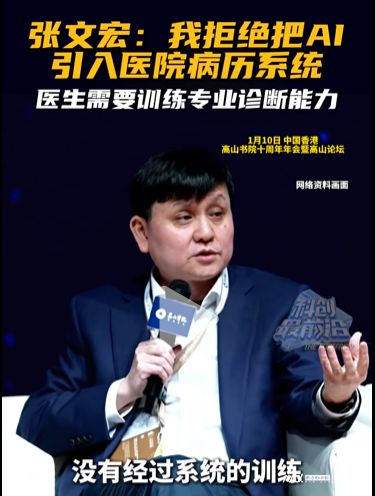
张文宏拒绝把AI引入病历系统,同行们“吵”起来了
Nan Fang Du Shi Bao· 2026-01-15 08:53
Core Viewpoint - The introduction of AI in medical record systems is controversial, with concerns about its impact on the training of young doctors and the potential for AI errors [3][11][12] Group 1: AI in Medical Training - Zhang Wenhong, a prominent figure in infectious disease medicine, refuses to integrate AI into medical record systems, arguing it could disrupt the training of young doctors who need systematic training to diagnose diseases [3] - Some young doctors believe that traditional methods of medical education are outdated in the AI era, suggesting that AI can accelerate learning and enhance clinical skills [9] - The debate centers around whether AI can effectively replace the hands-on training traditionally provided by experienced doctors [6][9] Group 2: AI Applications in Healthcare - AI has been applied in various healthcare scenarios, with over 80 recommended applications outlined by the National Health Commission, including intelligent diagnostic assistance in medical imaging and clinical decision-making [4] - The most common application is in medical imaging, with 73 cases reported, followed by clinical decision support for specific diseases and intelligent medical record generation [4][5] - AI tools are reported to significantly improve efficiency in tasks such as medical record writing and patient history organization, reducing time spent on these activities [5][6] Group 3: Concerns About AI Errors - There are significant concerns regarding the potential for AI to make mistakes, particularly when young doctors may lack the experience to identify these errors [11][12] - Some AI systems have demonstrated lower error rates than human doctors in specialized fields, but issues remain, such as the inability to access external databases for real-time corrections [11][12] - The responsibility for AI errors is a critical issue, with the consensus that users must possess the knowledge to verify AI outputs [12]

2025年中国智慧医院行业洞察:从工具革命到生态革命,卫宁健康、东华软件竞逐数字医院解决方案新蓝海
Tou Bao Yan Jiu Yuan· 2025-12-08 12:56
Investment Rating - The report does not explicitly state an investment rating for the smart hospital industry in China Core Insights - The smart hospital industry in China is transitioning from a tool revolution to an ecosystem revolution, with companies like Weining Health and Donghua Software competing in the digital hospital solution market [1] - The AI healthcare ecosystem is supported by infrastructure development and data collection, enhancing diagnostic efficiency and service quality to address issues like resource shortages and aging populations [4] - Despite a slowdown in overall healthcare investment since 2022 due to geopolitical tensions and more realistic technology expectations, the "AI + healthcare" sector continues to attract significant investment driven by demand and technology [4][10] Summary by Sections Research Purpose and Overview - The report aims to explore the market hotspots, sub-industry conditions, and competitive landscape of the smart hospital industry in China [2][3] Global and Chinese Smart Hospital Industry Development - The global smart hospital industry is experiencing rapid advancements in AI technology, leading to a shift towards intelligent, digital, and information-driven healthcare [5] - The Chinese smart hospital industry is characterized by a diverse range of players and significant potential for growth, particularly in AI integration and digital infrastructure [24] AI Healthcare Investment Environment - Investment in the AI healthcare sector peaked in 2021 with a total financing amount of 97.41 billion yuan and 380 financing events, but saw a decline in 2022 due to various global challenges [10][8] - The financing rounds for AI healthcare in China are primarily concentrated in early stages, with a shift towards later rounds as investors seek more certainty [12] Smart Hospital Information Technology Applications - New application technologies in hospitals, such as outpatient dispensing machines and AI in medical imaging, show significant regional disparities, with developed areas exhibiting over twice the application rates compared to less developed regions [14][15] - The integration of AI in hospital information systems is expected to increase, with software and service investments likely to rise as digital infrastructure improves [24] Automated Pharmacy Market - The penetration rate of automated pharmacies in China is currently low, but there is substantial potential for growth as healthcare infrastructure expands and AI technologies are further integrated [20][21] - Leading companies in the automated pharmacy sector are leveraging diverse product offerings and channel expansion to maintain market positions [26] Company Comparisons in Hospital Information Technology - The report provides a comparative analysis of key players in the hospital information technology sector, highlighting their strengths and areas of focus, such as Weining Health's comprehensive solutions in HIS systems and AI [24] Company Comparisons in Automated Pharmacy - A competitive landscape analysis of automated pharmacy companies reveals varying strengths, with companies like Jianhui Information and Ailong Technology leading in integrated solutions and market presence [26]


AI医疗迎政策利好,港股通医疗板块上涨
Mei Ri Jing Ji Xin Wen· 2025-11-20 02:28
Core Viewpoint - The National Health Commission and other departments released implementation opinions on November 18 to promote and regulate the application of "Artificial Intelligence + Healthcare," clearly supporting AI deployment in diagnosis, imaging, and management [1] Group 1: Policy Impact - The new policy provides a clear industrialization blueprint for "Artificial Intelligence + Healthcare," with specific goals and pathways [1] - The policy opens up a vast incremental market for software and hardware service providers, particularly in medical imaging AI and clinical decision support systems [1] Group 2: Market Reaction - On November 20, the Hong Kong medical sector experienced a strong surge, with companies like Ping An Good Doctor, WuXi AppTec, and WuXi Biologics showing active trading [1] - The Hong Kong Stock Connect medical ETF (520510), which has a leading AI healthcare component, rose over 1% at one point during the early trading session [1]
一家AI芯片公司,C轮融资超10亿丨投融周报
投中网· 2025-04-14 05:58
将投中网设为"星标⭐",第一时间收获最新推送 速览投资风口,掌握资本律动。 作者丨 长风 来源丨 东四十条资本 大家好,我是长风。今天给大家带来上周资本市场的专业投研信息。 上周焦点回顾: 硬科技赛道,红杉连续加注具身机器人。 上周,灵心巧手宣布完成超亿元种子轮融资。本轮融资由红杉种子基金、万凯新材领投,力合资本、力合金 融、华仓资本、鞍羽跟投。此外,穹彻智能成功完成数亿元Pre-A++轮融资。本轮融资由盛宇投资、嘉御资本、云启资本、上海科创集团等多家知名投 资机构联合投资,同时老股东Prosperity7、红杉中国、小苗朗程、璞跃中国等持续追投。 镁源动力完成数千万元融资 4月7日消息,固态镁基储氢材料量产企业镁源动力宣布完成数千万元股权融资,本轮融资由中财融商、合肥创新投共同投资。 云象机器人完成A轮融资 大健康赛道,iPSC成重点。 上周,中盛溯源宣布在 B 轮融资中再获数千万元资金支持。至此,中盛溯源 B 轮融资圆满收官,本轮累计融资金额达 2.35 亿元。本次追加融资由广药资本、科金控股、合肥产投、菡源资产知名投资机构联合参与。 4月11日,聚焦iPSC化学诱导平台的睿健医药新宣布 完成了近亿元B+ ...