
医疗服务模式创新

Search documents
用奋进之笔书写健康答卷
Xin Lang Cai Jing· 2026-01-28 18:54
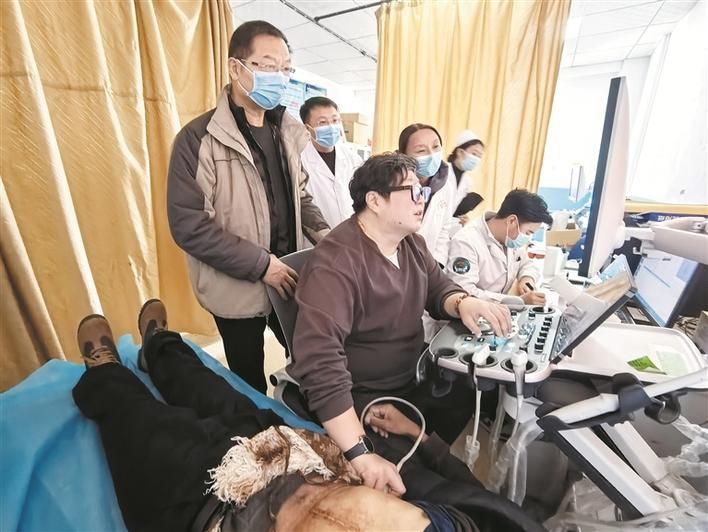
Core Viewpoint - The article highlights the advancements and initiatives of Shihezi University First Affiliated Hospital (石大一附院) in enhancing healthcare services, showcasing its commitment to high-quality medical care and community support through various programs and technological advancements [7][9][10]. Group 1: Medical Advancements and Initiatives - The hospital has established 34 renowned medical studios, including 14 expert teams and 20 individual studios, involving a total of 99 experts to improve healthcare delivery [3][12]. - In recent years, the hospital has reported a 13.60% increase in inpatient numbers, a 13.24% rise in surgical procedures, and a 38.47% growth in minimally invasive surgeries, indicating a significant enhancement in its medical capabilities [9]. - The successful treatment of a critical case involving an 85-year-old patient with a 15 cm abdominal aortic aneurysm demonstrates the hospital's advanced capabilities in handling complex medical emergencies [8]. Group 2: Community Engagement and Support - The hospital has actively engaged in community support by sending 176 medical experts to assist various local hospitals and conducting over 200 free medical consultations, benefiting nearly 20,000 people [10][12]. - The establishment of a one-stop outpatient service center aims to streamline patient services, reducing the need for multiple visits and enhancing patient experience [14]. Group 3: Leadership and Organizational Development - The hospital's leadership has implemented a robust organizational structure and a series of reforms to enhance decision-making and operational efficiency, including a new "1236" decision-making mechanism [15][16]. - A focus on talent development has led to a significant increase in the proportion of middle-level managers with advanced degrees, enhancing the hospital's overall competency [17]. Group 4: Future Aspirations and Commitment - The hospital is committed to continuous improvement in healthcare services, aiming to provide high-quality, efficient, and patient-centered care while fostering a culture of innovation and excellence [18].

“预住院”服务,让患者少跑腿、少等待、少花费
Ren Min Ri Bao· 2026-01-10 09:05
Core Viewpoint - The "pre-admission" service reform aims to alleviate the issue of bed shortages in medical institutions and reduce patient expenses by allowing patients to complete pre-operative checks and evaluations in outpatient settings before being admitted for surgery [2][3]. Group 1: Implementation and Benefits - The "pre-admission" model shifts pre-operative checks and health assessments to the outpatient stage, resulting in benefits for patients such as reduced waiting times and lower costs [2][3]. - In Changsha, Hunan, hospitals implementing "pre-admission" services have seen an average reduction in hospital stay by 1 to 3 days, with costs decreasing by over 1,000 yuan [2]. - Since the pilot program began in 2020 at Central South University Xiangya Third Hospital, the average waiting time for surgery has decreased from 7 days to 3 days, with surgery dates moved up by 2 to 3 days [2]. Group 2: Operational Efficiency - For medical institutions, "pre-admission" represents a beneficial exploration to enhance operational efficiency by allowing better planning of bed resources and surgical schedules [3]. - Traditional models restrict efficient bed turnover as patients only begin queuing for checks after admission; the new model allows for more precise resource allocation [3]. Group 3: Challenges and Considerations - The "pre-admission" model faces challenges such as the need for coordination between departments and adjustments in billing and insurance reimbursement policies [4]. - It is essential to define the appropriate patient population for "pre-admission" services to ensure efficiency and reflect refined medical management [4]. - Increased pressure on outpatient services necessitates improved scheduling, guidance services, and intelligent information system support [4]. Group 4: Broader Implications - The value of practices like "pre-admission" lies not only in optimizing resource allocation and improving efficiency but also in shifting the healthcare paradigm from a disease-centered approach to a patient-centered, integrated health management model [5]. - Emphasizing "people's health" requires attention to both treatment outcomes and the overall patient experience throughout the medical process [5]. - Continuous innovation in healthcare services is crucial for enhancing patient experience and improving medical effectiveness, contributing to the overall health of the population and the advancement of health initiatives in China [5].

“预住院”服务的改革深意(新知)
Ren Min Ri Bao· 2026-01-06 02:06
Core Viewpoint - The introduction of "pre-admission" services aims to alleviate the issue of bed shortages in medical institutions and reduce patient expenses by allowing patients to complete pre-operative checks and evaluations in outpatient settings before being admitted for surgery [1][2]. Group 1: Implementation and Benefits - The "pre-admission" model allows for pre-operative checks and health assessments to be conducted in outpatient settings, leading to reduced waiting times and costs for patients [1]. - In Changsha, Hunan, hospitals implementing "pre-admission" services have seen an average reduction of 1 to 3 days in hospital stay and a decrease in costs exceeding 1,000 yuan [1]. - Since the pilot program began in 2020 at Central South University Xiangya Third Hospital, the average waiting time for surgery has decreased from 7 days to 3 days [1]. Group 2: Operational Efficiency - The "pre-admission" model enhances operational efficiency for medical institutions by allowing for better planning of bed resources and surgical schedules, thus serving more patients with limited resources [2]. - Traditional models restrict efficient bed turnover as patients only begin queuing for checks after admission; the new model addresses this issue by front-loading the necessary evaluations [2]. Group 3: Challenges and Considerations - The implementation of "pre-admission" requires adjustments in billing items and insurance reimbursement policies, necessitating enhanced collaboration among departments and active participation from insurance agencies [3]. - The model primarily targets elective surgery patients, raising the need for careful definition of the applicable patient population to ensure service efficiency and reflect refined medical management [3]. - Increased pressure on outpatient services due to pre-admission checks necessitates more precise appointment scheduling, guidance services, and intelligent information system support [3]. Group 4: Broader Implications - The value of practices like "pre-admission" extends beyond resource optimization and efficiency; it signifies a shift in healthcare philosophy from a disease-centric approach to a patient-centered, integrated health management model [4]. - Emphasizing "people's health" requires not only treating existing conditions but also preventing future ones, focusing on the entire medical process and patient experience [4]. - Continuous innovation in healthcare services, aimed at improving patient experience and enhancing medical efficiency, is essential for advancing public health and contributing to the construction of a healthy China [4].
“预住院”服务的改革深意
Ren Min Ri Bao· 2026-01-06 01:54
Core Insights - The "pre-admission" service has been introduced in various regions to alleviate the issue of hospital bed shortages and reduce patient expenses for elective surgeries, allowing patients to complete pre-operative checks and assessments in outpatient settings before being admitted for surgery when a bed becomes available [1][2] Group 1: Implementation and Benefits - The "pre-admission" model addresses the challenges of bed shortages by moving pre-operative checks and health assessments to the outpatient stage, resulting in reduced waiting times and costs for patients [2] - In Changsha, Hunan, hospitals implementing "pre-admission" services have seen an average reduction in hospital stay by 1 to 3 days and a decrease in costs exceeding 1,000 yuan [2] - Since the pilot program began in 2020 at Central South University Xiangya Third Hospital, the average waiting time for surgery has decreased from 7 days to 3 days, enhancing operational efficiency for medical institutions [2] Group 2: Challenges and Considerations - The "pre-admission" model requires careful coordination between departments and adjustments in billing and insurance reimbursement policies to ensure that the benefits reach patients effectively [3] - It is essential to define the appropriate patient population for "pre-admission" services to maintain service efficiency and reflect refined medical management [3] - Increased pressure on outpatient services necessitates improved scheduling, guidance services, and intelligent information systems to support the "pre-admission" process [3] Group 3: Broader Implications - The value of practices like "pre-admission" extends beyond resource optimization and efficiency improvements; it signifies a shift in healthcare philosophy from a disease-centered approach to a patient-centered, integrated health management model [4] - Emphasizing "people's health" requires not only treating existing conditions but also preventing future ones, focusing on the entire healthcare experience [4] - Continuous innovation in healthcare services is crucial for enhancing patient experience and improving healthcare effectiveness, contributing to the overall health and well-being of the population [4]
广东公立医疗机构将推行“一次挂号管三天”,此前多地试点成效显著
Yang Shi Wang· 2025-12-30 13:55
Core Viewpoint - Guangdong Province will implement a "one registration covers three days" policy for public medical institutions starting January 1, 2026, aimed at reducing patient costs and improving convenience in medical services [1][2]. Group 1: Policy Implementation - The "one registration covers three days" policy allows patients to receive a follow-up appointment within three days without additional registration fees if diagnostic results are not available on the same day [2]. - The policy will be applied to all public medical institutions in Guangdong, including traditional Chinese medicine and maternal and child health institutions, with encouragement for private medical institutions to adopt similar measures [1][2]. Group 2: Pilot Program Results - The pilot program, initiated in cities like Shenzhen, Zhuhai, and Guangzhou, has served nearly 7 million patients since its launch, demonstrating significant positive outcomes [3]. - In Shenzhen, over 500 million patients benefited from the policy, with diagnostic fees waived amounting to over 200 million yuan [3]. - Zhuhai implemented a similar policy allowing free follow-up appointments within a week, resulting in a fee reduction of nearly 13 million yuan [3].
聊城:以日间医疗模式赋能肿瘤精准诊疗
Qi Lu Wan Bao· 2025-12-23 01:42
Core Insights - The article highlights the innovative daytime medical service model implemented in Liaocheng, which significantly improves the treatment experience for cancer patients by allowing them to receive care without lengthy hospital stays [1][2][3] Group 1: Service Model Innovation - Liaocheng has established a daytime radiotherapy and chemotherapy center, set to be operational by July 2024, focusing on optimizing medical resource allocation and enhancing patient experience [1] - The center employs a "four-in-one" service framework that includes process re-engineering, multidisciplinary collaboration, smart empowerment, and humanistic care to provide efficient and precise treatment [1][2] Group 2: Process Optimization - The city has integrated diagnostic and treatment processes, allowing patients to move from outpatient consultation to treatment planning in an average of just one working day [2] - The use of a unified appointment and intelligent scheduling system has reduced the average time patients spend in the hospital by over 2 hours per visit, achieving a "treat and go" model [1][2] Group 3: Multidisciplinary Collaboration - A multidisciplinary team, including specialists in radiation therapy, traditional Chinese medicine, nutrition, and psychology, collaborates to create personalized care plans for patients, ensuring a comprehensive management approach [2] - This integrated care model forms a closed-loop system of "treatment-rehabilitation-support," enhancing the overall patient experience [2] Group 4: Quality and Safety Measures - The city has incorporated daytime medical services into a unified quality control system, establishing mechanisms for quality checks and traceability throughout the treatment process [2] - Initiatives such as patient care stations and a 24-hour online communication platform have been implemented to ensure timely responses and support for patients [2] Group 5: Impact and Future Plans - Since its launch, the model has served thousands of cancer patients, achieving a treatment completion rate of over 95% and increasing bed turnover rates in related departments by over 30% [2] - The successful implementation of this model is being expanded to county-level healthcare facilities, enhancing regional cancer prevention and treatment capabilities [2][3] - Future plans include further development of daytime surgeries and chemotherapy, aiming to create a more efficient, precise, and patient-centered healthcare network [3]
镇江稳步提升公立医院医疗服务能力
Xin Hua Ri Bao· 2025-10-21 23:15
Core Insights - The Jiangsu province is enhancing its healthcare services through innovative medical technologies and improved patient experiences, as evidenced by the inclusion of advanced medical techniques in the national "Good Technology" project [1][2] - The focus on high-quality development in public hospitals aims to meet the health needs of the population by improving medical technology, service models, and patient experiences [1][3] Group 1: Medical Innovations - Two medical technologies from Zhenjiang's hospitals have been recognized in the national "Good Technology" project, showcasing the city's commitment to healthcare innovation [1] - The Zhenjiang First People's Hospital successfully performed a complex finger reconstruction surgery using advanced techniques, marking a significant achievement in local medical capabilities [2][3] Group 2: Public Hospital Development - Zhenjiang is prioritizing the development of specialized capabilities in public hospitals, with multiple national and provincial key specialty units established to enhance healthcare services [3][4] - The integration of traditional Chinese medicine into modern healthcare practices is being emphasized, with new initiatives to promote its application in various medical conditions [4] Group 3: Patient Experience Improvements - The implementation of a health cloud platform allows for the sharing of medical imaging and test results across multiple healthcare facilities, significantly improving patient convenience [5][6] - Community health centers are enhancing patient access to specialists through innovative appointment systems and telemedicine, reducing the need for patients to travel for care [7][8] Group 4: Community Health Initiatives - The "Service for People's Health Action" initiative by Zhenjiang First People's Hospital aims to provide accessible healthcare services in local communities, addressing the challenges of distance and specialist availability [8] - A series of measures have been introduced to streamline healthcare processes and improve patient satisfaction, including free follow-up visits and reduced medical fees [8][9] Group 5: Future Directions - The Zhenjiang health authority is committed to establishing a regional medical center and enhancing public hospital reforms to ensure high-quality healthcare delivery [10]