医育

Search documents
如何理解发展医育、医养结合服务
Xin Hua She· 2026-01-28 05:00
Group 1 - The core viewpoint of the article emphasizes the development of integrated medical education and elderly care services in response to China's demographic challenges, including declining birth rates and an aging population [1] Group 2 - The proposal is part of the recommendations from the Central Committee of the Communist Party of China regarding the formulation of the 15th Five-Year Plan for national economic and social development [1] - The focus on medical and elderly care services reflects a targeted approach to address the current and future demographic trends in the country [1]
学习规划建议每日问答丨如何理解发展医育、医养结合服务
Xin Hua Wang· 2026-01-28 04:26
Core Viewpoint - The article emphasizes the development of integrated medical education and elderly care services in response to China's demographic challenges, including declining birth rates and an aging population [1] Group 1: Development Strategies - The proposal suggests that medical institutions should leverage their technical advantages to form close business relationships with childcare and elderly care institutions, either through direct management or contractual agreements [1] - Regions such as Beijing, Hebei, Anhui, Hubei, and Zhejiang are already exploring tighter integration of medical education and elderly care services, showing positive social benefits and resource optimization [1] Group 2: Support Measures - It is essential to enhance inter-departmental collaboration among various government sectors, including health, education, and finance, to expand effective supply and meet basic service needs [2] - The article advocates for the establishment of a collaborative service network involving different healthcare institutions to share resources and improve service efficiency [2] Group 3: Management Mechanisms - A clear operational management mechanism should be established, with defined responsibilities and roles for different entities involved in integrated services [3] - The integration of medical education and elderly care services should be aligned with the construction of medical alliances to ensure seamless service delivery [3] Group 4: Safety and Regulation - A multi-departmental coordination mechanism is necessary to ensure regulatory compliance and service quality in integrated medical and elderly care institutions [3]
学习规划建议每日问答|如何理解发展医育、医养结合服务
Xin Hua She· 2026-01-28 04:04
Core Viewpoint - The article emphasizes the development of integrated medical and educational services, as well as medical and elderly care services, in response to China's demographic challenges, including declining birth rates and an aging population [1] Group 1: Policy Recommendations - The proposal suggests enhancing inter-departmental collaboration and expanding effective supply through various channels, including public-private partnerships, to meet the basic service needs of residents [2] - It advocates for the establishment of a collaborative service network involving various healthcare institutions to ensure resource sharing and efficient coordination [2] Group 2: Operational Management - The article recommends creating a clear operational management mechanism tailored to local needs, defining responsibilities among participating units, and ensuring safe and effective service delivery [3] - It highlights the importance of integrating medical and educational services with the construction of medical alliances to facilitate communication and service delivery between different healthcare providers [3] Group 3: Safety and Regulation - The article stresses the need to establish a robust safety framework through multi-departmental coordination, regulatory clarity, and quality assessment systems to ensure the safety and quality of integrated services [3]
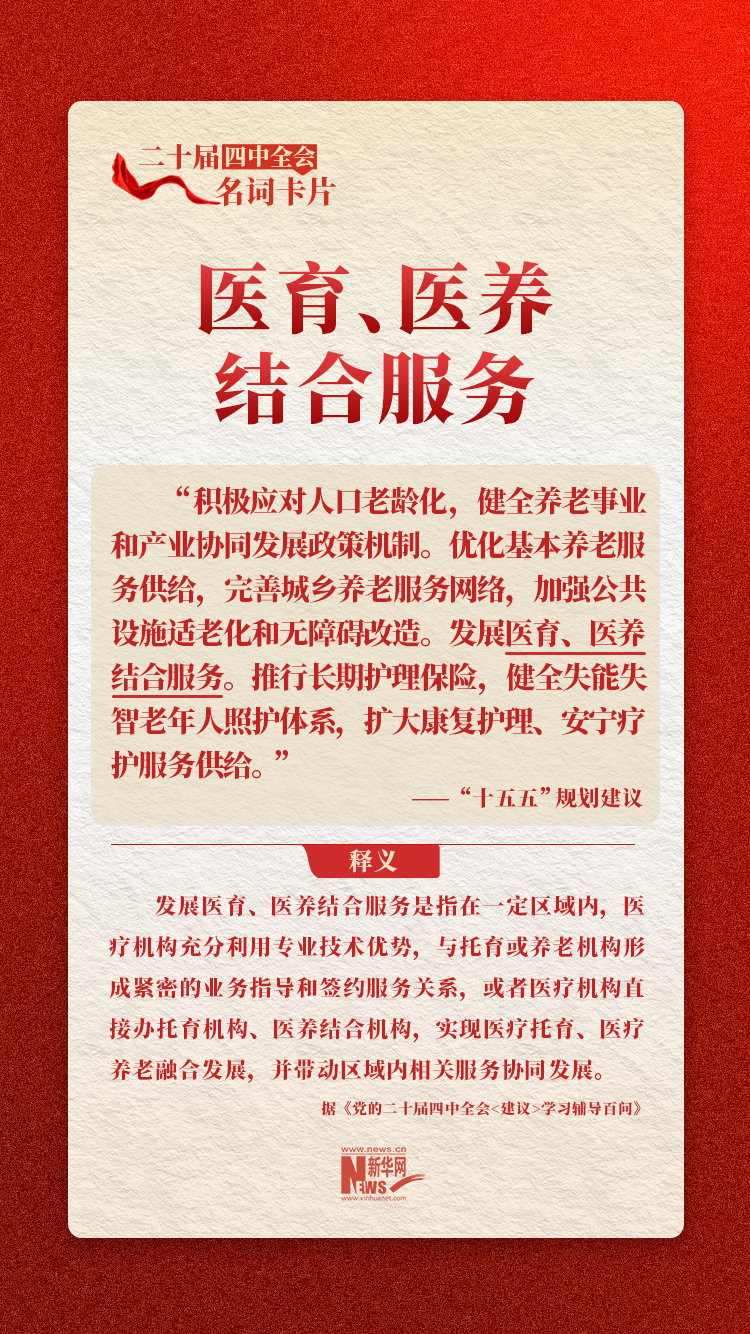
谋篇布局“十五五”?热点问答|发展医育、医养结合服务,不同机构如何分工?
Zhong Guo Jing Ji Wang· 2025-12-02 08:21
Group 1 - The core idea of the article emphasizes the development of integrated medical education and elderly care services, which involves close collaboration between medical institutions and childcare or elderly care facilities [2][3] - The "Fifteen Five" planning proposal suggests that medical institutions should leverage their professional advantages to establish business guidance and service agreements with childcare or elderly care organizations, or directly operate such institutions [2][3] - The proposal aims to promote the coordinated development of related services within the region, creating a collaborative service network involving various healthcare institutions [3] Group 2 - The article outlines the roles of different healthcare entities, such as disease control agencies guiding childcare and elderly care institutions in establishing disease prevention and control systems [3] - Maternal and child health institutions are encouraged to enhance awareness of common diseases in infants and children, conducting regular health checks and providing comprehensive health services [3] - Traditional Chinese medicine hospitals are tasked with promoting suitable techniques and providing health services, while secondary and higher-level medical institutions are expected to support critical care and referral services [3]

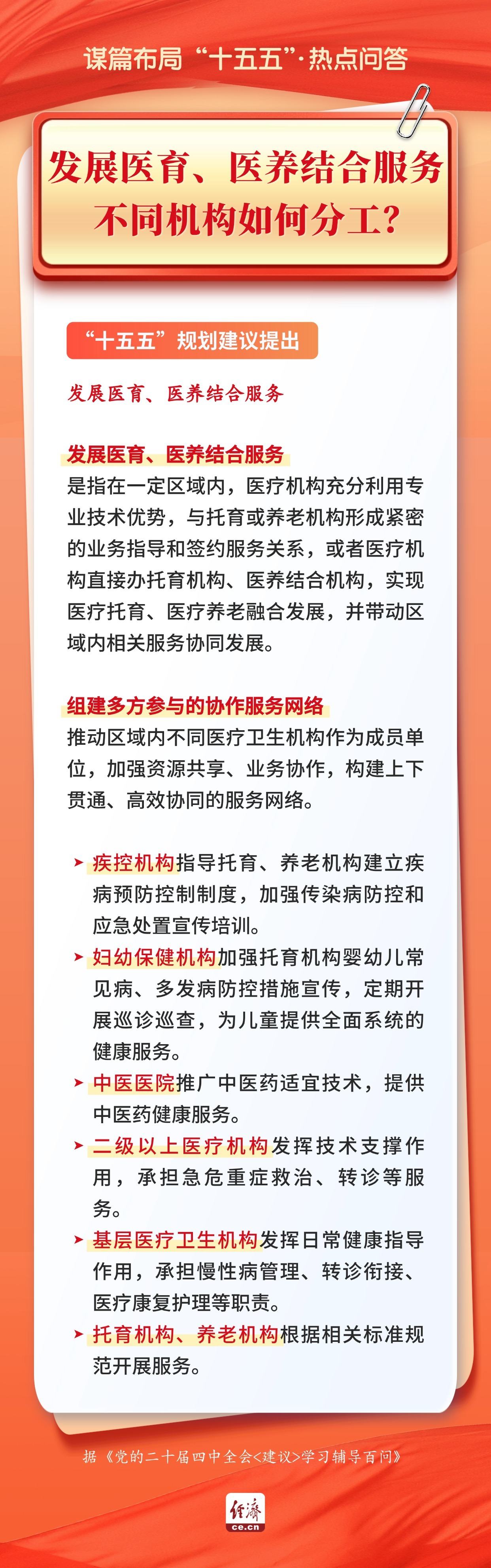
二十届四中全会名词卡片:医育、医养结合服务
Xin Hua Wang· 2025-11-21 05:44
Core Viewpoint - The article emphasizes the importance of developing integrated medical and elderly care services to address the challenges posed by an aging population, highlighting the need for a coordinated policy framework and collaborative service networks [2][4]. Group 1: Development Strategies - The "14th Five-Year Plan" suggests enhancing the quality of childcare and elderly care services through various measures, including improving basic service supply and optimizing the urban-rural elderly care service network [2][4]. - It advocates for the establishment of a collaborative service network involving multiple healthcare institutions to share resources and enhance service efficiency [5][6]. - The plan includes the formation of clear operational management mechanisms to define responsibilities and ensure effective service delivery [5][6]. Group 2: Implementation Measures - The article outlines the need for inter-departmental collaboration among various government sectors, such as health, education, and social services, to create supportive policies and expand service availability [4][5]. - It highlights the importance of integrating medical services with community health initiatives, ensuring that healthcare providers can offer comprehensive support to both children and the elderly [6]. - The establishment of a safety net for service delivery is crucial, involving regulatory oversight and quality assessment to maintain high standards in integrated care facilities [6].