半导体十大技术趋势预测

Search documents
半导体十大预测,“进度条”几何?
3 6 Ke· 2025-12-17 11:59
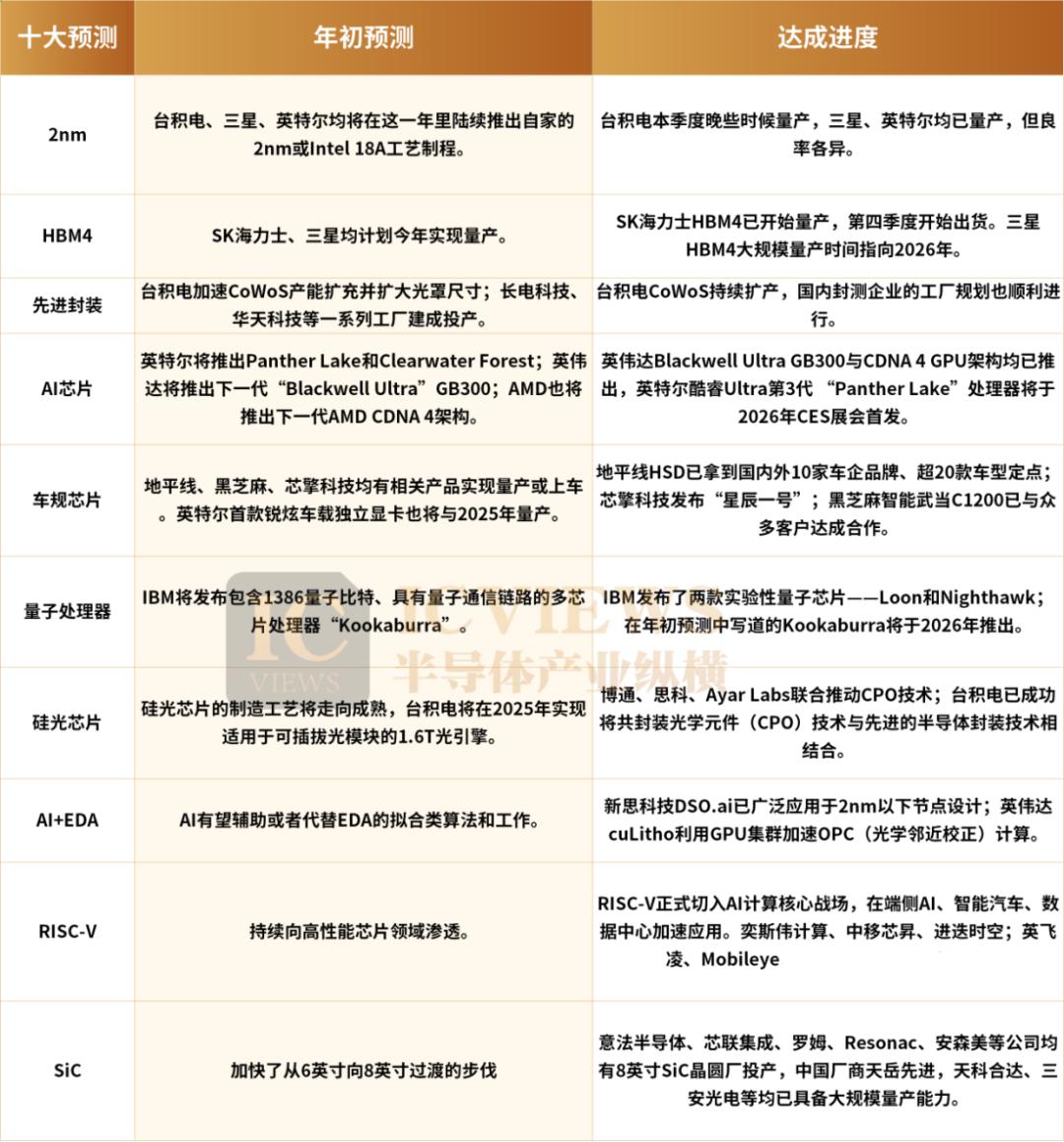
Core Insights - The semiconductor industry has made significant progress in the ten key technology trends predicted for 2025, including advancements in 2nm technology, HBM4, advanced packaging, AI processors, automotive chips, quantum processors, silicon photonics, AI in EDA, RISC-V, and SiC technology [1][2]. Group 1: 2nm Technology - TSMC, Samsung, and Intel have all initiated mass production of 2nm or equivalent processes, with TSMC planning to ramp up production capacity significantly [2][3]. - TSMC has received orders for 2nm chips from major clients like Apple and NVIDIA, with demand exceeding that of the previous 3nm generation [3]. - Samsung's 2nm mobile application processor, Exynos 2600, has begun mass production, but its yield rates remain uncertain [3][4]. Group 2: HBM4 - SK Hynix has entered mass production of HBM4 memory chips, with shipments expected to start in Q4 2025, while Samsung is still in the final testing phase [5]. - Samsung is negotiating prices for HBM4 supplies with NVIDIA, aiming to maintain its competitive edge in the DRAM market [5]. Group 3: Advanced Packaging - TSMC is expanding its CoWoS capacity and has initiated the development of CoPoS technology, with plans for mass production by 2026 [6][7]. - Domestic packaging companies are also ramping up production capabilities, with several projects already in operation [7]. Group 4: AI Processors - NVIDIA has launched the Blackwell Ultra GB300 chip, which is now in mass production, promising significant improvements in computational throughput [8][9]. - AMD has introduced the CDNA 4 GPU architecture, with plans for the MI400 series GPU to be released in 2026 [9]. Group 5: Automotive Chips - Horizon has secured partnerships with over 10 automotive brands for its high-level intelligent driving solutions, with significant production milestones achieved [11]. - Black Sesame has developed a cross-domain computing chip platform for smart vehicles, with multiple collaborations established [11][12]. Group 6: Quantum Processors - IBM has released experimental quantum chips and plans to launch the Kookaburra processor in 2026, marking a step towards practical quantum computing [13][14]. Group 7: Silicon Photonics - The integration of silicon photonics and CPO technology is advancing, with TSMC expected to provide samples for 1.6T optical transmission technology in 2025 [15][16]. - The demand for 800G optical modules is projected to surge, with significant growth anticipated in the coming years [15][17]. Group 8: RISC-V - RISC-V is expanding its presence in high-performance computing, with various companies developing AI-related chips and platforms [18][19]. - The RISC-V International predicts substantial market share growth across multiple sectors by 2031 [19]. Group 9: SiC Technology - The transition to 8-inch SiC wafer production is underway, with several companies achieving large-scale production capabilities [20][21]. - The shift to 8-inch substrates is expected to reduce costs and increase production efficiency in various applications, including electric vehicles and renewable energy [21][22]. Group 10: AI in EDA - AI is transforming the EDA landscape, with tools like Synopsys DSO.ai enhancing chip design efficiency significantly [22][23]. - The integration of AI in EDA processes is lowering the barriers for high-end chip design, indicating a shift in industry practices [24].