
AI+EDA

Search documents
中国银河证券:国产EDA并购潮涌 AI+先进制程驱动“芯片之母”崛起
Zhi Tong Cai Jing· 2025-12-31 01:25
Core Viewpoint - The domestic EDA industry is currently experiencing a "policy-driven + technological breakthrough + high demand" triple resonance period, suggesting significant investment opportunities in core industry chain targets for the long term [1] Industry Positioning - EDA is a core technology for electronic system design automation, positioned at the upstream of the integrated circuit industry chain, influencing chip design efficiency, production costs, and performance, thereby impacting the global digital economy worth trillions of dollars [2] Market Dynamics - The global EDA market is highly concentrated, with three major players (Synopsys, Cadence, Siemens EDA) holding 74% market share. The global EDA market is projected to reach $18.3 billion by 2026 and exceed $30 billion by 2034. In China, the market size is expected to reach 22.2 billion yuan by 2026, with a growth rate of 20%, significantly higher than overseas [3] Growth Drivers - Three key factors are driving industry growth: 1. Domestic substitution is becoming essential due to U.S. export controls on EDA software, particularly for advanced process tools below 7nm, pushing domestic EDA companies to accelerate localization [4] 2. Technological and demand upgrades are emerging as design costs for advanced processes from 7nm to 3nm increase exponentially, with new demands arising from post-Moore era designs like Chiplet, 3D IC, and heterogeneous integration [4] 3. Industry consolidation is accelerating as the current Chinese EDA market is fragmented, with leading domestic EDA firms enhancing their product lines and overall strength through mergers and acquisitions [4]

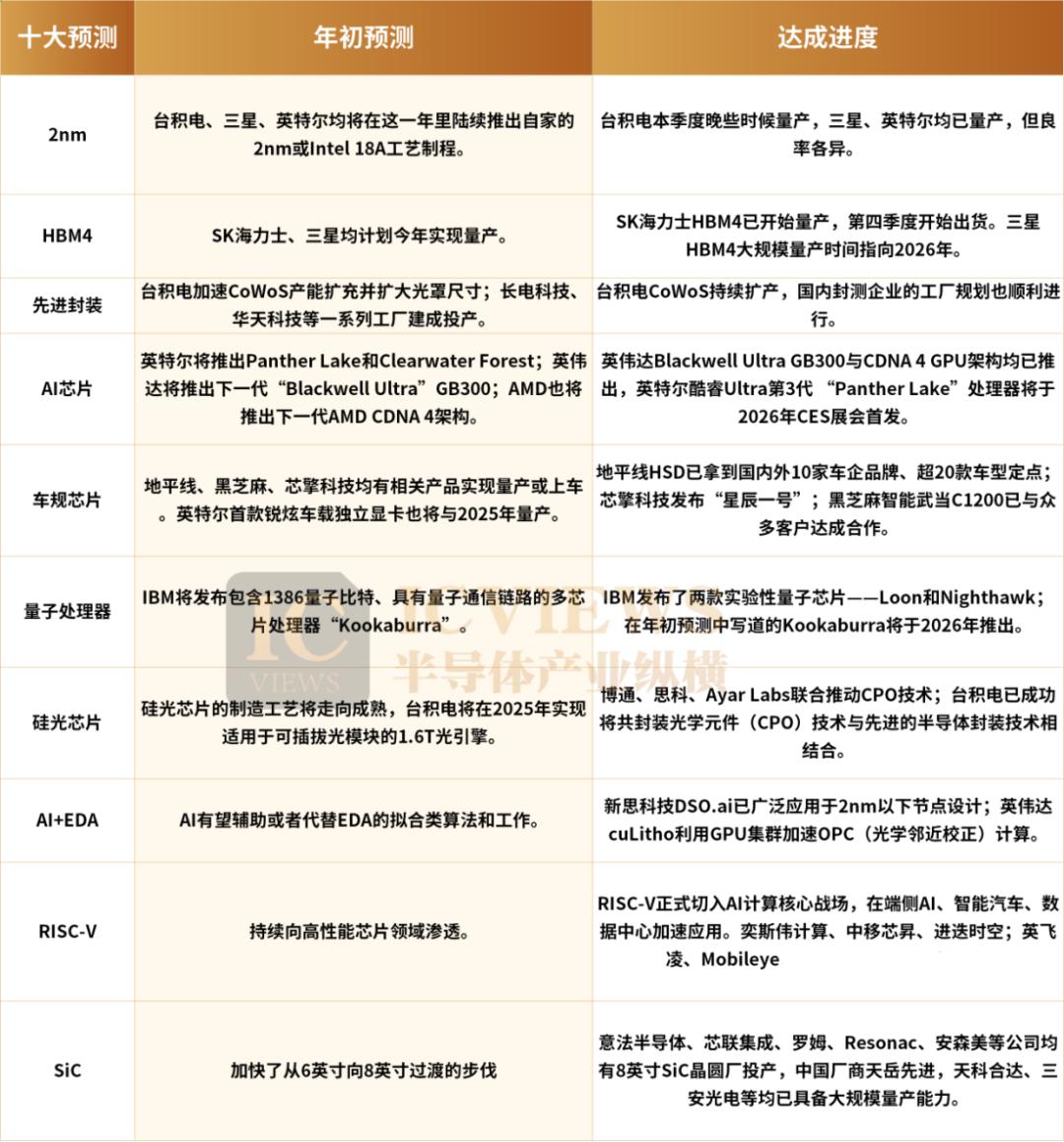
半导体十大预测,“进度条”几何?
3 6 Ke· 2025-12-17 11:59
Core Insights - The semiconductor industry has made significant progress in the ten key technology trends predicted for 2025, including advancements in 2nm technology, HBM4, advanced packaging, AI processors, automotive chips, quantum processors, silicon photonics, AI in EDA, RISC-V, and SiC technology [1][2]. Group 1: 2nm Technology - TSMC, Samsung, and Intel have all initiated mass production of 2nm or equivalent processes, with TSMC planning to ramp up production capacity significantly [2][3]. - TSMC has received orders for 2nm chips from major clients like Apple and NVIDIA, with demand exceeding that of the previous 3nm generation [3]. - Samsung's 2nm mobile application processor, Exynos 2600, has begun mass production, but its yield rates remain uncertain [3][4]. Group 2: HBM4 - SK Hynix has entered mass production of HBM4 memory chips, with shipments expected to start in Q4 2025, while Samsung is still in the final testing phase [5]. - Samsung is negotiating prices for HBM4 supplies with NVIDIA, aiming to maintain its competitive edge in the DRAM market [5]. Group 3: Advanced Packaging - TSMC is expanding its CoWoS capacity and has initiated the development of CoPoS technology, with plans for mass production by 2026 [6][7]. - Domestic packaging companies are also ramping up production capabilities, with several projects already in operation [7]. Group 4: AI Processors - NVIDIA has launched the Blackwell Ultra GB300 chip, which is now in mass production, promising significant improvements in computational throughput [8][9]. - AMD has introduced the CDNA 4 GPU architecture, with plans for the MI400 series GPU to be released in 2026 [9]. Group 5: Automotive Chips - Horizon has secured partnerships with over 10 automotive brands for its high-level intelligent driving solutions, with significant production milestones achieved [11]. - Black Sesame has developed a cross-domain computing chip platform for smart vehicles, with multiple collaborations established [11][12]. Group 6: Quantum Processors - IBM has released experimental quantum chips and plans to launch the Kookaburra processor in 2026, marking a step towards practical quantum computing [13][14]. Group 7: Silicon Photonics - The integration of silicon photonics and CPO technology is advancing, with TSMC expected to provide samples for 1.6T optical transmission technology in 2025 [15][16]. - The demand for 800G optical modules is projected to surge, with significant growth anticipated in the coming years [15][17]. Group 8: RISC-V - RISC-V is expanding its presence in high-performance computing, with various companies developing AI-related chips and platforms [18][19]. - The RISC-V International predicts substantial market share growth across multiple sectors by 2031 [19]. Group 9: SiC Technology - The transition to 8-inch SiC wafer production is underway, with several companies achieving large-scale production capabilities [20][21]. - The shift to 8-inch substrates is expected to reduce costs and increase production efficiency in various applications, including electric vehicles and renewable energy [21][22]. Group 10: AI in EDA - AI is transforming the EDA landscape, with tools like Synopsys DSO.ai enhancing chip design efficiency significantly [22][23]. - The integration of AI in EDA processes is lowering the barriers for high-end chip design, indicating a shift in industry practices [24].


AI+EDA怎么玩?芯行纪交出首份答卷
半导体芯闻· 2025-12-05 10:21
Core Viewpoint - The article highlights the emergence of EDA (Electronic Design Automation) companies in China, focusing on the innovative capabilities and technological advancements of ChipXingji Technology Co., Ltd. (芯行纪) since its establishment in 2020, positioning it as a key player in the EDA industry [2][12]. Group 1: Company Overview - ChipXingji specializes in digital implementation EDA research and development, offering a range of innovative tools to support digital chip design [2][5]. - The company has developed several products, including the first fully self-developed digital layout and routing tool, AmazeSys, and various machine learning optimization tools [5][8]. Group 2: Product Features - AmazeSys provides a comprehensive solution for digital chip physical design, supporting large-scale designs and optimizing performance, power, and area (PPA) [8]. - AmazeFP, an intelligent layout planning tool, addresses challenges in backend design by offering congestion awareness and efficient data flow analysis, significantly reducing design iteration times and costs [8][9]. - The machine learning optimization tool, AmazeME-FP, enhances design efficiency by exploring vast solution spaces without manual parameter tuning, improving PPA outcomes [9][10]. Group 3: AI Integration - AI technology plays a crucial role in enhancing design efficiency and quality in digital implementation EDA, with applications in layout, timing optimization, and design rule checks (DRC) [12][13]. - The integration of AI in EDA is evolving, with methods such as reinforcement learning for automatic optimization and the use of large language models to streamline design processes [15][17]. - The company emphasizes the need for collaboration within the EDA industry to leverage AI for more intelligent and customized design optimizations [17].
200+全球高端集成电路及工业软件企业亮相中国工博会!
半导体芯闻· 2025-09-04 10:36
Core Viewpoint - The 25th China International Industry Fair features the New Generation Information Technology and Application Exhibition, showcasing over 200 global high-end integrated circuit and industrial software companies, emphasizing the theme "Digital Transformation, Intelligent Manufacturing" [3][4]. Group 1: Exhibition Highlights - The exhibition includes a newly established "Integrated Circuit Exhibition Area" with over 40 leading enterprises and more than 60 specialized companies, demonstrating China's independent breakthroughs and collaborative innovations in the semiconductor industry [4][5]. - The event features three major highlight exhibition areas: Integrated Circuit Exhibition Area, Industrial Intelligence/Software Exhibition Area, and numerous cutting-edge technologies [6]. Group 2: Featured Exhibits - Dework's OBF Smart Factory utilizes innovative technology for dynamic control of production processes, integrating software and hardware to achieve flexible and intelligent production across various application scenarios [9]. - Huada Empyrean has developed a comprehensive EDA tool system covering multiple domains, supporting domestic leading chip design and manufacturing enterprises [11][12]. - Tridium's Niagara Framework provides a unified open platform for developing, integrating, and managing various devices and systems, facilitating interoperability [16]. - Toshiba's VenetDCP supports collaborative simulation environments for complex systems, improving product quality and speeding up development cycles [19]. - Synopsys has launched the first AI-enabled EDA solution, enhancing chip design efficiency across the entire design process [24]. - Unisoc's T9100 chip, built on advanced 6nm technology, offers enhanced performance for 5G applications, supporting high-resolution video recording and photography [26]. - Realtek's Ethernet solution alleviates CPU load, improving the efficiency and stability of robotic systems [29]. - Rockchip's RK182X co-processor is designed for high-performance applications, supporting various AI-driven scenarios [32].

华大九天(301269):多款产品实现AI+EDA 数字电路设计覆盖~80%
Xin Lang Cai Jing· 2025-08-17 00:34
Group 1 - The company reported a total revenue of 502 million yuan for the first half of 2025, representing a year-on-year increase of 13.01% [1] - The net profit attributable to shareholders was 3.0679 million yuan, a significant year-on-year decrease of 91.90%, primarily due to stock payment expenses of 104 million yuan [1] - After adjustments, the net profit was 102 million yuan, with a year-on-year increase of 28.63% when excluding government subsidies [1] Group 2 - The proportion of revenue from technical services increased, while the gross margin slightly declined to 89.12%, down 2.27 percentage points year-on-year due to increased costs associated with the higher share of technical service revenue [1] - Research and development expenses rose to 365 million yuan, an increase of 4.58% year-on-year, indicating a continued commitment to R&D with a workforce of 949 R&D personnel [1] Group 3 - The company upgraded its traditional advantages in AI and launched new products, including the PyAether design platform and AndesAMS tool for mixed-signal design automation [2] - The company introduced four new tools for digital circuit design, increasing coverage to approximately 80% of the market [2] - In the wafer manufacturing sector, the company enhanced its solutions with a complete lifecycle management system and collaborative optimization solutions [2] Group 4 - The company launched the Argus 3DIC physical verification platform, supporting 2.5D/3D heterogeneous integration packaging design [3] - The company maintains a "buy" rating, projecting revenues of 1.62 billion, 2.06 billion, and 2.65 billion yuan for 2025-2027, with net profits of 250 million, 410 million, and 600 million yuan respectively [3]

华大九天(301269):多款产品实现AI+EDA,数字电路设计覆盖~80%
Shenwan Hongyuan Securities· 2025-08-16 15:15
Investment Rating - The report maintains an "Outperform" rating for the company [2][7]. Core Insights - The company reported a total revenue of 502 million yuan for H1 2025, reflecting a year-on-year growth of 13.01%. However, the net profit attributable to the parent company was only 3 million yuan, down 91.90% year-on-year due to increased stock payment expenses and reduced government subsidies [7]. - The company has enhanced its digital circuit design capabilities, achieving an approximately 80% coverage with the introduction of four new core EDA products for digital chip simulation and verification [7]. - The company continues to increase its R&D investment, with R&D expenses reaching 365 million yuan in H1 2025, a 4.58% increase year-on-year, indicating a commitment to product expansion and capability enhancement [7]. - The semiconductor industry is expected to undergo domestic production trends, and the company aims to achieve sustained growth through both organic growth and external acquisitions [7]. Financial Data and Profit Forecast - The company forecasts total revenue of 1,621 million yuan for 2025, with a year-on-year growth rate of 32.6%. The net profit attributable to the parent company is expected to reach 245 million yuan, representing a significant recovery from the previous year [6][9]. - The gross profit margin is projected to remain high, with estimates of 93.3% for 2025, indicating strong profitability [6]. - The return on equity (ROE) is expected to improve from 0.1% in H1 2025 to 4.7% by the end of 2025, reflecting better utilization of equity capital [6].