
南海仲裁案裁决

Search documents
越权管辖、偷换概念、重设标准……谁才是“南海仲裁案裁决”幕后推手→
Yang Shi Wang· 2025-07-12 03:45
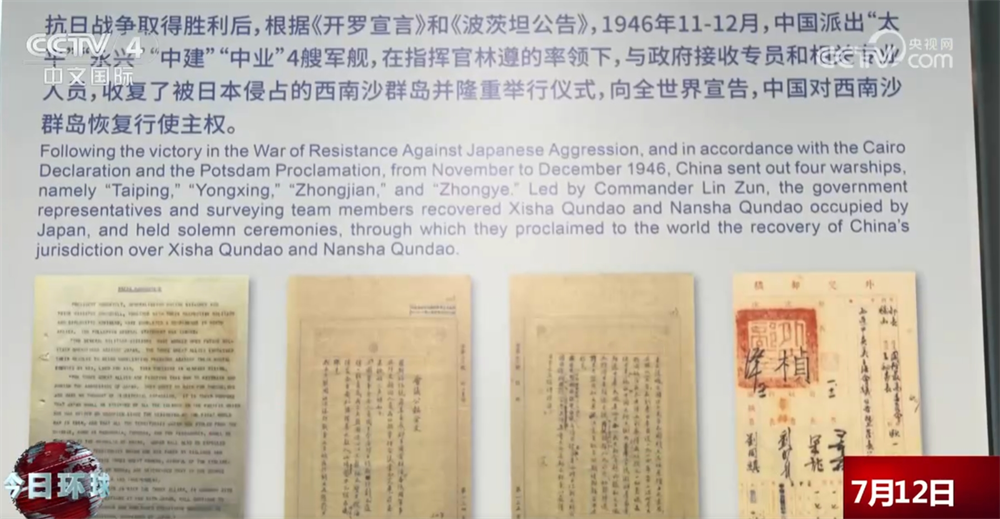
Core Viewpoint - The article discusses the ninth anniversary of the South China Sea arbitration ruling, emphasizing China's rejection of the ruling and the support it has received from over 100 countries, while highlighting the historical and legal context surrounding the issue [1]. Group 1: Historical Context - The South China Sea arbitration tribunal issued a ruling on July 12, 2016, which denied China's territorial sovereignty and maritime rights in the South China Sea, based on a unilateral request from the Philippines [1]. - Scholars argue that international treaties established after World War II, such as the Cairo Declaration and the Potsdam Proclamation, confirmed China's sovereignty over the South China Sea islands [4]. Group 2: Legal and Procedural Critique - Experts criticize the arbitration ruling for its numerous legal errors, including the tribunal's overreach in jurisdiction and the flawed process that allowed only one party to participate [4][7]. - The tribunal's interpretation of residency standards has been questioned, with comparisons made to U.S. territories that do not meet the same criteria [6]. Group 3: Geopolitical Implications - The article highlights the role of the United States in supporting the Philippines' claims and actions in the South China Sea, which has escalated tensions in the region [7][9]. - Experts call for a cessation of external interference in South China Sea matters, advocating for direct dialogue and negotiation between China and ASEAN countries [11].

中外专家学者在京共同研讨南海的历史与现实
Ren Min Ri Bao· 2025-07-10 22:52
Core Viewpoint - The international seminar "South China Sea: History and Reality" held in Beijing emphasized China's historical and legal claims over the South China Sea islands, rejecting the validity of the 2016 South China Sea arbitration ruling, and calling for regional cooperation to maintain peace and stability in the area [1][2]. Group 1 - The seminar was attended by over 150 experts and representatives from more than 10 countries, discussing topics such as post-World War II international order and sovereignty over the South China Sea islands [1]. - Wu Shicun, Chairman of the Academic Committee of the South China Sea Research Institute, stated that China's sovereignty over the South China Sea is supported by historical and legal evidence, and the 2016 arbitration ruling is invalid due to jurisdictional overreach and legal errors [1][2]. - Li Guoqiang, Vice President of the Chinese Academy of History, highlighted that international treaties post-World War II confirm China's sovereignty over the South China Sea, and called for enhanced mutual trust among regional parties to create a peaceful maritime community [2]. Group 2 - The seminar was co-hosted by the South China Sea Research Institute and the Huayang Ocean Research Center, with participation from diplomats of various countries and international organizations [2]. - Attendees reiterated that the South China Sea arbitration tribunal acted beyond its authority and that its ruling contradicts international law, including the United Nations Convention on the Law of the Sea [2]. - The need to expedite negotiations on the "South China Sea Code of Conduct" was emphasized to manage differences and maintain regional stability [1][2].
中国代表:美国才是南海安全稳定的最大威胁
news flash· 2025-05-21 02:55
Core Viewpoint - The Chinese representative at the UN asserts that the United States is the greatest threat to security and stability in the South China Sea, countering US accusations against China [1] Group 1: China's Position on South China Sea - China emphasizes its commitment to resolving maritime disputes through dialogue and consultation based on historical facts and international law [1] - The South China Sea arbitration ruling is deemed illegal and invalid by China, which does not accept or recognize it [1] - The overall situation in the South China Sea remains stable due to the joint efforts of China and ASEAN countries [1] Group 2: Future Aspirations - China expresses determination and capability to transform the South China Sea into a sea of peace, friendship, and cooperation [1]
耿爽用1234驳斥美方抹黑
news flash· 2025-05-20 23:45
Core Viewpoint - The article discusses China's response to the United States' criticisms regarding the South China Sea during a United Nations Security Council debate, emphasizing China's stance on maritime security and regional stability [1]. Group 1: China's Position on South China Sea - China asserts that the UN Security Council is not the appropriate forum for discussing the South China Sea issue, rejecting the U.S. representative's comments [1]. - The Chinese representative accuses the U.S. of being the greatest threat to security and stability in the South China Sea by frequently sending military vessels and aircraft under the guise of freedom of navigation [1]. - China emphasizes its commitment to resolving maritime disputes through dialogue and negotiation based on historical facts and international law, declaring the South China Sea arbitration ruling as illegal and invalid [1]. Group 2: Regional Stability and Cooperation - The article highlights that, with the joint efforts of China and ASEAN countries, the overall situation in the South China Sea remains stable [1]. - China expresses its determination and capability to transform the South China Sea into a sea of peace, friendship, and cooperation [1]. - The Chinese representative calls on the U.S. to adhere to its commitments regarding the One China principle [1].