县域医共体建设

Search documents
重点专科与县域医共体建设赋能健康岷县高质量发展
Xin Lang Cai Jing· 2026-02-13 10:06
Core Viewpoint - The construction of key specialties and county-level medical community in Min County is empowering high-quality health development, enhancing medical service efficiency and patient experience through technological advancements and integrated healthcare systems [1][2]. Group 1: Technological Advancements - The introduction of the "Yin Yi Tong" self-service system at Minyang Central Health Hospital has significantly reduced patient wait times for registration and payment, allowing for a more efficient healthcare experience [1]. - Real-time data uploading from township health centers to county hospitals enables remote diagnosis by county-level experts, improving diagnostic accuracy and reducing the need for patients to travel for test results [1]. Group 2: Healthcare System Integration - Min County has established a three-tier service system with county hospitals as the lead, township health centers as hubs, and village clinics as the foundation, achieving integrated management and standardized services across healthcare institutions [2]. - The county's healthcare service network is becoming increasingly efficient and collaborative, enhancing the overall quality of medical services available to the population [2]. Group 3: Policy and Future Directions - The Min County Health Bureau is committed to enhancing healthcare service capabilities and improving public health satisfaction, aligning with the directives from the 20th National Congress of the Communist Party of China regarding health system reform and service capacity improvement [3].
以改革筑牢基层健康防线(专家点评)
Ren Min Ri Bao· 2026-01-05 22:28
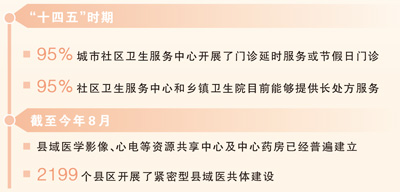
Core Viewpoint - The construction of county-level medical communities is a crucial approach to promote hierarchical diagnosis and treatment, ensuring the health of the public at their doorstep [1] Group 1: Development and Coverage - By the end of 2025, over 3,000 tightly-knit county medical communities are expected to be established, covering a population of more than 900 million [1] - The rate of visits and the volume of primary care in counties are steadily increasing, achieving a preliminary model of "primary examination, higher-level diagnosis" [1] Group 2: Key Focus Areas for Reform - The reform during the "14th Five-Year Plan" period should focus on continuous efforts in key areas, including deepening institutional and mechanism innovation [1] - Establishing a collaborative development mechanism for medical services, insurance, and pharmaceuticals, while optimizing insurance payment methods [1] - Creating a community of shared responsibilities and benefits, innovating personnel compensation systems, and enhancing talent cultivation and incentives [1] Group 3: Service Model Transformation - Promoting the transformation of service models to gradually establish a health outcome-oriented evaluation system for residents [1] - Encouraging the integration of medical and preventive services to better safeguard public health through county medical communities [1]
在镇卫生院享受专家诊疗(迈向“十五五”的民生图景)
Ren Min Ri Bao· 2025-10-25 22:54
Core Insights - The article highlights the successful implementation of a county-level medical community model in Dangtu County, which enhances access to healthcare services for local residents [4][5][6] Group 1: Medical Community Model - The Dangtu County People's Hospital has been recognized as a provincial-level demonstration unit for a tightly-knit county medical community, which integrates management of resources across village and town health institutions [4][5] - The model allows for expert medical services to be provided closer to home, reducing the need for patients to travel to larger hospitals [4][5] - The county hospital's management approach includes optimizing the healthcare system and resource integration to improve service delivery [5] Group 2: Patient Experience and Outcomes - A case study of a patient, Ding Xiaoqin, illustrates the benefits of the model, as she underwent a successful surgery at a local health center without needing to visit a larger hospital [4][5] - The number of inpatient visits at the town health center increased by 19.8% year-on-year in the first three quarters of the year, indicating growing trust and utilization of local healthcare services [5] - Post-surgery, Ding Xiaoqin reported a smooth recovery and a return to work, showcasing the effectiveness of local healthcare delivery [6] Group 3: Future Developments - The Dangtu County Health Commission plans to further develop the medical community model by establishing specialized departments in town health centers and training key personnel [6] - The goal is to increase the local consultation rate to 90%, ensuring that high-quality medical services are more deeply rooted and widely available in the community [6]

夯实健康中国数智底座,AI赋能医共体建设
Sou Hu Cai Jing· 2025-05-21 00:45
Group 1 - The core viewpoint of the articles emphasizes the integration of AI technology into the healthcare sector, particularly in enhancing the quality and accessibility of medical services at the grassroots level [1][2][4] - The Chinese government has initiated a "strong foundation project" in healthcare, aiming to expand quality medical resources and improve regional distribution, with AI playing a crucial role in this strategy [1][2] - The healthcare sector is experiencing a transformation from a disease-centric approach to a health-centered model, facilitated by AI applications in various clinical scenarios [2][4] Group 2 - Huawei is increasing its investment in the healthcare sector, focusing on both high-level technical breakthroughs and empowering grassroots medical institutions through AI [4][10] - The establishment of the County Medical Community AI Ecological Academic Alliance aims to promote the deep integration of AI technology in county-level healthcare, facilitating a tiered diagnosis and treatment system [8][10] - Key hospitals are leveraging AI for diagnostic and treatment assistance, significantly improving efficiency and quality in healthcare delivery [5][6][12] Group 3 - Huawei's DCS AI solutions are designed to support the intelligent upgrade of county hospitals, providing a unified IT infrastructure and data management platform [12][13] - The DCS AI solutions have been successfully implemented in leading hospitals, optimizing and standardizing solutions for easier deployment in county-level healthcare [13][15] - The focus on safety and stability in AI applications is critical for the successful integration of AI in healthcare, with Huawei's innovations providing a reliable foundation for these technologies [15][17]