
可插拔光模块

Search documents
800亿光模块龙头华工科技涨停,17万手封单,订单爆满排至四季度
Xin Lang Cai Jing· 2026-02-24 05:51
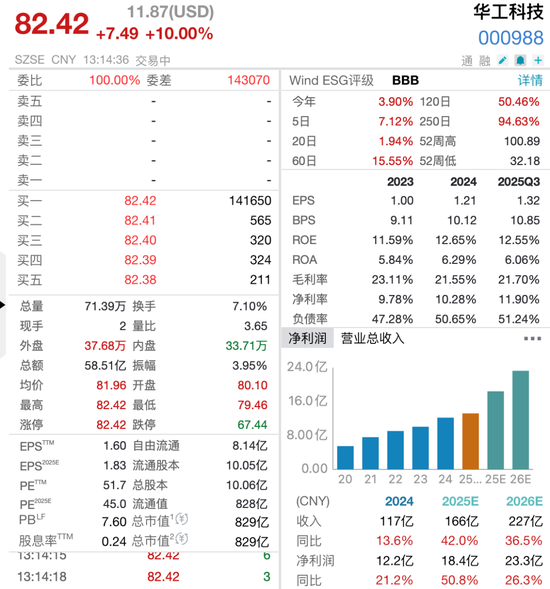
Core Viewpoint - The leading optical module company, Huagong Technology (000988.SZ), experienced a rapid stock price increase, reaching a limit-up of 82.42 CNY per share, with a total market capitalization of 829 billion CNY as of February 24 [1][6]. Company Performance - Huagong Technology reported a revenue of 110.38 billion CNY for the first three quarters of 2025, reflecting a year-on-year growth of 22.62%. The net profit attributable to shareholders was 13.21 billion CNY, up 40.92% year-on-year [3][9]. - However, in the third quarter of 2025, the company's revenue decreased by 10.33% year-on-year to 34.09 billion CNY, primarily due to fluctuations in traditional business sectors [3][9]. Business Operations - The company maintained continuous production during the Spring Festival, with its optical module business experiencing high demand and full order books, with orders extending to the fourth quarter of 2026 [2][10]. - The optical module production lines in Wuhan and Thailand operated at full capacity, focusing on the mass production of high-speed optical modules such as 1.6T and 800G [2][10]. Industry Trends - The global AI infrastructure is experiencing high demand, with major companies like Google and Meta increasing their AI capital expenditures, indicating a significant "siphon effect" in the AI sector [4][10]. - The market for pluggable optical modules is expected to remain a mainstream solution for data center optical interconnections in the next two to three years, despite current concerns about market concentration and stock structure [11].


美股光通信新高,厘清可插拔CPONPOOIO投资机会
2026-02-10 03:24
Summary of Conference Call Industry Overview - The conference primarily focused on the optical communication industry, particularly the developments in optical modules and related technologies [1][4]. - There is ongoing debate regarding the adoption and impact of new technologies such as CPUs, NPUs, and OBOs within the industry [2][3]. Key Points and Arguments - **Market Dynamics**: The optical module market is expected to perform better than other sectors, with leading companies currently valued at around 15 times earnings, indicating a potential for rapid valuation recovery [4][5]. - **Order Trends**: Despite recent controversies surrounding CPUs, the demand for detachable optical modules remains strong, with expectations of significant growth in 2027 [5][6]. - **Long-term Contracts**: Companies are increasingly locking in long-term contracts for materials, with some suppliers securing agreements for 2-3 years, reflecting robust demand exceeding supply [6][7]. - **Technological Evolution**: The industry is experiencing a shift in packaging methods, with advancements in materials and designs leading to new product offerings, such as 1.6T and future 3.2T modules [2][3]. - **Fragmented Information**: Analysts noted that discussions around CPUs often lead to polarized views due to fragmented information, emphasizing the need for a clearer understanding of the technology's applications [7][8]. Additional Important Insights - **Production Challenges**: The production efficiency and yield rates of new technologies, particularly in the context of CPUs and optical modules, remain critical concerns that could impact large-scale deployment [17][19]. - **Evolving Architectures**: The conference highlighted the importance of understanding new network architectures and their implications for optical module usage, suggesting that the industry is moving towards more complex configurations [20][21]. - **Competitive Landscape**: Established companies with a strong technological foundation are likely to have a competitive advantage in the evolving market, while new entrants may struggle to gain traction without significant innovation [22][23]. Conclusion - The conference provided a comprehensive overview of the current state and future prospects of the optical communication industry, emphasizing the importance of understanding technological advancements, market dynamics, and production challenges to make informed investment decisions [23].