OBO

Search documents
Arista XPO白皮书解析
傅里叶的猫· 2026-03-22 13:54
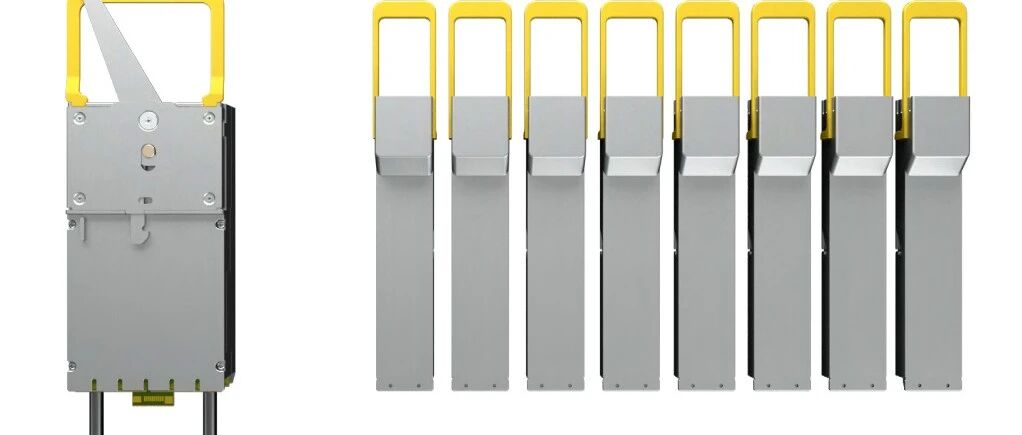
Core Viewpoint - The article discusses the recent developments in optical interconnects for AI data centers, focusing on Arista Networks' XPO architecture, which aims to address the increasing bandwidth demands and operational challenges faced by AI workloads [1][2]. Group 1: Infrastructure Challenges in AI - The scale of AI data centers has surpassed 100,000 GPUs, leading to training costs reaching millions of dollars per task, highlighting the need for a redefined optical interconnect [2]. - Traditional network architectures are struggling to meet the extreme bandwidth requirements of distributed training clusters, necessitating innovative solutions [4]. Group 2: XPO Architecture Overview - XPO is designed to provide both flexibility and a significant increase in density, achieving a single module bandwidth of 12.8Tbps and a front panel density of 204.8Tbps per 1U [5][6]. - Compared to OSFP, XPO's single module bandwidth is eight times greater, and its front panel density is four times higher, while also supporting integrated liquid cooling [6]. Group 3: Innovations in XPO Design - The "belly-to-belly" dual PCB architecture enhances heat dissipation by placing high-power components on the inner side and cooler components on the outer side [9]. - Integrated liquid cooling is a revolutionary feature, allowing the module to handle over 400W of heat, significantly improving thermal management compared to traditional air cooling [11]. - XPO utilizes a 50V high-voltage power supply, reducing current requirements and enhancing system reliability [15][16]. Group 4: System-Level Benefits - In a standard ORv3 liquid-cooled rack, XPO can achieve a total bandwidth of 6.5Pbps, supporting 32 switches, while OSFP only achieves 1.6Pbps with 8 switches [19][22]. - The use of XPO reduces the number of racks needed for large-scale deployments, leading to significant savings in space, power infrastructure investment, and cooling capacity [23]. Group 5: Ecosystem and Future Developments - XPO's development is supported by a broad ecosystem of over 45 partners, ensuring interoperability and competitive pricing through a multi-source agreement [32][33]. - The architecture is designed for continuous evolution, with plans to support 64 channels of 400Gbps in the future, doubling the current bandwidth capacity [35].


美股光通信新高,厘清可插拔CPONPOOIO投资机会
2026-02-10 03:24
Summary of Conference Call Industry Overview - The conference primarily focused on the optical communication industry, particularly the developments in optical modules and related technologies [1][4]. - There is ongoing debate regarding the adoption and impact of new technologies such as CPUs, NPUs, and OBOs within the industry [2][3]. Key Points and Arguments - **Market Dynamics**: The optical module market is expected to perform better than other sectors, with leading companies currently valued at around 15 times earnings, indicating a potential for rapid valuation recovery [4][5]. - **Order Trends**: Despite recent controversies surrounding CPUs, the demand for detachable optical modules remains strong, with expectations of significant growth in 2027 [5][6]. - **Long-term Contracts**: Companies are increasingly locking in long-term contracts for materials, with some suppliers securing agreements for 2-3 years, reflecting robust demand exceeding supply [6][7]. - **Technological Evolution**: The industry is experiencing a shift in packaging methods, with advancements in materials and designs leading to new product offerings, such as 1.6T and future 3.2T modules [2][3]. - **Fragmented Information**: Analysts noted that discussions around CPUs often lead to polarized views due to fragmented information, emphasizing the need for a clearer understanding of the technology's applications [7][8]. Additional Important Insights - **Production Challenges**: The production efficiency and yield rates of new technologies, particularly in the context of CPUs and optical modules, remain critical concerns that could impact large-scale deployment [17][19]. - **Evolving Architectures**: The conference highlighted the importance of understanding new network architectures and their implications for optical module usage, suggesting that the industry is moving towards more complex configurations [20][21]. - **Competitive Landscape**: Established companies with a strong technological foundation are likely to have a competitive advantage in the evolving market, while new entrants may struggle to gain traction without significant innovation [22][23]. Conclusion - The conference provided a comprehensive overview of the current state and future prospects of the optical communication industry, emphasizing the importance of understanding technological advancements, market dynamics, and production challenges to make informed investment decisions [23].
CPO,大有可为
半导体行业观察· 2025-07-21 01:22
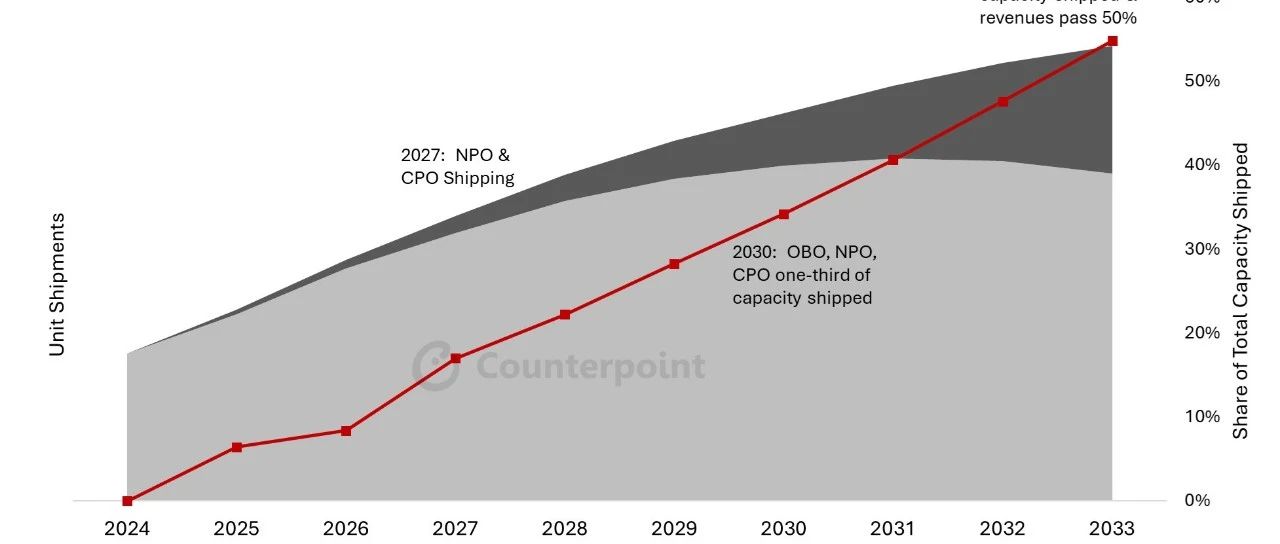
Core Insights - The article discusses the growing importance of integrated semiconductor optical modules, specifically On-Board Optical (OBO), Near-Package Optical (NPO), and Co-Packaged Optical (CPO) solutions, which are expected to see a compound annual growth rate of 50% in shipment volume by 2033 [2][4]. Group 1: Market Trends - Integrated optical solutions are significantly improving transmission capacity and processing for AI systems, providing higher bandwidth at lower power consumption [2][4]. - The transition from copper to optical solutions is anticipated to lead to a non-linear performance enhancement, with potential performance increases of up to 80 times compared to existing solutions [7]. Group 2: Key Players and Future Projections - Major companies like NVIDIA, Intel, Marvell, and Broadcom are currently leading the development of CPO technology, which is expected to drive substantial revenue growth and shipment volume by 2027 [4]. - By 2033, it is projected that over half of the revenue and shipment volume will come from integrated semiconductor optical I/O solutions [4].


嵌入式光传输技术,CPO的到来将推动人工智能超级计算的拓展
Counterpoint Research· 2025-07-17 01:25
Core Viewpoint - The report from Counterpoint Research highlights the significant growth potential of integrated semiconductor optical modules, particularly embedded optical interconnects, which are expected to achieve a compound annual growth rate (CAGR) of 50% by 2033, driven by advancements in AI and high-bandwidth network architectures [2][3]. Group 1: Market Trends - The shipment volume of integrated optical solutions, including On-Board Optical (OBO), Near-Package Optical (NPO), and Co-Packaged Optical (CPO), is projected to grow at a CAGR of 50% by 2033 [2]. - The transition from copper to optical technology is anticipated to enhance bandwidth and reduce power consumption, with embedded optical modules expected to see a significant increase in adoption [2][3]. - By 2027, widespread adoption of NPO and CPO is expected to drive a triple-digit year-on-year revenue growth, with their share in total shipments reaching double digits [2][3]. Group 2: Technological Advancements - CPO is identified as a game changer for AI computing, enabling ultra-high bandwidth expansion and significant reductions in power consumption [3][5]. - The shift towards "less copper, more light" will lead to a substantial decrease in copper usage at each stage of transition from OBO to NPO to CPO, resulting in nonlinear performance improvements [7]. - The performance of 3D CPO solutions may exceed current technologies by up to 80 times, marking a significant leap in capabilities [7]. Group 3: Key Players - Major companies leading the CPO field include NVIDIA, Intel, Marvell, and Broadcom, with ongoing technological evolution expected to be a gradual process [3][5].