
司法大数据

Search documents
法官成功追款80万!年底清账,企查查这几个技巧你学会了吗?
Qi Cha Cha· 2026-01-20 07:02
Core Insights - The article highlights the successful recovery of over 800,000 yuan in a seemingly hopeless execution case, showcasing the effectiveness of the commercial query tool Qichacha in uncovering hidden assets and debts [1][3]. Group 1: Case Overview - The execution case faced initial difficulties as the debtor company had no visible assets, leading to a standstill in the judicial process [3]. - The breakthrough came when the judge utilized Qichacha's data capabilities to identify a key piece of information: the debtor had won a sewage treatment project, which included a receivable amount of over 800,000 yuan [3][4]. - The court issued an execution order to the project owner, who complied without objection, allowing the recovery of the funds [3]. Group 2: Qichacha's Capabilities - Qichacha's strength lies in its comprehensive data coverage, processing petabytes of data daily from authoritative sources, which aids in uncovering critical information [4]. - The platform employs intelligent analysis to transform data into actionable insights, allowing users to identify relationships and hidden assets effectively [4][5]. - Its functionalities are tailored to meet the specific needs of judicial execution and debt recovery, enhancing the efficiency of these processes [5][6]. Group 3: Broader Implications - Qichacha's role extends beyond debt recovery; it serves as a vital link between commercial activities and social governance, contributing to judicial efficiency and legal authority [7][8]. - The platform has established data cooperation mechanisms with various judicial bodies, facilitating the identification of shell companies and optimizing case handling [7]. - In the commercial sector, Qichacha aids businesses in managing risks associated with debt collection, providing essential data for negotiations and legal actions [7][8]. Group 4: Practical Debt Recovery Techniques - Technique 1: Use Qichacha's bidding query function to identify the debtor's income sources through recent project wins, which can indicate potential recoverable assets [9]. - Technique 2: Leverage the associated enterprise analysis feature to uncover hidden debts and assets that may be held by related companies [10]. - Technique 3: Monitor risk factors such as operational anomalies and financial changes in the debtor's business to time recovery efforts effectively [11].
数字法院折射治理之变(法治头条)
Ren Min Ri Bao· 2025-12-10 22:30
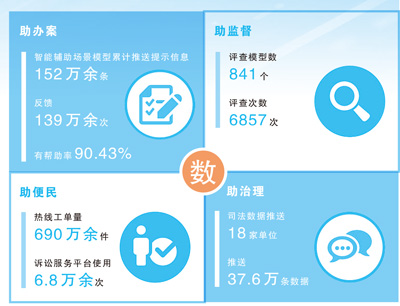
Core Viewpoint - The Shanghai courts are actively advancing the construction of digital courts, integrating big data and artificial intelligence into judicial processes to enhance efficiency and precision in governance and legal proceedings [4][10][12]. Group 1: Digital Court Construction - The Shanghai courts focus on scene construction and digital modeling to promote the digital court initiative, which includes comprehensive case management and specialized adjudication [4][6]. - The establishment of over 1,100 intelligent auxiliary scene models has improved case handling efficiency and strengthened judicial management [6][10]. - The transition from "experience-driven" to "data-driven" approaches in case handling has been emphasized, allowing judges to utilize data for better decision-making [10][12]. Group 2: Judicial Efficiency and Case Management - The integration of data resources into a single intelligent auxiliary model has significantly enhanced the efficiency of case handling, allowing for quick identification of assets for execution [9][10]. - The digital court initiative has led to the generation of over 152,000 prompt notifications, covering 92% of judges in the city, thereby improving judicial quality [12][13]. - The focus on data sharing and analysis distinguishes the digital court from previous information technology initiatives in the judiciary [10][12]. Group 3: Public Service and Accessibility - The digital court initiative has improved public access to judicial services, allowing citizens to query marriage-related documents online, which constitutes nearly 70% of civil service requests [13][14]. - The implementation of a mechanism for sharing information related to domestic violence cases has enhanced the effectiveness of protective orders [16][17]. - The digital court system enables real-time feedback on litigation risks and provides predictive analytics for case outcomes, enhancing transparency and public trust [16][17]. Group 4: Collaborative Governance - The digital court initiative facilitates collaboration between judicial and administrative departments, addressing issues such as medical insurance fund recovery through data sharing [18][19]. - The proactive identification of potential issues through data analysis has led to significant recoveries of medical funds, amounting to nearly 8.7 million yuan [20][21]. - The establishment of intelligent auxiliary models to address prepayment consumption disputes has improved consumer protection and market order [22][23].

能识别“假离婚实逃债”上海数字法院用新招破司法难题
Yang Shi Xin Wen· 2025-11-28 02:32
Core Viewpoint - Shanghai's digital court system is effectively addressing traditional judicial challenges, such as identifying fraudulent divorce cases used for debt evasion, through advanced data integration and predictive alerts [1][3]. Group 1: Digital Court Innovations - The Shanghai digital court has integrated data deeply into judicial practices, significantly improving the identification of issues like false litigation [1][3]. - Since the implementation of the 14th Five-Year Plan, the digital court has developed over 1,800 application scenarios and embedded more than 800 into case handling systems, generating over 1.5 million alerts that cover 92% of judges in the city [5]. Group 2: Case Study of Fraudulent Divorce - A divorce case in the Pudong New Area revealed potential debt evasion, where the husband had numerous ongoing litigation cases, prompting the court to investigate further [2][3]. - The court's alert system indicated that the husband might be attempting to transfer assets to the wife, which could hinder debt repayment, leading to a decision to separate the divorce proceedings from asset distribution [2][3]. Group 3: Data-Driven Dispute Resolution - The digital court utilizes big data to identify common disputes, such as noise and smoke complaints, and has initiated community巡回审判 (circuit trials) to address these issues directly [6][7]. - In a notable case involving neighbor disputes over property use, the court facilitated a resolution that led to the removal of a problematic structure, resulting in the resolution of 21 related disputes [7]. Group 4: Community Safety Initiatives - A fire incident caused by improper electric vehicle charging highlighted safety concerns, leading to a court ruling that mandated compensation and the establishment of community guidelines for electric vehicle management [8]. - The Shanghai courts have set up 340巡回审判 points across 200 neighborhoods, resolving over 4,880 disputes through community engagement and legal education [8].