数字正义

Search documents
数字法院折射治理之变(法治头条)
Ren Min Ri Bao· 2025-12-10 22:30
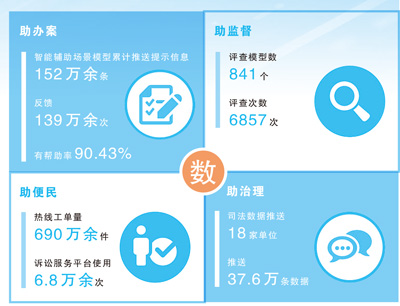
Core Viewpoint - The Shanghai courts are actively advancing the construction of digital courts, integrating big data and artificial intelligence into judicial processes to enhance efficiency and precision in governance and legal proceedings [4][10][12]. Group 1: Digital Court Construction - The Shanghai courts focus on scene construction and digital modeling to promote the digital court initiative, which includes comprehensive case management and specialized adjudication [4][6]. - The establishment of over 1,100 intelligent auxiliary scene models has improved case handling efficiency and strengthened judicial management [6][10]. - The transition from "experience-driven" to "data-driven" approaches in case handling has been emphasized, allowing judges to utilize data for better decision-making [10][12]. Group 2: Judicial Efficiency and Case Management - The integration of data resources into a single intelligent auxiliary model has significantly enhanced the efficiency of case handling, allowing for quick identification of assets for execution [9][10]. - The digital court initiative has led to the generation of over 152,000 prompt notifications, covering 92% of judges in the city, thereby improving judicial quality [12][13]. - The focus on data sharing and analysis distinguishes the digital court from previous information technology initiatives in the judiciary [10][12]. Group 3: Public Service and Accessibility - The digital court initiative has improved public access to judicial services, allowing citizens to query marriage-related documents online, which constitutes nearly 70% of civil service requests [13][14]. - The implementation of a mechanism for sharing information related to domestic violence cases has enhanced the effectiveness of protective orders [16][17]. - The digital court system enables real-time feedback on litigation risks and provides predictive analytics for case outcomes, enhancing transparency and public trust [16][17]. Group 4: Collaborative Governance - The digital court initiative facilitates collaboration between judicial and administrative departments, addressing issues such as medical insurance fund recovery through data sharing [18][19]. - The proactive identification of potential issues through data analysis has led to significant recoveries of medical funds, amounting to nearly 8.7 million yuan [20][21]. - The establishment of intelligent auxiliary models to address prepayment consumption disputes has improved consumer protection and market order [22][23].

律三多——一个懂法律、更懂你的法律服务APP
Bei Ke Cai Jing· 2025-04-22 03:49
Core Insights - The article highlights the emergence of the "Lü San Duo" legal service app, which addresses unmet legal needs in the context of rising digital economy challenges such as personal privacy disputes and labor rights protection [1] Group 1: Company Overview - "Lü San Duo" aims to create a leading all-scenario intelligent legal service system in China, emphasizing the integration of technology and legal services [3] - The platform collaborates with numerous top-tier law firms to build an intelligent legal ecosystem, combining over 30 years of practical experience with advanced technology [3] - It features a database of over 100,000 real cases and employs a three-dimensional service model that includes senior lawyer core services, comprehensive resource support, and a rapid response system [3] Group 2: Service Features - The app utilizes deep learning from 300,000 legal consultation cases to provide digital solutions across various fields, including family law, labor injuries, corporate compliance, and intellectual property [3] - An innovative intelligent diversion system allows for 90% of common inquiries to receive responses in seconds, while contract processing efficiency is reported to improve by five times [5] - The platform offers a "yearly package" model for businesses, significantly reducing service costs compared to industry averages, and an on-demand payment model for individual users [5] Group 3: Market Impact - The introduction of legal technology is changing public perceptions of legal services, with a recent survey indicating that 78.6% of users of legal tech products are more likely to pursue legal action, a 42 percentage point increase compared to traditional service users [5] - The app is seen as a tool for democratizing access to legal services, making legal resources as essential as utilities like water and electricity [5][7] - The ongoing "Digital Justice" strategy positions legal technology as a means for ordinary individuals to combat injustice, providing timely professional responses to legal inquiries [7]