合作拿地

Search documents
中建智地“举报”越秀地产后续:北京黄杉木店项目操盘权之争达成和解
Mei Ri Jing Ji Xin Wen· 2025-11-17 18:22
Core Viewpoint - A dispute between a central enterprise-backed real estate company and a local state-owned real estate company has been resolved through mutual agreement, highlighting the competitive dynamics in the Beijing real estate market [1][8]. Group 1: Project Development and Collaboration - The Beijing Huangshanmu store project, also known as Zijing Chenyuan and Puyue, is a joint development by Guangzhou Yuexiu Real Estate, Beijing Xingding Real Estate, and Beijing Fangxing Yicheng Real Estate, with a total land acquisition cost of 12.6 billion yuan [1][2]. - The three companies have agreed to collaborate on marketing and project development, adhering to principles of professionalism, transparency, and better service delivery to clients [1][9]. - The shareholding structure shows that Beijing Xingchang Real Estate (Zijing Chenyuan project) is 50.1% owned by Zhongjian Zhidi, 32.9% by China Jinmao, and 17% by Yuexiu Real Estate [2]. Group 2: Market Competition and Pricing Issues - Allegations of unfair competition were raised by Zhongjian Zhidi against Yuexiu Real Estate, claiming that the latter's marketing strategies led to customer loss and disrupted pricing order in the market [5][6]. - The pricing strategy for both projects was supposed to follow a unified standard based on core dimensions such as unit type and location, but discrepancies arose during the marketing process [4][5]. - The competitive environment is intense, with both projects targeting high-end improvement customers, leading to significant media attention and market discussions [6][7]. Group 3: Sales Performance - Zijing Chenyuan achieved sales of 5.65 billion yuan shortly after its launch, while Puyue reported sales of 4.565 billion yuan, indicating strong market interest [3][6]. - As of November 16, Zijing Chenyuan had 111 units signed at an average price of approximately 98,000 yuan per square meter, while Puyue had 117 units signed at around 99,600 yuan per square meter [6]. Group 4: Future Market Outlook - The Huangshanmu store area is positioned as a prime location for residential development, with plans for 30 high-quality residential land resources to be released in Chaoyang District over the next three years [7]. - The collaboration between these companies is seen as a strategy to mitigate risks and enhance competitiveness in a challenging real estate market [6].

中建智地举报越秀地产后续:北京126亿元“地王”项目操盘权之争达成和解
Mei Ri Jing Ji Xin Wen· 2025-11-16 21:30
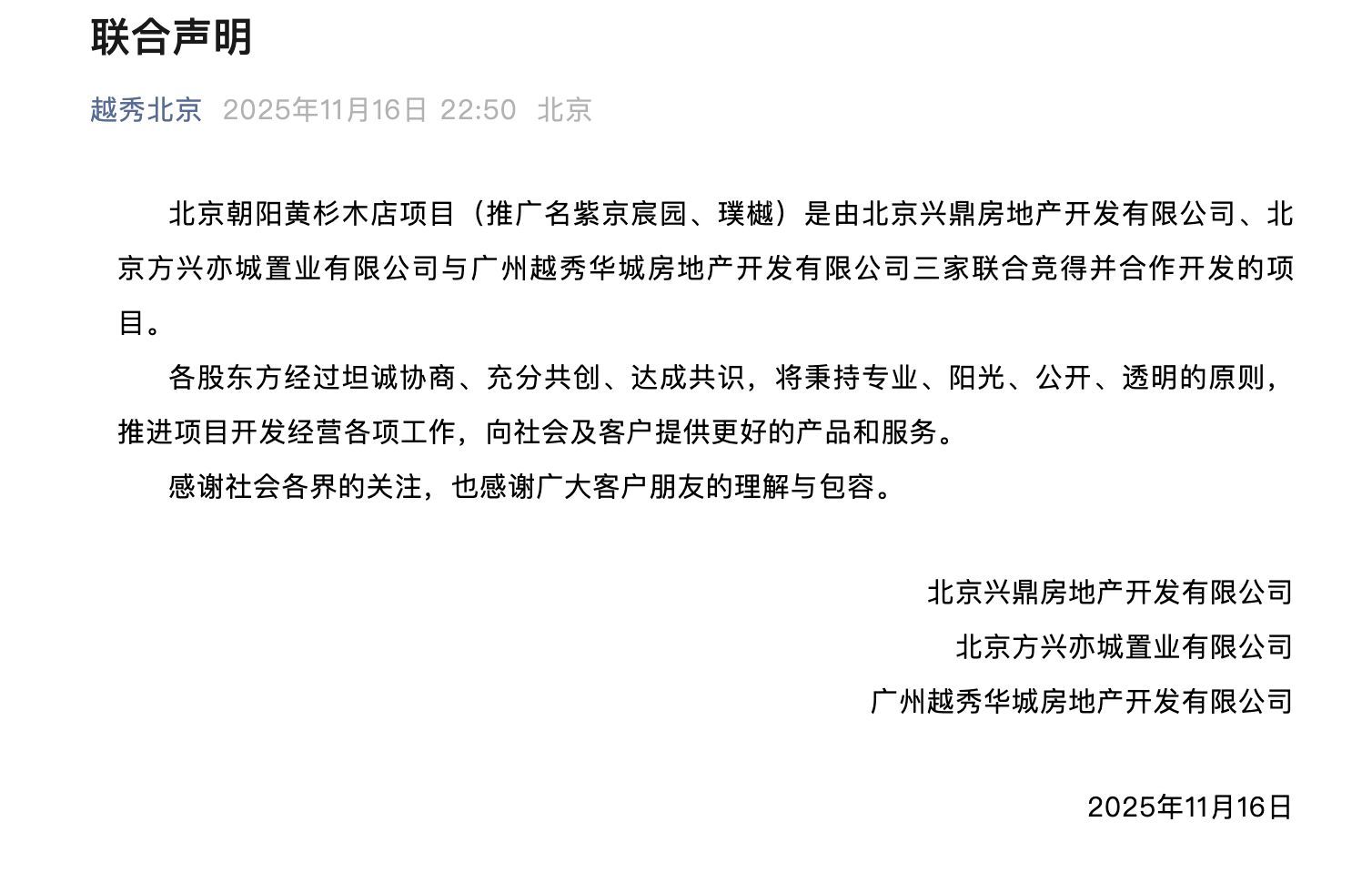
Core Viewpoint - A dispute between state-owned real estate companies has been resolved amicably, following allegations of unfair competition and pricing issues in a joint project in Beijing [1][3][6]. Group 1: Background of the Dispute - On November 12, a complaint was filed by Beijing Xingding Real Estate Development Co., a subsidiary of China State Construction, against Guangzhou Yuexiu Real Estate's subsidiary, alleging unreasonable pricing and malicious competition in the Beijing Puyue project [1][3]. - The joint project, known as the Huangshanmu Store project, was won by a consortium including China State Construction, China Jinmao, and Yuexiu Real Estate for 12.6 billion yuan, setting a record for floor prices in the Chaoyang District [7][10]. Group 2: Resolution and Future Plans - On November 16, the involved parties reached a consensus and issued a joint statement, committing to transparency and collaboration in project development [3][6]. - The three companies will jointly manage marketing for both the southern and northern plots of the Huangshanmu Store project, aiming to enhance product offerings and services [6][19]. Group 3: Market Context and Implications - The competitive landscape in Beijing's real estate market is intense, with significant public interest in the projects, leading to discussions about pricing strategies and customer retention [15][19]. - The resolution of the dispute is seen as beneficial for both developers and buyers, allowing for a more stable market environment amid ongoing adjustments in the real estate sector [20].