
和平总统

Search documents
特朗普在战争与和平之间摇摆
Xin Lang Cai Jing· 2026-02-19 16:50
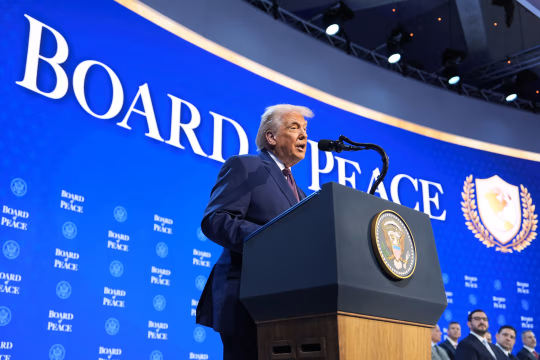
Core Viewpoint - The newly established Board of Peace by President Trump aims to mediate global conflicts, a role traditionally held by the United Nations, with over 20 countries already signed on to join [2][5]. Group 1: Peace Committee - The Board of Peace is set to hold its first meeting in Washington, indicating the arrival of significant figures as evidenced by the deployment of security measures [2][5]. - Trump's vision for the committee is to create a global institution focused on conflict resolution, which raises questions about its effectiveness compared to existing international bodies [2][5]. Group 2: Military Presence and Tensions - Concurrently, Trump has amassed a substantial military presence in the Middle East, leading to speculation about potential military action against Iran, with Tehran preparing for possible attacks [2][5]. - The dual approach of "peace through strength" is causing anxiety among Middle Eastern leaders, who are uncertain whether Trump will pursue diplomatic solutions or military interventions [2][5]. Group 3: Diplomatic Strategy - Trump's willingness to take decisive action against countries like Iran and Venezuela contrasts with previous U.S. presidents, who often hesitated in similar situations [2][5]. - The effectiveness of Trump's peace initiatives is questioned, especially as he navigates military deployments between South America and the Middle East, complicating his image as a "peace president" [2][5]. - Despite challenges in gaining broader support for the peace committee, there remains an opportunity for Trump to adjust key roles within the global alliance to enhance his position [2][5].

1年内近600次单方面对外军事打击,特朗普重返白宫一周年:“只有你想不到,没有他做不到”
Xin Jing Bao· 2026-01-20 00:22
Core Viewpoint - The article discusses the significant domestic and international impacts of Trump's policies during his second term, highlighting a shift towards aggressive strategies and a focus on national interests, which has led to both support and controversy within the U.S. and abroad [1][2][8]. Domestic Policy - Trump has aimed to "clean up the deep state" by reforming federal agencies, cutting federal employment, and implementing strict immigration policies, which have garnered mixed reactions from the public but some support from his voter base [1][9]. - The administration's focus on immigration has led to a notable decrease in illegal immigration, which Trump emphasizes as a key achievement [1]. - Trump's economic narrative contrasts with the public's experience of rising living costs, prompting him to seek foreign policy victories to bolster his domestic image [4][9]. Foreign Policy - Trump's foreign policy has shifted to a more aggressive stance, characterized by a "tariff war" and unilateral military actions, including nearly 600 strikes in less than a year [2][10]. - The administration's focus on the Western Hemisphere has intensified, with controversial actions such as the attempted capture of Venezuelan President Maduro, reflecting a strategic pivot [2][3]. - The concept of "Donroe Doctrine" has emerged, indicating a more forceful approach to foreign policy that relies less on international norms and more on military power [6][7]. International Relations - The U.S. has seen a decline in its credibility regarding the "rules-based international order," as Trump's administration has shown a disregard for established norms and agreements [6][12]. - The relationship with China has evolved into a "comprehensive strategic stalemate," with both nations engaging in mutual pressure and competition, indicating a more realistic understanding of China's capabilities [14][16]. - Trump's selective withdrawal from international agreements reflects a strategy of prioritizing U.S. interests while maintaining influence in key global institutions [12][13].