品牌生态构建

Search documents
新股解读|乐欣户外:稳健基本盘与高成长赛道共振 打造户外装备投资稀缺标的
智通财经网· 2026-02-03 03:51
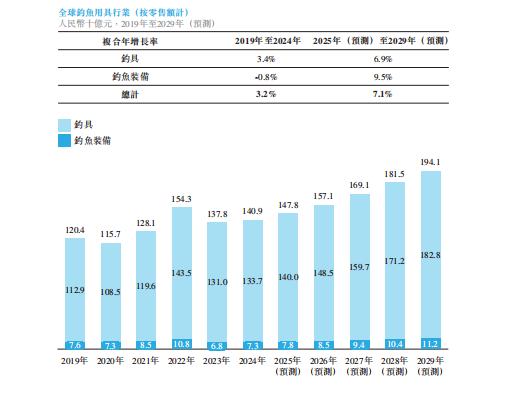
Core Viewpoint - The global fishing tackle industry is increasingly attractive to capital due to its stable fundamentals and clear growth potential, with Lexin Outdoor positioned as a leader benefiting from both industry growth and its unique strategic layout [1][2]. Group 1: Industry Growth and Market Position - The global fishing tackle market is expected to see a significant growth acceleration, with a projected compound annual growth rate (CAGR) increasing from 3.2% over the past five years to 7.1% in the next five years [3][4]. - Lexin Outdoor holds a 23.1% share of the global fishing tackle manufacturing market, providing it with strong pricing power and stability in earnings [2][4]. Group 2: Strategic Focus and Value Capture - Lexin Outdoor is strategically positioned in high-growth segments of the fishing tackle market, achieving a CAGR of 9.5%, significantly outpacing the overall industry growth [6][7]. - The company’s focus on enhancing product experience aligns with the "experience economy" trend, leading to increased product lifecycle, higher average transaction values, and more frequent purchases [7][8]. Group 3: Financial Performance and Growth Trajectory - Lexin Outdoor's revenue for 2024 is projected to reach 573.463 million RMB, reflecting a 23.8% increase from 2023, with the first eight months of 2025 already achieving 4.60 billion RMB, nearing 80% of the previous year's total [14][15]. - The company has demonstrated a consistent improvement in gross margin, increasing from 23.2% in 2022 to 26.6% in 2024, and further to 27.7% in the first eight months of 2025 [14][18]. Group 4: Strategic Evolution and Brand Development - Lexin Outdoor is transitioning from a global manufacturing leader to a provider of comprehensive fishing lifestyle solutions, driven by an upgraded business model that emphasizes brand value [8][9]. - The acquisition of the Solar brand in 2017 exemplifies the company's ability to leverage manufacturing efficiencies to enhance brand value, with projected sales growth of approximately three times by 2024 compared to 2018 [8][9]. Group 5: Ecosystem and Market Penetration - The company has built a robust global customer network, enhancing its market presence in regions like the US, UK, and Japan, while also strategically expanding into China and Southeast Asia to capture growth opportunities [10][11]. - Collaborations with leading brands such as Decathlon and others have created high switching costs and trust barriers, facilitating market entry and brand validation [10][11].

主业做大,副牌做小,海底捞们集体开启“第二战场”
3 6 Ke· 2025-11-10 01:43
Core Insights - Major restaurant chains are increasingly focusing on smaller business models, diversifying their offerings beyond traditional large-scale operations [1][3][5] - The trend of "miniaturization" in the restaurant industry is gaining momentum, with companies like Haidilao and MoMo exploring niche markets [1][19] Group 1: Industry Trends - Haidilao has launched several new brands targeting smaller segments, including "SHUA BAKERY" and "小嗨爱炸hiburger," indicating a strategic shift towards smaller business models [1][6][19] - Other companies, such as Xibei and MoMo, are also experimenting with smaller store formats and focused product offerings, reflecting a broader industry trend [3][10][14] - The traditional emphasis on large-scale operations is being challenged by more agile and precise "small" models, which are seen as a new competitive advantage [5][19] Group 2: Business Strategies - The "small business" approach allows for reduced operational costs and increased efficiency, as seen in Haidilao's "举高高自助小火锅," which has achieved high table turnover rates [23][24] - Companies are focusing on fewer products to strengthen brand identity and consumer recognition, exemplified by MoMo's "软虎虎" brand, which centers on a single product [25][27] - The branding strategy is shifting towards creating relatable and youthful identities, making it easier for consumers to connect with new sub-brands [29][31] Group 3: Competitive Landscape - The move towards smaller business models is not just a trend but a strategic necessity for companies to explore new markets and build competitive barriers [34][35] - Companies are transitioning from being "super brands" to creating a "brand fleet," allowing for diversified offerings and shared resources across different brands [36][38] - The ability to test new concepts with lower investment risks is a significant advantage, enabling companies to innovate while maintaining their core business [39][40]