品牌稀缺性

Search documents
Birkenstock plc(BIRK) - 2025 Q4 - Earnings Call Transcript
2025-12-18 14:02
Financial Data and Key Metrics Changes - The company reported full-year revenue growth of 18% in constant currency, reaching EUR 2.1 billion, exceeding the initial guidance of 15%-17% [8][15] - Gross margin increased by 30 basis points to 59.1%, while adjusted EBITDA margin rose by 100 basis points to 31.8% [9][18] - Adjusted net profit for the fourth quarter was EUR 94 million, up 71% year over year, with adjusted EPS of EUR 1.85 for the full year, up 45% from fiscal 2024 [18][19] Business Line Data and Key Metrics Changes - The Americas segment grew by 18% in constant currency, EMEA by 14%, and APAC by 34% [15][16] - B2B channel revenue increased by 21%, while D2C grew by 12% in constant currency [16] - Closed-toe share of revenue increased by 500 basis points year over year to 38% [11] Market Data and Key Metrics Changes - The company sold over 38 million pairs in fiscal 2025, up over 12%, with an average selling price (ASP) increase of 5% in constant currency [9][10] - The APAC segment now accounts for 11% of global revenue, with the highest ASP [11] Company Strategy and Development Direction - The company plans to open about 40 new stores in 2026, aiming for a total of 150 stores ahead of schedule [10][24] - Focus on maintaining brand scarcity and managing distribution tightly to support full-price realization, which remains over 90% [10][12] - The company is investing in production capacity and innovation to meet growing demand, particularly in the APAC market [12][27] Management's Comments on Operating Environment and Future Outlook - Management expressed optimism about future growth despite challenges from FX and tariffs, expecting a slower revenue growth of 13%-15% in fiscal 2026 [20][22] - The company highlighted strong demand across all segments, particularly from younger consumers in the B2B channel [30][49] - Management noted that production capacity constraints are the primary limitation to growth, not demand [31][60] Other Important Information - The company repurchased shares totaling EUR 176 million and reduced net leverage from 1.8x to 1.5x [19][20] - Capital expenditures for fiscal 2026 are expected to be between EUR 110 million and EUR 130 million [24] Q&A Session Summary Question: What is driving the more conservative view for 2026? - Management indicated that while demand remains strong, production capacity constraints are the main limitation to growth [30] Question: Can you elaborate on the margin outlook for 2026? - Management explained that FX and tariffs will significantly impact margins, with a total drag of about 200 basis points expected [39][40] Question: How do you see channel growth in 2026? - Management expects B2B to continue outpacing D2C growth, driven by strong demand from younger demographics [49] Question: What are the expectations for consumer demand in the EU? - Management reported strong growth in EMEA, particularly in closed-toe products, and expects continued positive trends in Q1 [57][58] Question: How will the new stores be located and what is the strategy for DTC? - The company plans to open stores in key cities and aims to enhance the DTC channel through targeted membership benefits and loyalty programs [78][80]

中银证券:维持贵州茅台“买入”评级,聚焦渠道稳定性,稳步推进改革
Xin Lang Cai Jing· 2025-12-10 05:25
Core Viewpoint - The report from Zhongyin Securities indicates that Kweichow Moutai's shareholders' meeting emphasized the importance of quality over mere metrics, committing to long-term value and steady reform amidst industry demand and price pressures [1] Group 1: Company Performance - In the context of declining industry demand and pricing pressures, the company's revenue and profit growth significantly slowed in the third quarter [1] - The price of the "Feitian" product has seen a substantial decline this year, leading to a reduction in the thickness of the channel moat [1] Group 2: Strategic Outlook - The shareholders' meeting conveyed Moutai's strategic determination and commitment to high-quality development in the medium to long term [1] - Despite the current challenging policy environment and demand side, the company is expected to take time to digest channel inventory [1] Group 3: Earnings Forecast - Based on the third-quarter performance, the company has adjusted its previous earnings forecast, projecting diluted earnings per share for 2025 to 2027 at 72.31, 75.80, and 80.93 yuan per share, respectively [1] - The current market capitalization corresponds to price-to-earnings ratios of 19.6X, 18.7X, and 17.5X for the respective years [1] - The rating of "Buy" is maintained [1]

深度:如何构建品牌稀缺性?
Hu Xiu· 2025-06-12 01:42
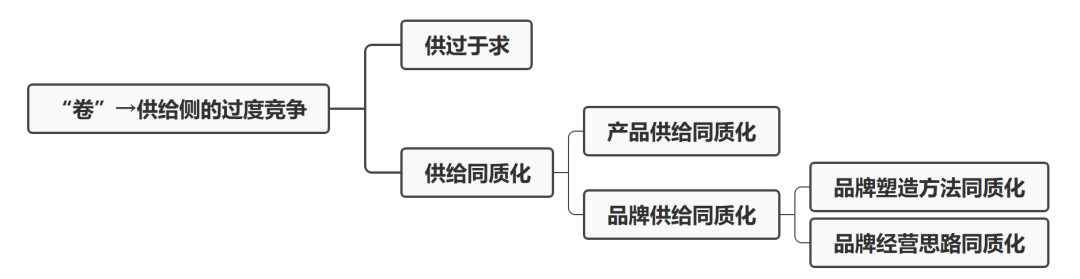
Core Viewpoint - The concept of "competition" in the consumer goods sector has intensified, evolving from mere growth to a survival mode, affecting even niche categories that were previously less competitive [1][4]. Group 1: Nature of Competition - The essence of "competition" is characterized by oversupply and supply homogenization, driven by excessive competition on the supply side [4]. - Two main factors contribute to this phenomenon: oversupply due to a high number of competitors and the homogenization of supply, where many brands follow similar paths, leading to a crowded market [4][6]. Group 2: Brand Homogenization - The trend of brand homogenization has become more pronounced in recent years, with brands increasingly adopting similar strategies and methods, resulting in a lack of differentiation [8][9]. - The rise of e-commerce has lowered the barriers for brand creation, leading to an explosion of brands and consequently, a homogenization of brand offerings [8][9]. Group 3: Building Brand Scarcity - To escape the cycle of homogenization, brands need to focus on creating scarcity through unique brand positioning and innovative strategies [10][11]. - The differentiation of brands can be achieved by understanding the dual nature of branding: as a tool for business strategy and as a result of consumer perception [12][14]. Group 4: Positioning Theory - The essence of consumer goods business is rooted in "concept" and the competition for consumer mindshare through effective positioning [20]. - Many brands tend to adopt a simplistic approach to positioning, focusing solely on product categories, which can lead to a lack of differentiation in a saturated market [21][22]. Group 5: Multi-Dimensional Brand Image - A multi-dimensional brand image is more difficult to replicate and can provide a competitive edge, as seen in successful brands like Apple [37][38]. - Building a multi-dimensional brand requires a cohesive narrative and alignment with business strategies to create a strong brand identity [38].