哈勃常数危机

Search documents
“中国天眼”揭示快速射电暴双星起源关键证据 极目星河深处 求索未解之谜(科技自立自强)
Ren Min Ri Bao· 2026-01-18 22:05
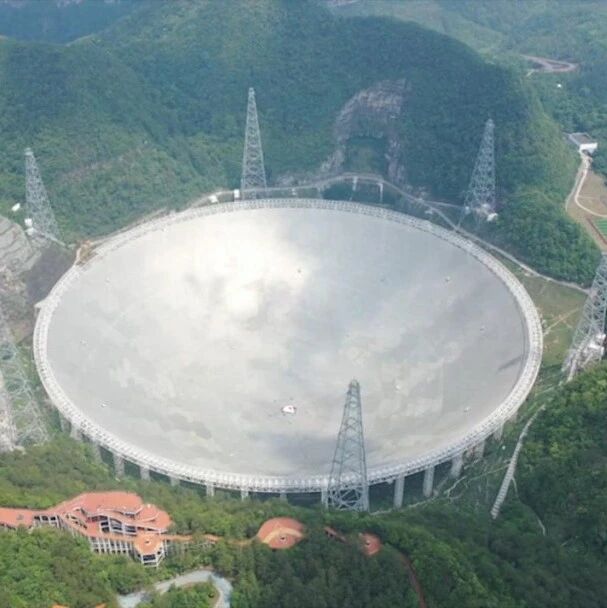
Core Viewpoint - The research team led by the Chinese Academy of Sciences has found key evidence regarding the origin of fast radio bursts (FRBs), suggesting they may originate from binary star systems, as reported in the journal "Science" [1][2]. Group 1: Fast Radio Bursts Research - Fast radio bursts are mysterious cosmic phenomena that release energy equivalent to the total radiation of the Sun over a week in just milliseconds [2]. - The team monitored the repeating fast radio burst FRB 20220529 for over two years, utilizing the high sensitivity of the "Chinese Sky Eye" [2][3]. - A significant observation was made when the Faraday rotation measure of FRB 20220529 surged to 20 times its normal level before returning to typical fluctuations, marking a first in recorded FRB studies [2][3]. Group 2: Scientific Contributions of the "Chinese Sky Eye" - Since its operation began in 2020, the "Chinese Sky Eye" has maintained high efficiency, with over 5400 hours of observation and more than 17.5 petabytes of new scientific data generated in the last complete observation year [4]. - The telescope has produced groundbreaking results in various fields, including the detection of gravitational waves, pulsar searches, and studies of neutral hydrogen [5]. - The "Chinese Sky Eye" has also improved radar imaging resolution of the Moon from kilometers to 10 meters, aiding geological studies and resource exploration [6]. Group 3: Future Developments and Upgrades - The "Chinese Sky Eye" is advancing its upgrade plans to become a "super probe" of the universe, with ongoing research to replace imported components with domestically produced alternatives [7][8]. - By 2025, two core array antennas will be completed, enhancing observational capabilities and addressing long-standing astrophysical questions [8].
“中国天眼”,有新突破!
券商中国· 2026-01-16 04:22
Core Viewpoint - The article discusses a significant breakthrough in the study of fast radio bursts (FRBs) by the Chinese research team using the Five-hundred-meter Aperture Spherical Telescope (FAST), providing strong evidence that FRBs may originate from binary star systems [1][3]. Group 1: Research Findings - The research team captured the detailed evolution of the Faraday rotation measure (RM) of a repeating FRB, which showed a dramatic spike and subsequent drop, marking the first observation of such a phenomenon in recorded FRB history [2][3]. - The observed RM of FRB 20220529 increased to 20 times its normal fluctuation level before returning to the typical range within two weeks, indicating a significant environmental change around the source [2]. - The core physical mechanism behind this phenomenon is attributed to a dense, magnetized plasma cloud from the FRB's source passing through the line of sight to Earth, similar to solar coronal mass ejections [2]. Group 2: Theoretical Implications - Current theories cannot explain the rapid and large-scale changes in the magnetic environment if FRB 20220529 originated from a solitary neutron star; however, if it is part of a binary system, the intense activity from a companion star could account for the observed RM fluctuations [3]. Group 3: Future Developments - FAST is set to undergo upgrades to establish a giant integrated aperture array, enhancing its observational capabilities and solidifying China's leading position in low-frequency radio astronomy [4]. - The upgraded FAST will significantly improve spatial resolution and sensitivity, aiding in the understanding of FRB origins and addressing other astrophysical mysteries [4].