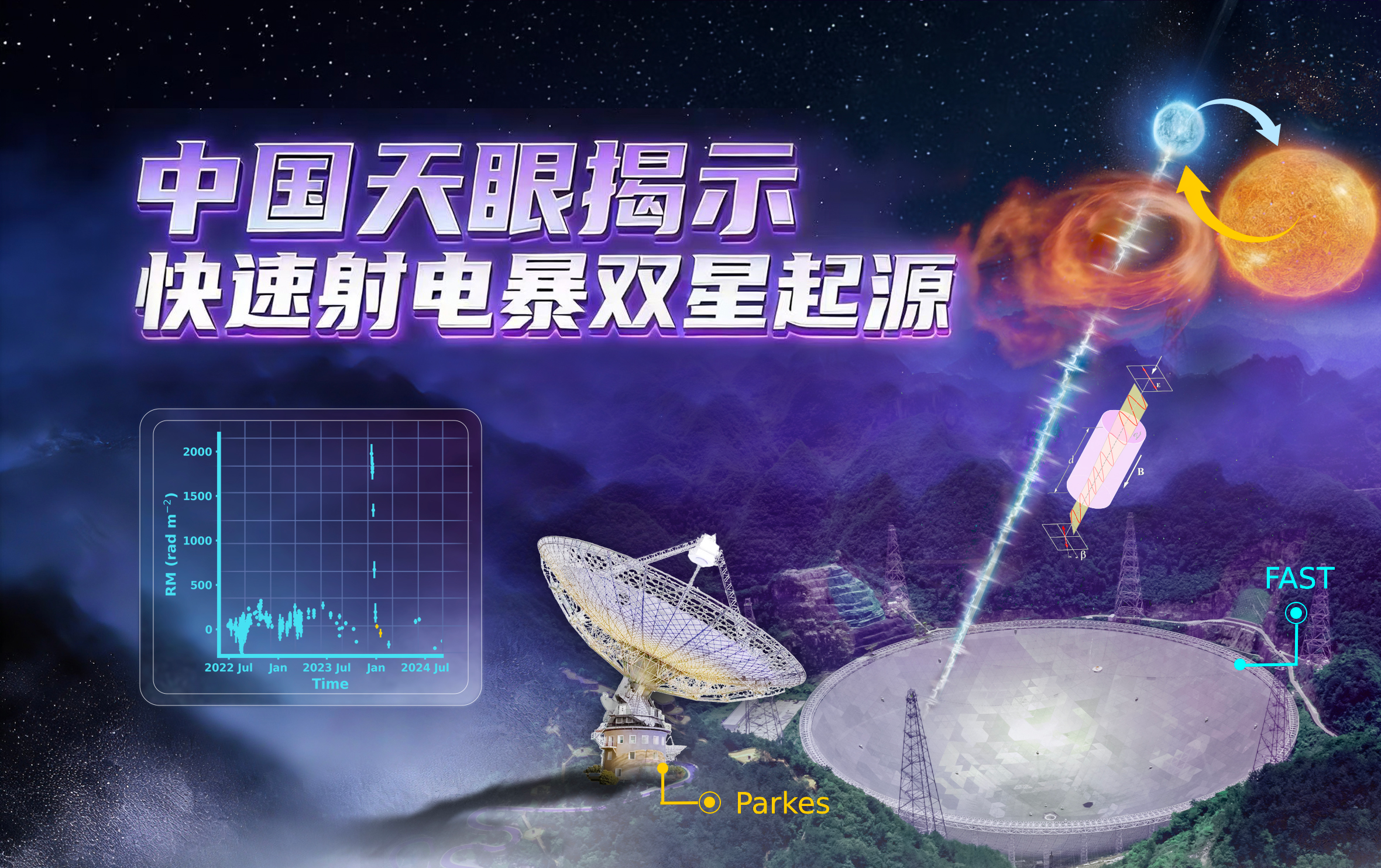
快速射电暴起源

Search documents
【新华社】“中国天眼”找到快速射电暴起源关键证据
Xin Hua She· 2026-01-16 07:08
Core Viewpoint - The research team led by the Purple Mountain Observatory of the Chinese Academy of Sciences has captured the detailed evolution process of the Faraday rotation measure (RM) of a repeating fast radio burst (FRB), providing key observational evidence for the hypothesis that fast radio bursts originate from binary star systems [3][4]. Group 1: Research Findings - The team utilized the 500-meter Aperture Spherical Telescope (FAST) to monitor the repeating fast radio burst FRB 20220529 for over two years, concluding that it likely originates from a binary star system [3]. - The observed Faraday rotation measure exhibited a 20-fold increase followed by a rapid decrease, indicating the passage of a dense magnetized plasma cloud through the observational line, consistent with the intense activity of a companion star in a binary system [4]. Group 2: Technological Advancements - FAST, the world's largest single-dish radio telescope, has produced significant results in various fields, including gravitational wave detection, pulsar searches, and fast radio burst studies since its inception [4]. - The FAST operation and development center plans to upgrade the telescope by constructing dozens of medium-sized antennas around it, creating a giant integrated aperture array to enhance observational sensitivity and overcome the limitations of single-dish telescopes [4].

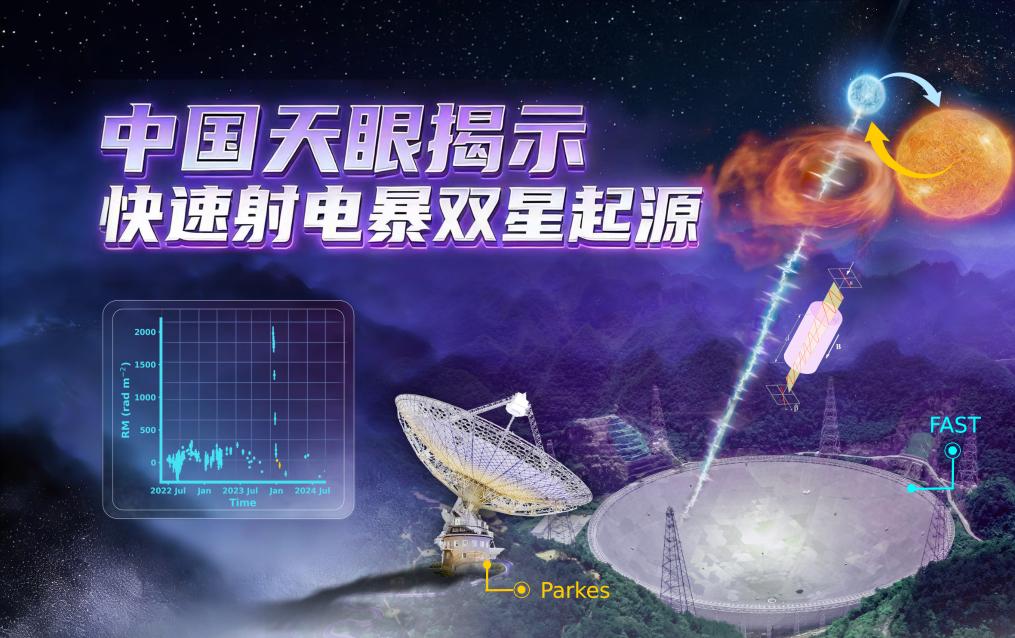
“中国天眼”,有新突破!
券商中国· 2026-01-16 04:22
Core Viewpoint - The article discusses a significant breakthrough in the study of fast radio bursts (FRBs) by the Chinese research team using the Five-hundred-meter Aperture Spherical Telescope (FAST), providing strong evidence that FRBs may originate from binary star systems [1][3]. Group 1: Research Findings - The research team captured the detailed evolution of the Faraday rotation measure (RM) of a repeating FRB, which showed a dramatic spike and subsequent drop, marking the first observation of such a phenomenon in recorded FRB history [2][3]. - The observed RM of FRB 20220529 increased to 20 times its normal fluctuation level before returning to the typical range within two weeks, indicating a significant environmental change around the source [2]. - The core physical mechanism behind this phenomenon is attributed to a dense, magnetized plasma cloud from the FRB's source passing through the line of sight to Earth, similar to solar coronal mass ejections [2]. Group 2: Theoretical Implications - Current theories cannot explain the rapid and large-scale changes in the magnetic environment if FRB 20220529 originated from a solitary neutron star; however, if it is part of a binary system, the intense activity from a companion star could account for the observed RM fluctuations [3]. Group 3: Future Developments - FAST is set to undergo upgrades to establish a giant integrated aperture array, enhancing its observational capabilities and solidifying China's leading position in low-frequency radio astronomy [4]. - The upgraded FAST will significantly improve spatial resolution and sensitivity, aiding in the understanding of FRB origins and addressing other astrophysical mysteries [4].

再立新功!“中国天眼”找到快速射电暴起源关键证据
Xin Hua She· 2026-01-16 03:41
Core Insights - The research team led by the Purple Mountain Observatory has captured the detailed evolution of the Faraday rotation measure (RM) of a repeating fast radio burst (FRB), providing key observational evidence for the hypothesis that FRBs originate from binary star systems [1][2] Group 1: Research Findings - The team monitored the repeating fast radio burst FRB 20220529 for over two years, concluding that it likely originates from a binary star system [2] - The observed Faraday rotation measure increased by 20 times and then rapidly decreased, indicating the passage of a dense magnetized plasma cloud, which aligns with the intense activity expected in a binary star system [2] Group 2: Technological Advancements - The Five-hundred-meter Aperture Spherical Telescope (FAST) is the world's largest single-dish radio telescope, contributing to various fields such as gravitational wave detection and pulsar searches since its operation began [2] - FAST is set to undergo upgrades, including the construction of several medium-sized antennas to form a giant aperture array, enhancing spatial resolution and observational sensitivity [2][3] - Upon completion of the upgrades, FAST will serve as a more powerful "cosmic super probe," aiding scientists in understanding fundamental astrophysical mysteries [3]
中国天眼揭示快速射电暴双星起源关键证据
Ren Min Ri Bao· 2026-01-16 03:07
Core Insights - A research team led by the Chinese Academy of Sciences' Purple Mountain Observatory has made a significant breakthrough by capturing the detailed evolution of the Faraday rotation measure (RM) of a repeating fast radio burst (FRB) for the first time internationally, providing key observational evidence for the hypothesis that fast radio bursts originate from binary star systems [2][3][5]. Group 1: Research Findings - The team monitored the repeating fast radio burst FRB20220529 for 2.2 years using China's 500-meter Aperture Spherical Telescope (FAST), which has ultra-high sensitivity [3][6]. - The Faraday rotation measure of FRB20220529 fluctuated between -300 to +300 rad/m² with a median of 17 rad/m² during regular monitoring, but in December 2023, it surged to 1977±84 rad/m², approximately 20 times the previous levels, before rapidly declining back to normal [4][5]. - This rapid and reversible change in the magnetic environment is unprecedented in the history of fast radio burst research, indicating a dense magnetized plasma cloud passing between the Earth and the burst source [4][5]. Group 2: Implications for Astrophysics - The observed rapid change in the Faraday rotation measure cannot be explained by existing theories if FRB20220529 originated from an isolated neutron star; however, it can be reasonably explained if it is part of a binary star system, where the companion star's activity could cause such fluctuations [5]. - This discovery provides strong observational support for the binary star origin model of fast radio bursts, which has been a significant mystery in astrophysics [5]. Group 3: Technological Advancements - The breakthrough highlights the unmatched sensitivity of FAST, which can detect extremely weak radio signals, and the innovative data processing methods employed by the research team to extract key polarization information from vast observational data [6]. - The collaboration involved multiple institutions, including the University of Science and Technology of China and the Australian Commonwealth Scientific and Industrial Research Organisation, showcasing the strength of China's scientific infrastructure [6]. Group 4: Future Developments - To maintain its leading position in the field of low-frequency radio astronomy, FAST is advancing upgrade plans, which include constructing dozens of medium-sized antennas around the telescope to form a giant array [8]. - This upgrade aims to overcome the spatial resolution limitations of single-dish telescopes and enhance observational sensitivity, positioning FAST as a more powerful "cosmic super probe" for understanding fast radio bursts and other astrophysical mysteries [8].