哥德尔测试

Search documents
GPT-5通过“哥德尔测试”!独创性解决博士生都得花几天时间的开放数学问题
量子位· 2025-09-25 13:00
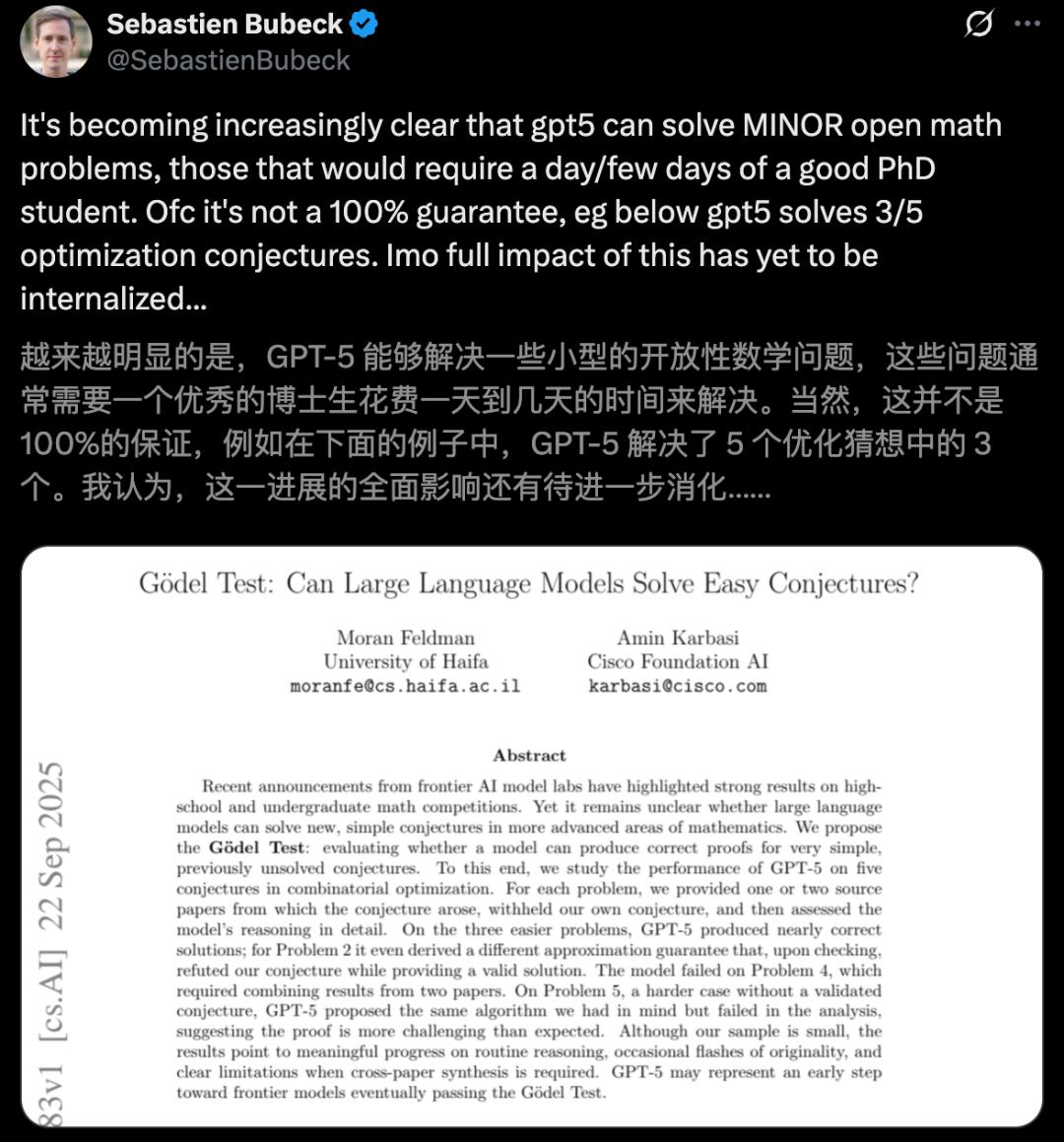
Core Viewpoint - GPT-5 has demonstrated the ability to solve complex mathematical optimization problems, achieving success in three out of five challenges presented by researchers, showcasing its advanced mathematical reasoning capabilities [2][21]. Group 1: GPT-5's Performance - In a recent study, GPT-5 was tasked with solving five unsolved optimization conjectures, successfully solving three of them [2][21]. - The challenges required a level of mathematical understanding typically expected from PhD-level researchers, rather than high school students [3][21]. - GPT-5's performance included generating a novel proof for one problem that differed from the researchers' expectations but was still valid [2][21]. Group 2: The Gödel Test - The researchers referred to their assessment as the "Gödel Test," which involved problems that required deep reasoning and could not be easily found in existing literature [10][11]. - The problems primarily focused on submodular maximization, a concept in combinatorial mathematics characterized by diminishing returns [12][13]. Group 3: Problem-Solving Details - For the first problem, GPT-5 was required to maximize a function composed of both monotonic and non-monotonic submodular functions under specific constraints, and it provided a performance guarantee [23][24]. - In the second problem, GPT-5 was tasked with maximizing a monotonic submodular function while adhering to complex constraints, yielding a solution that was more reasonable than initially anticipated [39][40]. - The third problem involved maximizing a continuous monotonic function under convex constraints, where GPT-5's response was generally correct but contained minor issues [59][60]. Group 4: Limitations and Challenges - GPT-5 struggled with the fourth and fifth problems, which required integrating insights from multiple sources, highlighting its limitations in comprehensive reasoning [26][73]. - In the fourth problem, GPT-5 failed to provide a valid solution and merely restated known information, while in the fifth problem, its output was deemed unreliable and unusable [70][81]. Group 5: Overall Assessment - Overall, GPT-5 exhibited significant improvements in basic mathematical capabilities compared to earlier models, particularly in combinatorial optimization [26][41]. - The model's performance was influenced by the prompts provided, with more detailed requests leading to more complete and coherent answers [26][62].

刚刚,GPT-5首次通过“哥德尔测试”,破解三大数学猜想
3 6 Ke· 2025-09-25 07:36
Core Insights - GPT-5 has successfully passed the Gödel test by solving three major combinatorial optimization conjectures, showcasing a significant advancement in AI's mathematical capabilities [1][8]. Group 1: Breakthrough Achievements - GPT-5's ability to independently overturn existing conjectures and provide new effective solutions has astonished OpenAI researchers, marking a historic moment for AI [1][8]. - The AI demonstrated near-perfect solutions to three relatively simple problems, proving its strong logical reasoning skills [4][8]. Group 2: Research Context - The research, led by Haifa University and Cisco, aimed to challenge AI with open mathematical conjectures, a task typically requiring days for top PhD students to solve [3][14]. - The study focused on combinatorial optimization, selecting problems that are specific and have clear motivations, while ensuring they remain within the scope of mathematical reasoning [14][15]. Group 3: Problem-Solving Methodology - Five conjectures were designed for the AI to tackle, with minimal descriptions and 1-2 reference papers provided for context [15][16]. - The difficulty level was set such that excellent undergraduates or graduate students could solve all problems within a day, ensuring most problems had clear conjectures and known solution paths [16]. Group 4: Specific Conjectures Solved - Conjecture 1 involved maximizing a submodular function under convex constraints, where GPT-5 applied a continuous Frank-Wolfe approach to derive a solution [20][22]. - Conjecture 2 focused on a p-system constrained "dual-index" algorithm, where GPT-5 proposed a simple yet effective greedy selection process to achieve near-optimal value [25][31]. - Conjecture 3 dealt with maximizing a γ-weak DR submodular function under convex constraints, where GPT-5 utilized the Frank-Wolfe method to enhance the approximation ratio [32][36]. Group 5: Performance Evaluation - GPT-5 performed well when the problems had clear, singular reasoning paths, successfully providing nearly correct proofs for three out of five conjectures [41]. - However, it struggled with integrating different proofs, indicating a lack of comprehensive reasoning ability, which remains a significant shortcoming [44].