商业文化

Search documents
人民创造文化
Xin Lang Cai Jing· 2026-02-25 16:57
Group 1 - The article highlights a unique village custom where families visit each other on the first day of the Lunar New Year, fostering community bonds and sharing updates about work and life [3][4][6] - This tradition has evolved over time, particularly driven by younger generations returning home, and serves as a means to strengthen social ties and resolve conflicts [3][4][6] - The practice of taking a collective family photo has become a significant cultural event, reflecting the growth and changes within the community, and enhancing social cohesion [6][10] Group 2 - The article discusses the impact of urbanization and marketization on traditional community structures, leading to a fragmentation of cultural practices and social relationships [4][12] - It emphasizes the importance of grassroots cultural initiatives, such as the "Village Song Project," which aims to revive local culture and foster community engagement through music and shared experiences [7][12] - The concept of culture is explored, defining it as a collective life experience shaped over time, which is essential for community identity and continuity [9][10][12]

第34期“A+H新浪潮”上市公司交流会:李想致辞共探产融新生态
Feng Huang Wang Cai Jing· 2026-01-23 03:27
Group 1 - The event titled "'A+H New Wave' and the 34th Listed Company Entrepreneur Exchange Conference" was held in Beijing, focusing on the opportunities and challenges faced by A+H listed companies in industrial upgrades, capital operations, and cross-border layouts [1] - The conference aimed to gather the strength of listed company entrepreneurs to discuss collaborative development, capital empowerment, and paths for industrial upgrades, contributing to the construction of a new ecosystem of industry-finance integration [1] - Li Xiang, the president of the Listed Company Branch of the China Business Culture Research Association, emphasized the importance of compliance as a top-level agenda, guiding listed companies to become enduring "value lights" rather than fleeting "hot spots" [1] Group 2 - Li Xiang highlighted the significance of the number "34," which symbolizes a complete bull-bear cycle in the capital market, reminding companies to adhere to their value foundations regardless of external changes [1] - The event featured key speakers, including former Vice President of the Supreme People's Court Jiang Bixin, who elaborated on the logic that "compliance is the cornerstone of market value," and Zhang Yuzhong from the State Administration for Market Regulation, who provided authoritative interpretations of policies for companies going abroad [1] - The forum announced a comprehensive upgrade of the "Industry Mentor" mechanism, aiming for "one-on-one" guidance to achieve industrial synergy through a "big ship leading small ships" approach [2]
无锡文化的多元透视
Xin Lang Cai Jing· 2026-01-16 19:06
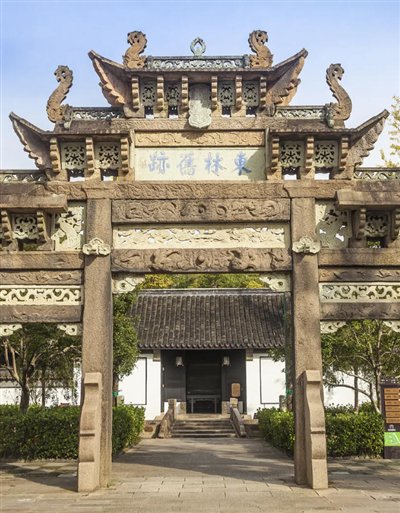
Cultural Heritage - Wuxi, an ancient city in Jiangnan, embodies a rich cultural heritage that includes political, musical, and educational traditions [3][4][5] - The story of Tai Bo, who left the Zhou kingdom to establish the Wu state, highlights the value of selflessness and virtue in governance, as praised by Confucius [3] - The cultural significance of Ji Zha, who evaluated poetry and music during the Spring and Autumn period, reflects Wuxi's historical influence on Chinese music and literature [3][4] Educational Influence - The establishment of Gui Shan Academy by Yang Shi and the prominence of Donglin Academy during the Ming dynasty illustrate Wuxi's role in the development of educational institutions [4] - The emphasis on practical application of knowledge, as advocated by Tang Wenzhi, underscores the importance of moral conduct alongside academic study [4] - Qian Mu's contributions to education and his reflections on the importance of character in scholarly pursuits further highlight Wuxi's educational legacy [4] Economic Development - Wuxi is recognized as a cradle of modern Chinese industry, with a thriving economy in sectors such as textiles, silk, and finance, driven by a spirit of entrepreneurship [5] - The "Su Nan model," characterized by township enterprises, emerged from Wuxi's innovative approach during the economic reforms of the 1990s, establishing it as a leading region in China [5] - The local ethos of "daring to be the first in the world" has propelled Wuxi to the forefront of contemporary commercial civilization and economic reform [5]