
商业航天全产业链生态

Search documents
我国首个海上液体火箭发射回收试验平台将投用
Yang Shi Xin Wen· 2026-01-21 05:04
Group 1 - The core objective of the "14th Five-Year Plan" includes the goal of accelerating the construction of a strong aerospace nation, with a focus on commercial space activities [1] - The first offshore liquid rocket launch recovery test platform in China is under construction in Yantai, Shandong, which is expected to be completed and begin testing around February 5 [2] - The platform features a hydraulic pit and a flow channel designed to manage the high temperatures and noise generated during rocket launches, ensuring the protection of launch facilities [2] Group 2 - The Dongfang Spaceport, located on an artificial island, is strategically positioned about 3 kilometers from the mainland, meeting safety requirements for offshore launches [3] - The spaceport has successfully launched 137 satellites into space and is leading the development of a comprehensive commercial aerospace industry chain in Shandong, which includes satellite manufacturing and space applications [3] - The industry layout in Shandong is characterized by a collaborative ecosystem involving multiple cities, with Yantai, Jinan, and Qingdao as core areas supporting the commercial aerospace sector [3]
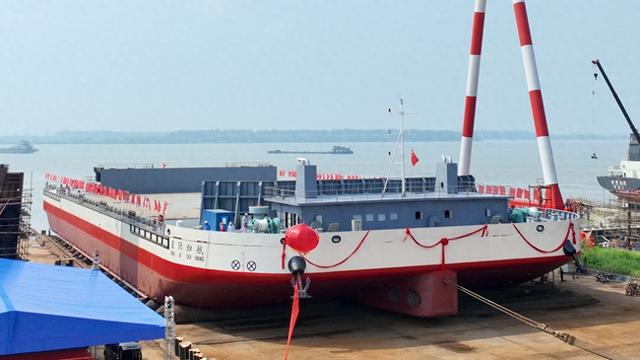
中国首艘非自航火箭回收船,即将开启任务
Xin Lang Cai Jing· 2025-12-26 00:35
Core Viewpoint - The article discusses the launch of China's first non-self-propelled rocket recovery ship, "Star Return," designed for maritime recovery of rockets, marking a significant advancement in China's commercial space industry and its capabilities in reusable rocket technology [1][3][18]. Group 1: Company Overview - Jiangsu Runyang Shipbuilding Co., Ltd. is constructing the "Star Return" ship, which is 100 meters long and 42 meters wide, specifically designed for the maritime recovery of rockets [1]. - Zhejiang Taihe Shipping Co., Ltd. is leading the design of the "Star Return" ship, leveraging its experience in specialized vessels and its role as a pioneer in the private oceanographic research sector [5][11]. Group 2: Technological Innovations - The "Star Return" ship is equipped with a DP2 dynamic positioning system to maintain centimeter-level positioning accuracy in challenging sea conditions, crucial for the safe recovery of rockets [7]. - The ship incorporates a high-precision GNSS, inertial navigation, and radar fusion system to ensure the rocket lands accurately on the designated platform [7]. - All systems on the ship are domestically produced, emphasizing cost-effectiveness, ease of maintenance, and safety [8][12]. Group 3: Industry Context - The demand for cost-effective launch solutions has surged with the rapid development of low-orbit satellite constellations in China, leading to the emergence of private space companies like Star Glory [6]. - The article highlights the shift from land-based recovery to maritime recovery as a key strategy to reduce launch costs, with the "Star Return" ship being a pivotal element in this transition [6][18]. Group 4: Challenges and Achievements - The construction of the "Star Return" faced numerous challenges, including the lack of existing standards for such vessels, requiring extensive coordination with regulatory bodies [11][12]. - The ship's construction was completed in just eight months, significantly faster than similar vessels built in other countries, showcasing the capabilities of domestic shipbuilding [12][14]. Group 5: Future Implications - The "Star Return" ship is expected to enhance the efficiency of rocket recovery, potentially accommodating multiple rockets and improving reuse rates by 300% [17]. - The successful development of this ship signifies a broader trend of private enterprises becoming integral to national strategic technological advancements in China [18].

卫星“家门口”搭车,火箭“走几步”发射!航天版图上崛起烟台新势力
Qi Lu Wan Bao Wang· 2025-10-10 00:03
Core Viewpoint - Yantai is rapidly developing a billion-level commercial aerospace industry cluster, highlighted by the successful launch of the "Yingli No. 1" rocket and the establishment of the Dongfang Spaceport as a key player in China's aerospace capabilities [1][2][5]. Group 1: Launch Capabilities - The "Yingli No. 1" rocket, capable of carrying 6.5 tons to low Earth orbit, has completed multiple successful launches, enhancing China's capacity for large-scale satellite deployment [1][2]. - Dongfang Spaceport has successfully supported 19 sea launch missions, placing a total of 127 satellites into orbit, showcasing its efficient launch organization capabilities [2][3]. Group 2: Infrastructure and Ecosystem - The development of Dongfang Spaceport is a strategic initiative leveraging Yantai's strong industrial and research foundation, including partnerships with leading companies in materials and aerospace [3][4]. - A 6-kilometer aerospace avenue connects various functional zones, facilitating rapid transitions from rocket assembly to sea launch within 48 hours [3][4]. Group 3: Industry Growth and Investment - The commercial aerospace sector in Yantai has attracted significant investment, with 30 aerospace projects totaling 32.2 billion yuan, creating a comprehensive industry chain from satellite development to launch services [5]. - The local government has prioritized the aerospace industry as one of its six key industrial chains, implementing action plans to foster growth and collaboration within the sector [5].