
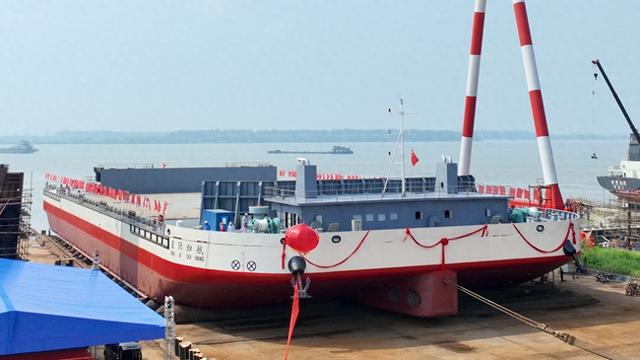
星际归航号火箭回收船

Search documents
中国首艘非自航火箭回收船,即将开启任务
Xin Lang Cai Jing· 2025-12-26 00:35
Core Viewpoint - The article discusses the launch of China's first non-self-propelled rocket recovery ship, "Star Return," designed for maritime recovery of rockets, marking a significant advancement in China's commercial space industry and its capabilities in reusable rocket technology [1][3][18]. Group 1: Company Overview - Jiangsu Runyang Shipbuilding Co., Ltd. is constructing the "Star Return" ship, which is 100 meters long and 42 meters wide, specifically designed for the maritime recovery of rockets [1]. - Zhejiang Taihe Shipping Co., Ltd. is leading the design of the "Star Return" ship, leveraging its experience in specialized vessels and its role as a pioneer in the private oceanographic research sector [5][11]. Group 2: Technological Innovations - The "Star Return" ship is equipped with a DP2 dynamic positioning system to maintain centimeter-level positioning accuracy in challenging sea conditions, crucial for the safe recovery of rockets [7]. - The ship incorporates a high-precision GNSS, inertial navigation, and radar fusion system to ensure the rocket lands accurately on the designated platform [7]. - All systems on the ship are domestically produced, emphasizing cost-effectiveness, ease of maintenance, and safety [8][12]. Group 3: Industry Context - The demand for cost-effective launch solutions has surged with the rapid development of low-orbit satellite constellations in China, leading to the emergence of private space companies like Star Glory [6]. - The article highlights the shift from land-based recovery to maritime recovery as a key strategy to reduce launch costs, with the "Star Return" ship being a pivotal element in this transition [6][18]. Group 4: Challenges and Achievements - The construction of the "Star Return" faced numerous challenges, including the lack of existing standards for such vessels, requiring extensive coordination with regulatory bodies [11][12]. - The ship's construction was completed in just eight months, significantly faster than similar vessels built in other countries, showcasing the capabilities of domestic shipbuilding [12][14]. Group 5: Future Implications - The "Star Return" ship is expected to enhance the efficiency of rocket recovery, potentially accommodating multiple rockets and improving reuse rates by 300% [17]. - The successful development of this ship signifies a broader trend of private enterprises becoming integral to national strategic technological advancements in China [18].

向海问天 筑梦苍穹 海南构筑中国商业航天新高地
Zheng Quan Ri Bao· 2025-12-14 16:13
Core Viewpoint - The development of the commercial aerospace industry in China is becoming a significant force in building a strong aerospace nation, with over 600 companies currently in operation and a projected industry scale of 2.8 trillion yuan by 2025 [1]. Geographical and Policy Advantages - Wenchang, located in northeastern Hainan Province, is uniquely positioned as the only city in China with both "low latitude and coastal launch" characteristics, providing a significant geographical advantage for commercial aerospace development [2]. - The low latitude of the Hainan launch site can enhance rocket payload capacity by 15%, directly impacting economic benefits and market competitiveness [2]. - The coastal location facilitates the transportation of large-diameter rockets, which is a limitation for inland launch sites due to railway constraints [2]. - The establishment of the Hainan Free Trade Port has introduced favorable policies, including zero tariffs and low tax rates, which lower operational costs and attract quality enterprises and talent [3]. Industry Growth and Projections - By 2027, the Wenchang International Aerospace City aims to achieve an operating income of 10 billion yuan, reflecting government support and market confidence in the commercial aerospace sector [4]. - The Wenchang International Aerospace City has over 700 aerospace-related enterprises, forming a complete industrial chain from rocket manufacturing to satellite development and data application [4]. Infrastructure and Technological Innovations - The Hainan commercial aerospace launch site was built in just 878 days, showcasing China's efficiency in establishing infrastructure [6]. - The launch site has achieved a high frequency of launches, with three launches occurring within 30 days, indicating a robust operational capacity [6]. - The second launch pad is designed to accommodate over 20 rocket models, with plans for additional launch pads to increase annual launch capacity to over 60 by the end of 2026 [6]. - The innovative three-plane measurement launch mode enhances launch efficiency and reduces costs [7]. Future Development and Integration - The Hainan Star Glory Aerospace company is developing a reusable rocket, the "Double Curve Three," which aims to significantly reduce launch costs through advanced technologies [9]. - The establishment of a specialized factory for rocket assembly and testing marks a significant advancement in China's commercial aerospace manufacturing capabilities [7]. - The integration of aerospace with tourism is being explored to enhance the social impact of the aerospace industry and stimulate local economic growth [10].