
商业航天融资

Search documents
50.37 亿!星际荣耀刷新民营火箭单笔融资纪录
Huan Qiu Lao Hu Cai Jing· 2026-02-13 07:21
Group 1 - The core point of the news is that the private commercial aerospace company, Xingji Hongyu, successfully completed a D++ round of financing amounting to 5.037 billion yuan, marking the largest single financing in China's commercial rocket sector [1] - The financing was led by Tongchuang Weiye and old shareholder Jingming Capital, with participation from several new institutions, focusing on the development and capacity building of reusable launch vehicles [1] - The funds raised will primarily accelerate the development and commercialization of Xingji Hongyu's reusable liquid oxygen-methane launch vehicle, while enhancing capabilities in land launch and sea recovery technologies [1] Group 2 - Xingji Hongyu, established in October 2016, is the first private commercial aerospace company in China and the third globally to successfully launch a rocket into orbit, focusing on low-cost, high-frequency satellite launch services [2] - The company has seen significant growth in its financing history, with cumulative financing reaching substantial amounts, including 1.193 billion yuan in B round financing in 2020 and 500 million yuan in D++ round financing [2] - The recent large-scale financing reflects the increasing activity in the commercial aerospace sector, with several private rocket companies advancing their financing and listing processes, indicating a concentration of capital towards leading firms [2][3]
融资超百亿,中国商业航天独角兽到交成绩单的时候了
3 6 Ke· 2026-02-05 11:32
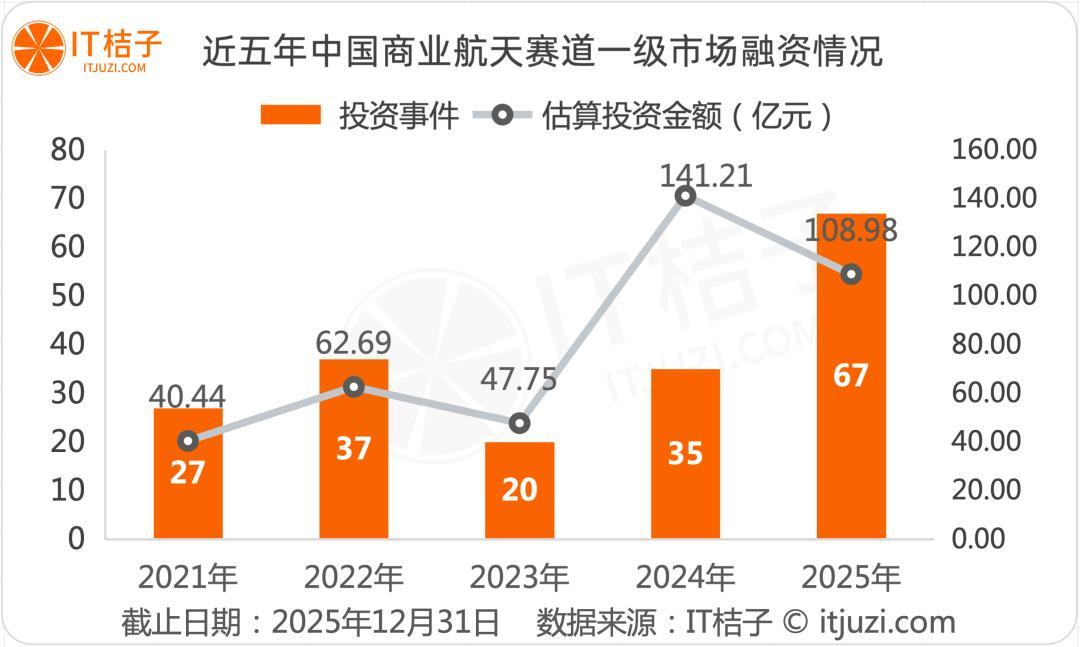
Core Insights - The private rocket companies in China achieved a record 67 financing events in 2025, marking a five-year high, with Beijing accounting for 54% of these events and over 90% of the total financing amount, establishing itself as the "first city of aerospace" [1][4][9] - The investment landscape is shifting from a focus on technology to a focus on delivery, indicating a maturation of the commercial aerospace sector [2][15] - The next decade is deemed critical for building a strong aerospace nation and developing new productive forces, with significant breakthroughs expected in policy, industry collaboration, capital, and application scenarios [1][15] Investment Trends - The long-term trend in capital investment in commercial aerospace remains upward, despite a temporary pullback in 2023. By 2025, the number of financing events reached 67, with a total amount of 10.9 billion yuan, signaling a new phase of rapid development in the industry [4][15] - Early-stage investments surged to 26 events in 2025, surpassing mid-stage investments, reflecting increased interest from new capital in earlier-stage potential projects [6][15] - The investment structure has evolved, with mid-stage investments (primarily Series A) dominating in recent years, indicating a higher risk assessment by capital towards companies that have undergone technology validation and possess delivery capabilities [6] Geographic Concentration - The distribution of financing events shows extreme concentration, with 54% of the financing activities occurring in Beijing, which accounted for over 95 billion yuan, representing more than 90% of the national total [9] - Other provinces such as Jiangsu, Sichuan, Guangdong, and Shanghai have significantly lower financing amounts compared to Beijing, highlighting the capital and talent advantages that Beijing holds in the aerospace sector [9] Investment Participation Dynamics - In the past five years, 59% of domestic commercial aerospace projects involved only market institutions, with a low co-investment rate, particularly for projects with more than five investors [11] - When state-owned capital is involved, the proportion of sole investments drops to 23%, while co-investments with 2-4 investors rise to 40%, indicating that state participation attracts more investors and promotes a collaborative financing model [11] Company Performance and Funding - In 2025, there were only 47 domestic commercial aerospace companies, with a clear "pyramid" structure in funding distribution. Unicorn companies received an average of 1.105 billion yuan, while other startups received significantly less [12][14] - Notable unicorns like Xinghe Power and Tianbing Technology each secured 2.5 billion yuan in funding, while other companies like Weina Aerospace and Xingji Glory also received substantial investments, demonstrating a strong focus on leading firms [12][14] Future Outlook - The commercial aerospace sector is opening up new opportunities, transitioning from being a supplement to the national team to becoming a main force in the industry [15] - For entrepreneurs, the sector presents high barriers, long cycles, and significant potential, while for investors, the focus has shifted to delivery and order fulfillment [15] - The next decade is seen as a critical window for determining which companies could emerge as the "Chinese version of SpaceX" [15]

长征火箭 披露拟实施增资
Zheng Quan Shi Bao· 2025-10-12 22:08
Core Points - China Long March Rocket Co., Ltd. is seeking financing, with a total fundraising amount to be formally disclosed by November 5 [1] - The company was established in 1998 with a registered capital of 219 million yuan and serves as a commercial rocket launch platform under China Aerospace Science and Technology Corporation [1] - In 2024, China is expected to conduct 68 space launches, accounting for approximately 25.8% of global orbital rocket launches, with Long March rockets being the backbone of this effort [1] Financial Performance - Long March Rocket's revenue for 2022, 2023, and 2024 is projected to be 379 million yuan, 510 million yuan, and 598 million yuan respectively, while net profits for the same years are 10.49 million yuan, 16.73 million yuan, and a loss of 68.31 million yuan [2] - As of the end of 2024, the company's total assets are expected to be 1.292 billion yuan, with total equity at 435 million yuan [2] Industry Context - The commercial space sector in China is experiencing significant capital interest, with total financing exceeding 20 billion yuan in 2024, marking a historical high [2] - Notable recent financing events include Starship Glory's 700 million yuan in D+ round funding and Star River Power's 2.4 billion yuan in D round funding [2] - The Aerospace Science and Industry Corporation is also undergoing changes, with a 30.66% stake in Aerospace Science and Industry Rocket being put up for transfer, indicating potential shifts in control [3]