商业航天企业上市

Search documents
继蓝箭航天后,又一个商业航天企业有新动作,中科宇航已完成上市辅导
Sou Hu Cai Jing· 2026-01-17 07:05
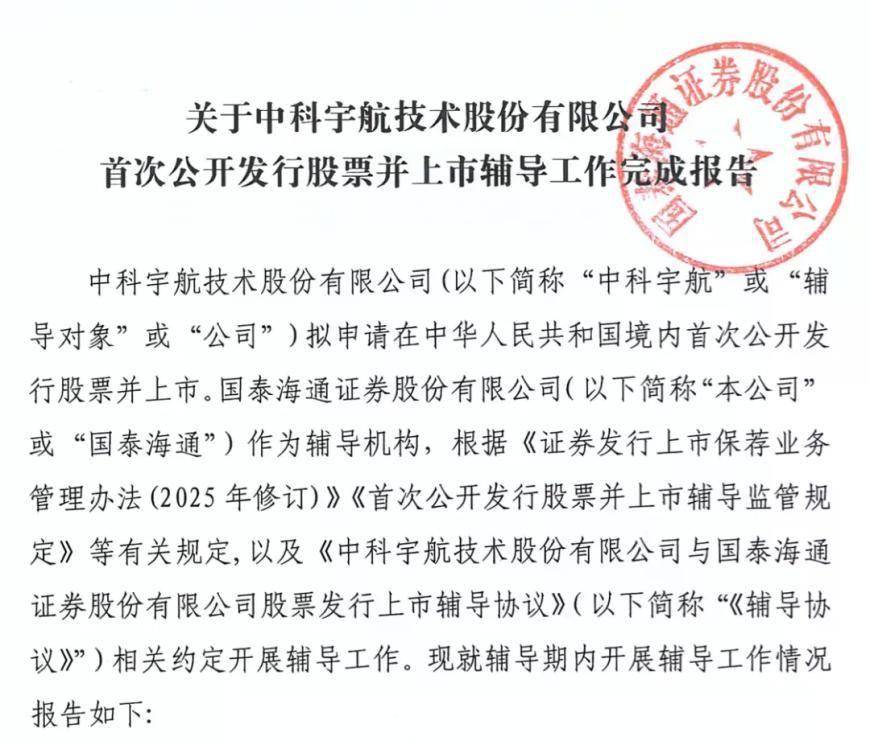
Group 1 - Zhongke Aerospace Technology Co., Ltd. has recently completed its IPO counseling work, as indicated by the public offering counseling announcement system of the China Securities Regulatory Commission (CSRC) [1] - The counseling report from Guotai Junan Securities states that the company possesses the necessary corporate governance structure, accounting foundation, and internal control systems to become a listed company [3] - The company and its key stakeholders have fully grasped the legal regulations and responsibilities related to issuing and listing, as well as the importance of integrity and self-discipline in entering the securities market [3] Group 2 - Zhongke Aerospace is the second commercial aerospace company to plan an IPO, following Blue Arrow Aerospace [4] - The CSRC's official website shows that Zhongke Aerospace registered for counseling with the Guangdong Securities Regulatory Bureau on August 12, 2025, and intends to apply for an initial public offering [3]

长征火箭 披露拟实施增资
Zheng Quan Shi Bao· 2025-10-12 22:08
Core Points - China Long March Rocket Co., Ltd. is seeking financing, with a total fundraising amount to be formally disclosed by November 5 [1] - The company was established in 1998 with a registered capital of 219 million yuan and serves as a commercial rocket launch platform under China Aerospace Science and Technology Corporation [1] - In 2024, China is expected to conduct 68 space launches, accounting for approximately 25.8% of global orbital rocket launches, with Long March rockets being the backbone of this effort [1] Financial Performance - Long March Rocket's revenue for 2022, 2023, and 2024 is projected to be 379 million yuan, 510 million yuan, and 598 million yuan respectively, while net profits for the same years are 10.49 million yuan, 16.73 million yuan, and a loss of 68.31 million yuan [2] - As of the end of 2024, the company's total assets are expected to be 1.292 billion yuan, with total equity at 435 million yuan [2] Industry Context - The commercial space sector in China is experiencing significant capital interest, with total financing exceeding 20 billion yuan in 2024, marking a historical high [2] - Notable recent financing events include Starship Glory's 700 million yuan in D+ round funding and Star River Power's 2.4 billion yuan in D round funding [2] - The Aerospace Science and Industry Corporation is also undergoing changes, with a 30.66% stake in Aerospace Science and Industry Rocket being put up for transfer, indicating potential shifts in control [3]
星际荣耀完成7亿元新融资,加速火箭量产与IPO进程
Nan Fang Du Shi Bao· 2025-09-19 07:57
Core Viewpoint - The capitalization process in China's commercial aerospace sector is accelerating, highlighted by Beijing Xingji Glory Space Technology Co., Ltd. completing a D+ round financing of 700 million RMB, aimed at enhancing its core rocket product development and production capabilities [2][4]. Funding Allocation - The newly injected funds will focus on three main areas: the continued research and testing of the "Double Curve No. 3" reusable liquid rocket, the construction of a production base in Chengdu, and the establishment of an engine production line in Mianyang [2][3]. - The Chengdu production base project has a total investment exceeding 3 billion RMB and aims to achieve an annual production capacity of 20 rockets once operational [2]. Product Development - The "Double Curve No. 3" rocket is designed to compete with SpaceX's Falcon 9, targeting high-frequency, low-cost launch services for future low-orbit satellite constellations in China [3]. - The first flight test of the "Double Curve No. 3" is scheduled for the end of 2025, aiming to complete a full process verification including "orbital insertion + sea recovery" [3]. Market Demand - There is a significant demand for launch capacity driven by large satellite constellation plans, such as the "G60 Thousand Sails Constellation" and "GW Constellation," which together plan to launch over 20,000 satellites [4]. - The current supply-demand imbalance in the market has led to instances where launch service procurements have failed due to insufficient qualified suppliers [4]. Industry Trends - The company is in the process of preparing for an IPO on the Sci-Tech Innovation Board, reflecting a broader trend of commercial aerospace companies seeking to enter capital markets [4][5]. - The recent regulatory changes have opened new pathways for commercial aerospace firms to list, with several companies already in the IPO preparation phase [5]. Future Outlook - As more commercial aerospace companies successfully enter the capital market, the competitive landscape and development models within the industry are expected to be reshaped, facilitating larger production scales and reduced launch costs [6].